You’re building a fashion-forward apparel brand. Your designs demand sophisticated silhouettes, unique fabrications, and trend-right details. But your values—and your customers’ demands—also require verified safety through standards like OEKO-TEX. You’ve likely hit a wall: factories with strong certifications often lack design flair, while creative sample rooms may see compliance as a bureaucratic afterthought. So, where do you find the rare partner that truly mergines high fashion with rigorous OEKO-TEX compliance?
Finding a manufacturer that seamlessly blends OEKO-TEX certification with high-fashion capabilities requires targeting suppliers who view chemical compliance as an integral part of their creative and technical design process, not a separate department. The key is to look for evidence of a dual competency: a strong in-house design & development team working in tandem with a dedicated quality and compliance management system.
This synergy doesn’t happen by accident. It’s a deliberate operational philosophy. The factory must be fluent in both the language of fashion trends and the science of material safety. Let’s map out a strategic approach to identify and vet this ideal partner.
What Specific Capabilities Signal a “Fashion-Forward” Compliant Factory?
High fashion manufacturing extends far beyond basic sewing. It involves a deep understanding of fit, fabric handling, complex construction, and trims. When combined with OEKO-TEX, each of these elements must be sourced and managed with compliance in mind. You need to look for tangible proof points during your sourcing process.
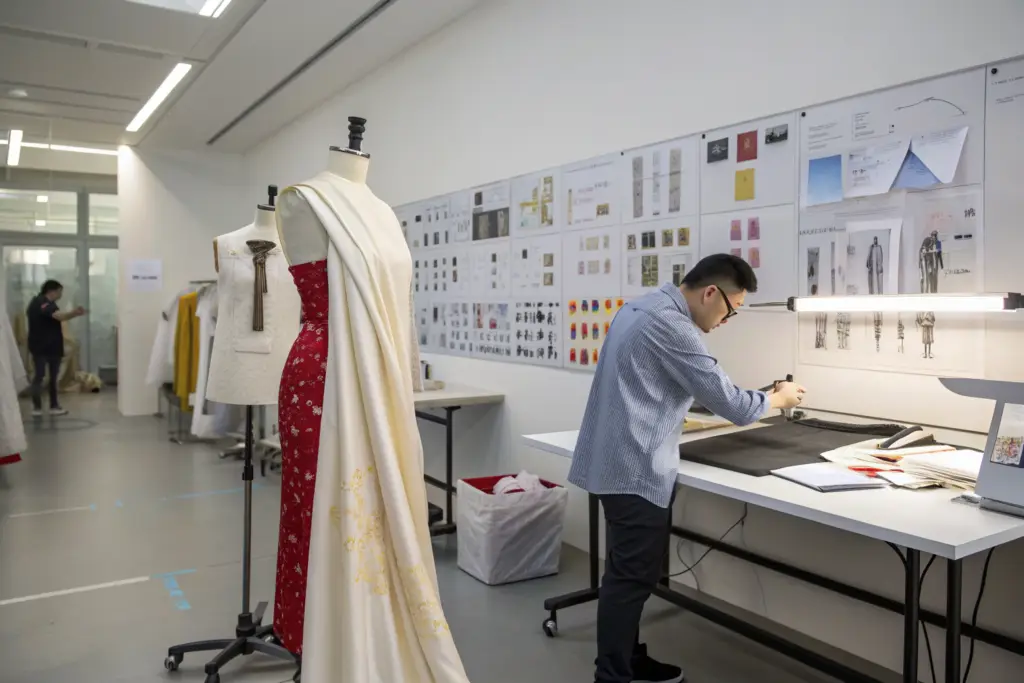
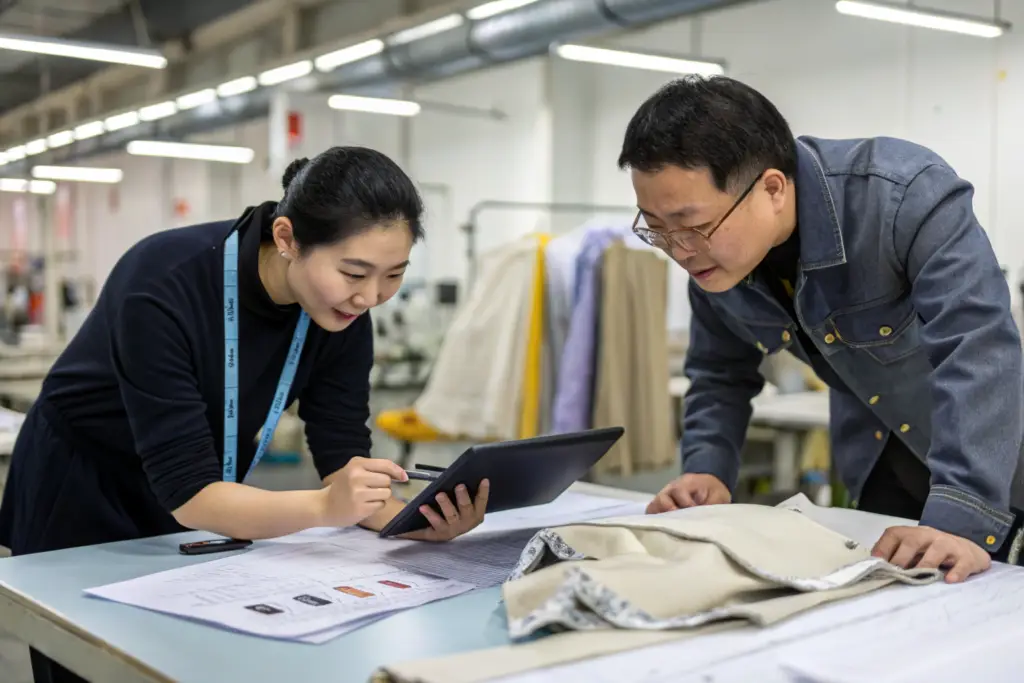
First, examine their in-house design team. Do they have pattern makers and sample developers who can work from your sketches or tech packs and suggest improvements? Ask to see their portfolio of past work—look for garments with interesting draping, pleating, bonded seams, or mixed materials. Then, critically, ask how they ensured OEKO-TEX compliance for those complex pieces. At Shanghai Fumao, our development process is integrated. Last season, we worked with a Los Angeles-based contemporary brand on a pleated woven blouse with a delicate lace inset. Our designers perfected the drape and proportion, while our compliance team simultaneously sourced OEKO-TEX certified lace and verified the dyeing process for the custom-colored chiffon, ensuring the entire garment was certifiable from the first prototype.
How does their fabric library and sourcing network demonstrate dual focus?
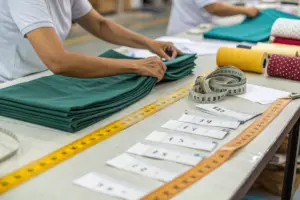
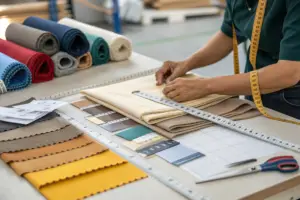
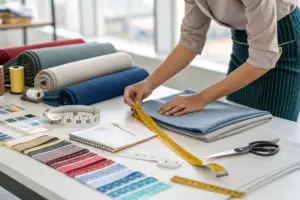
A factory’s material library is a tell-tale sign. A high-fashion manufacturer will have a diverse range of textiles—luxe wools, technical jacquards, sustainable innovations. A compliant manufacturer will have organized documentation for those materials. Ask to see samples. The best partners will present a swatch with a small tag that lists not only composition and weight but also its OEKO-TEX certificate number or status. They should be able to immediately connect you with their certified mills for special developments. For instance, when a New York brand needed a specific brushed tricot for a high-fashion skirt set, we were able to propose three OEKO-TEX certified options from our network with different drape and stretch properties within 48 hours, accelerating their design decision.
What questions should you ask about their development process?
During factory audits or calls, ask these revealing questions:
- “At what stage in the design process does your compliance team get involved?”
- “Can you show me an example where you had to find a compliant alternative for a unique trim or material a brand requested?”
- “How do you handle the certification process for garments with over 10 different material components?”
Their answers will reveal their integration level. A superficial answer: “We get the fabric certified.” A sophisticated answer: “Our tech pack review includes a compliance risk assessment for every component. We flag non-compliant materials during the prototyping phase and work with our design team and the client to find certified alternatives that meet the aesthetic and functional brief.” We operate on the latter model, which prevents costly last-minute changes.
Why is In-House Design & Product Development a Non-Negotiable?
Outsourcing design and sampling creates a dangerous disconnect. If your factory merely executes orders from a separate design house, compliance becomes a reactive checkpoint, often failing at the final stage. True integration requires the factory’s own developers to be making material and construction choices with compliance as a foundational constraint.
An in-house team that includes technical designers, pattern graders, and sampling specialists can build safety into the blueprint. They understand that a particular fusible interlining might be perfect for structure but could contain non-compliant resins. They will proactively source a compliant alternative. For a recent project with a European minimalist brand, their design called for a specific heavy metal zipper for a decorative front closure. Our in-house developer knew the aesthetic goal (a bold, metallic statement) but also knew the standard zipper would fail heavy metal tests. She sourced a compliant, coated zipper that achieved the same visual effect and presented it as a solution during the first sample review, saving weeks of back-and-forth.
How does 3D design technology support compliant fashion development?
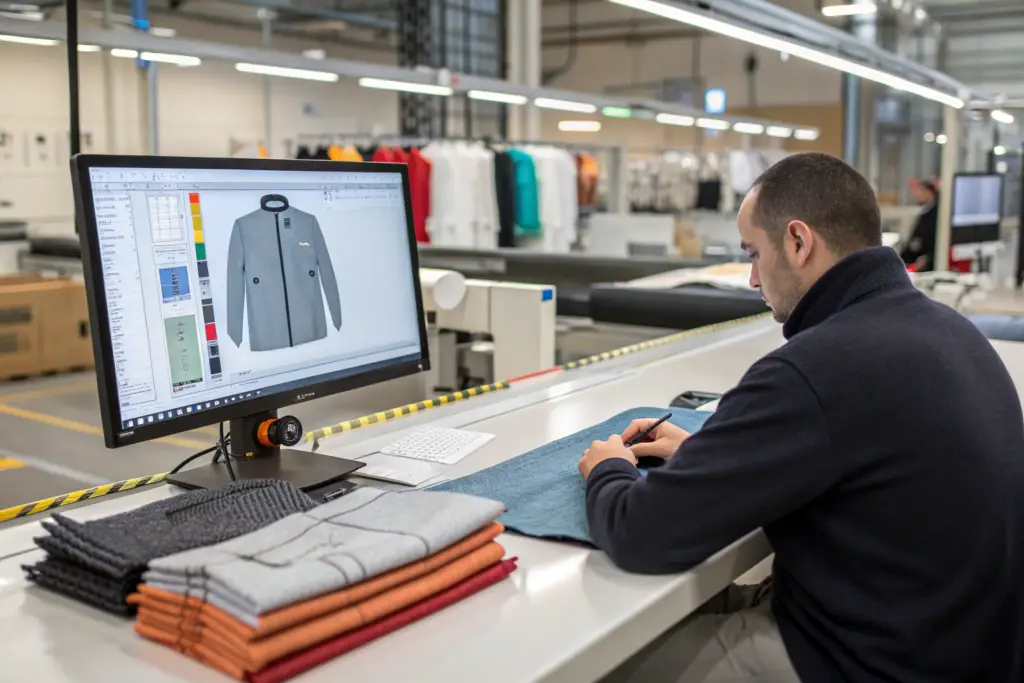
Leading factories now use 3D garment simulation software (like CLO or Browzwear). This allows brands and factories to visualize fit, drape, and style on a digital avatar before cutting any physical fabric. This is a game-changer for compliant fashion. It allows for rapid iteration on design details without wasting materials. More importantly, within these software platforms, designers can assign specific, pre-approved OEKO-TEX certified fabrics from the factory’s digital library to the 3D model, ensuring the visual and physical properties are aligned with compliant sourcing from the very first concept. This drastically reduces the number of physical samples needed and accelerates time-to-market for certified collections.
What role does the factory’s sample room play?
The sample room is the crucible where design meets reality. In a top-tier factory, the sample makers are not just sewers; they are highly skilled artisans who understand how to handle delicate or complex materials. They work closely with the compliance team to ensure that every thread, interlining, and stabilizer used in the sample is the same compliant material that will be used in bulk production. This is critical because the sample you approve is the one sent for OEKO-TEX certification. Any deviation between the sample and bulk materials invalidates the certificate. Our sample room at Shanghai Fumao operates under this strict protocol, maintaining a mini-warehouse of certified trims and fabrics specifically for prototyping.
How to Vet a Factory’s True OEKO-TEX Integration and Expertise?
Certificates on the wall are a start, but they are historical documents. You need to assess the factory’s live, operational integration of OEKO-TEX principles. This requires due diligence beyond asking for a certificate copy.
Request a virtual or physical tour of their quality control (QC) and testing lab. Do they have basic in-house testing equipment for pH, formaldehyde, or colorfastness? This shows proactive monitoring. Ask to see their supplier approval process. How do they vet and approve new fabric or trim suppliers for compliance? A robust system will include a questionnaire, request for test reports, and often a pre-shipment sample test. Crucially, ask about non-conformance handling. What happens if an incoming material fails an internal check? A serious factory will have a clear quarantine and return process, demonstrating that compliance gates are real and enforced, not just paperwork. We welcome such inquiries because they allow us to demonstrate our Integrated Management System, which is audited annually.
What documentation should you request during vetting?
Go beyond the main certificate. Ask for:
- Transaction Certificates (TCs): Request TCs for recent shipments of finished goods (with client names redacted). This proves they regularly execute full-article certification.
- Material Test Reports: Ask for sample test reports from their lab or their fabric mills for the types of materials you intend to use.
- Chemical Management Policy: A document outlining how they control restricted substances across their supply chain.
Reviewing these documents will show you the depth of their system. A factory that hesitates or provides only generic information is a red flag. The OEKO-TEX Association itself provides guidelines for brands on what to ask suppliers, which aligns with this vetting process.
Can they provide case studies or references?
Ask for specific case studies of challenging high-fashion projects they have certified. For example: “Have you produced a certified garment with metallic leather patches, printed linings, and intricate embroidery?” The story of how they managed it is more valuable than a thousand certificates. Speaking with a reference client in a similar market segment (contemporary fashion, premium activewear) can provide invaluable insight. Ask the reference: “Was compliance a barrier to creativity, or did the factory help navigate it seamlessly?” At Shanghai Fumao, we connect potential clients with long-term partners who can attest to our ability to deliver on both design and safety, because our reputation is built on these successful partnerships.
What are the Realistic Timelines and Cost Structures?
Merging high-fashion detailing with OEKO-TEX compliance will impact both schedule and budget compared to standard production. A transparent partner will outline these implications clearly from the outset, avoiding surprises.
The development timeline will be longer due to the double validation loop: one for design/sample approval and one for material/compliance approval. For a complex collection, you should budget an additional 4-6 weeks in the pre-production phase for material sourcing, lab-dip testing on custom colors, and component certification. Costs will be 15-30% higher than non-certified production due to: a) Premiums for certified, often higher-quality materials; b) Laboratory testing fees; c) The factory’s investment in specialized compliance personnel and systems. However, this investment protects you from far greater costs like recalls or reputational damage. A Denver-based brand we work with budgets this premium into their cost of goods sold and markets it as part of their value proposition, allowing them to command a retail price that supports healthy margins.
How should pricing be structured for such specialized production?
Beware of factories that give a single, low price per piece without breakdowns. A professional partner will provide a transparent cost breakdown that might include:
- Fabric Cost: Surcharge for OEKO-TEX certified vs. standard.
- Trim & Findings Cost: Itemized cost for certified zippers, buttons, etc.
- Development Fee: Covers multiple rounds of sampling with compliant materials.
- Testing & Certification Fee: Covers lab costs for the article.
- Manufacturing Cost: Cost of cutting, sewing, finishing.
This transparency allows you to understand where your money goes and make informed trade-offs (e.g., “Can we use a standard compliant zipper instead of a custom one to save $0.50/unit?”).
What MOQs are realistic for high-fashion certified production?
Minimum Order Quantities (MOQs) will be higher than a local sample room but should be negotiable based on complexity. For a very high-fashion, complex item, a factory might accept an MOQ of 300-500 pieces per style/color. For more basic styles within a fashion collection, MOQs might be 1000-2000 pieces. The key is the factory’s flexibility and their ability to group similar complex operations. We often work with emerging designers on lower MOQ launches by strategically planning production to share certified material rolls across several styles in their debut collection, making their initial investment more feasible.
Conclusion
Finding a manufacturer that authentically combines OEKO-TEX with high fashion is a quest for a partner, not just a vendor. It requires identifying a factory with demonstrated dual competencies: a creative, technical design studio capable of executing fashion-forward details, and a rigorous, proactive chemical compliance management system that is woven into every stage of development and production.
By vetting capabilities, examining integrated processes, and understanding the realistic implications on timeline and cost, you can form a partnership that elevates your brand. This alliance allows you to create collections that are not only beautiful and on-trend but also ethically sound and scientifically verified—a powerful combination in today’s market.
Ready to build a fashion brand that doesn’t compromise on safety or style? Partner with a manufacturer built for this exact challenge. At Shanghai Fumao, we bridge the gap between the atelier and the laboratory, ensuring your vision is realized with both creativity and integrity. Contact our Business Director, Elaine, to begin a collaboration where high fashion meets high standards. Reach her at elaine@fumaoclothing.com.