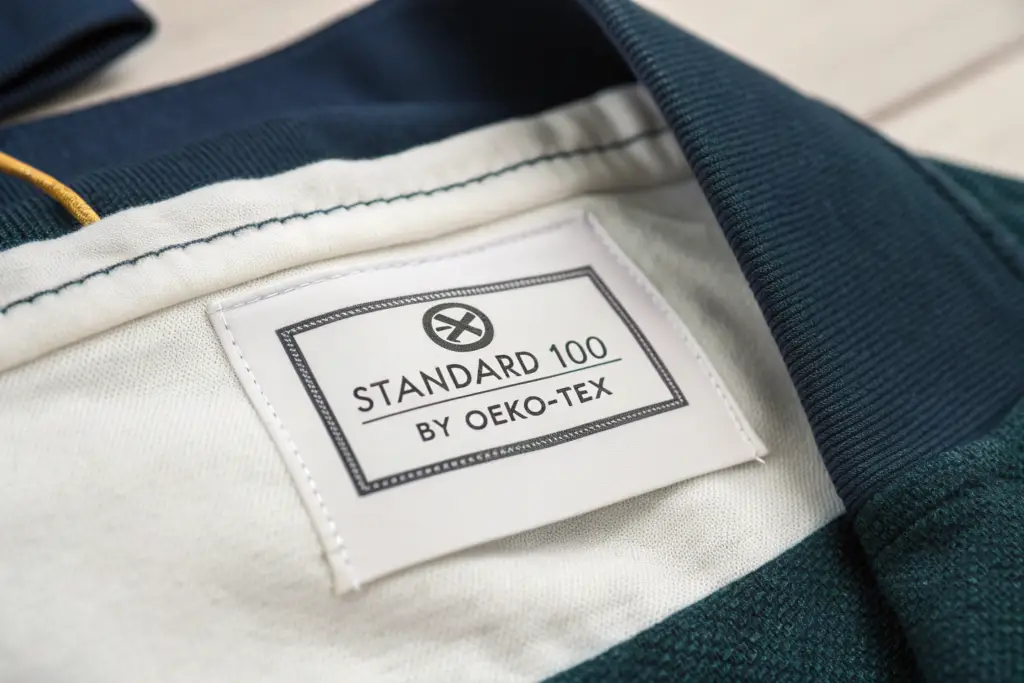
You’ve decided to source OEKO-TEX® certified golf vests. You’ve found a fabric that passes the test. But your design has a waterproof zipper, embroidered logos, mesh lining, and silicone grippers. A sinking feeling hits: does the certification cover everything, or just the main fabric? This gap in coverage is where risk hides for brands and resorts alike.
Yes, OEKO-TEX® certification, when properly obtained, must cover all trims and accessories on the finished garment. The core principle of the STANDARD 100 by OEKO-TEX® certification is that every component, regardless of its size or material, is tested for harmful substances. A certificate that only lists the shell fabric is incomplete and does not guarantee the safety of the final product you receive.
Understanding this “all-components” rule is critical to truly de-risking your supply chain. Let’s break down exactly what needs to be certified and how to verify it, ensuring your stylish and functional golf vests are as safe as they are professional.
What Exactly Does “Every Component” Mean in OEKO-TEX® Testing?
The phrase “every component” is literal and non-negotiable in OEKO-TEX® certification. It’s a systems-based approach designed to close all loopholes. If a single, untested component—like a drawcord tip or a specific button dye—contains a prohibited substance above the limit, the entire garment is non-compliant.
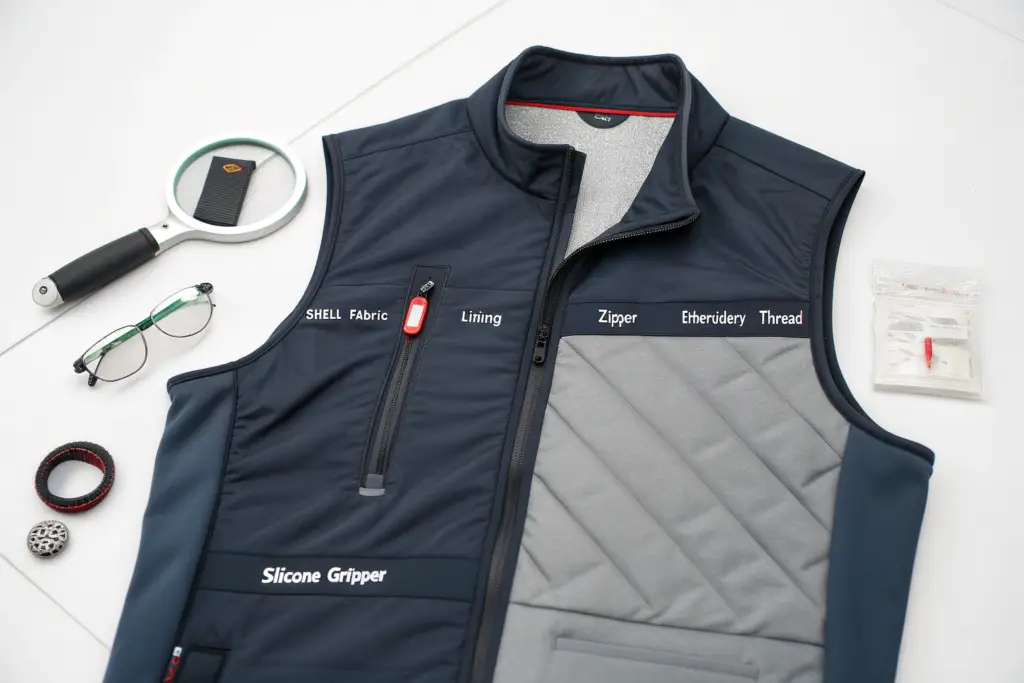
For a golf vest, “every component” includes the obvious and the easily forgotten: the outer shell fabric, insulation (if any), mesh or taffeta lining, zippers and sliders, pullers and cords, buttons, snaps, hook-and-loop (Velcro) tapes, embroidered threads, printed logos, elastic bands, silicone prints or grippers, care labels, and even the main label. Each material type and color variant must be included in the certification scope.
Which specific trims on a golf vest are commonly overlooked?
Two categories are most often missed. First are chemical treatments and finishes. A water-repellent (DWR) coating on the shell fabric or an antimicrobial treatment on the mesh lining are separate chemical applications that require testing. Second are multi-material assemblies. A zipper is not one item; it’s the tape (often polyester), the teeth/slider (metal or plastic), and the puller (which may have a rubberized or coated segment). Each distinct material in that assembly needs to be covered. We once audited a sample from a potential supplier whose certificate omitted the polyurethane coating on their vest’s laminated sections—a critical oversight.
How are prints and embroideries handled in the certification?
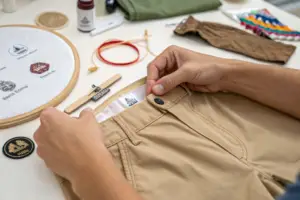
They are treated as separate, critical components. For screen prints or heat-transfer logos, the inks and their carriers are tested. For embroidery, the thread (its fiber and dye) and the backing or stabilizer material used behind the stitch are in scope. The certification body needs samples of each color of print and embroidery thread. This is why working with a certified factory like Shanghai Fumao, which sources pre-certified threads and inks from its supply chain, dramatically simplifies compliance and reduces your risk.
How to Verify Your Vest’s Full Certification Coverage?
Trust, but verify. A supplier may claim “OEKO-TEX certified fabrics,” but that claim is useless without proof of comprehensive coverage for your specific style. Verification is a simple, three-step process that protects your business.
You verify coverage by obtaining the official OEKO-TEX® certificate from your manufacturer and checking it against your garment’s Bill of Materials (BOM). The certificate is a searchable digital document with a unique number. It lists every certified component by a specific article number or description provided by the factory.

What key information should you look for on the certificate?
The certificate is your legal proof. Focus on these sections:
- Certificate Holder: This should be your manufacturing partner (e.g., Shanghai Fumao Clothing Co., Ltd.). This confirms they are authorized to produce articles under this certificate.
- Product Class: OEKO-TEX® has four classes (I: Baby, II: Skin Contact, III: No Skin Contact, IV: Decoration). Golf vests typically need Class II (items worn directly on skin).
- Article List/Description: This is the most critical part. It must list clear descriptions like “100% Polyester Woven Shell Fabric, blue,” “Nylon Mesh Lining, black,” “YKK Vislon Zipper #5 with metal slider,” and “Polyester Embroidery Thread, white.” Generic terms like “all accessories” are insufficient.
- Validity Period: Certificates are valid for one year and must be renewed.
This is a fundamental OEKO-TEX® principle: if a single button on a certified garment is replaced with an uncertified button of the same type and color, the entire garment loses its certification status. This rule underscores the integrity of the system. For you, it means your manufacturer must have strict inventory control for certified trims. They cannot mix batches. When we produce for clients, we manage certified trim inventory in a locked, segregated area to prevent accidental contamination of the supply chain, ensuring every vest that leaves our line is fully compliant.
What Are the Risks of Incomplete or “Fabric-Only” Certification?
Settling for partial certification is a high-stakes gamble. The risks are operational, financial, and legal. They can damage your brand overnight and negate the very reason you sought certification in the first place.
The primary risks include product recalls, failed retailer compliance audits, customer health complaints, and brand reputation damage. If a retailer like REI or a golf pro shop conducts a random test and finds lead in a zipper pull or phthalates in a PVC logo print, you will be liable. The recall costs, destroyed inventory, and loss of trust far exceed the cost of full certification.
Can you face legal or compliance issues with partial coverage?
Yes, absolutely. While OEKO-TEX® itself is a voluntary standard, it often serves as proof of compliance with mandatory regulations. For instance, California’s Proposition 65 or EU REACH regulations restrict specific chemicals. If an uncertified trim contains a substance regulated under these laws above the limit, you are in legal violation. You could face fines, import bans, and mandatory recalls. Full OEKO-TEX® certification is your best defense, as it tests for these regulated substances across all components. It shifts the liability and testing burden to your supplier’s certification body.
How does this affect your brand’s reputation with end-consumers?
The damage is severe and lasting. A guest at a luxury resort who gets a rash from the nylon mesh lining of your branded vest will not distinguish between “shell fabric” and “trim.” Their experience is with the finished product. They will post online reviews about “uncomfortable, itchy material,” associating your brand with poor quality and a lack of care. This erodes the premium image you’re building. Conversely, a fully certified vest allows you to market with complete confidence, using the OEKO-TEX® label as a unified symbol of total safety—a powerful trust signal in the competitive golf apparel market.
How to Ensure Your Manufacturer Certifies Everything?
The responsibility for full certification lies with your manufacturing partner. Your role is to select a partner with the expertise, systems, and integrity to manage this process flawlessly. It’s about their capability, not just their intention.
To ensure full coverage, you must partner with a factory that practices integrated “full-package” certified manufacturing. This means they control and document their entire trim supply chain. They should proactively provide you with the complete certificate and a matching BOM before production begins. Ask detailed questions about their process for sourcing and verifying certified trims.

What questions should you ask your supplier about trim certification?
Move beyond “Is it certified?” to these specific questions:
- “Can you provide the OEKO-TEX® certificate that lists all components for this specific golf vest style, including each zipper, button, and thread color?”
- “How do you manage and segregate inventory for certified vs. non-certified trims to prevent mix-ups?”
- “If we add a new trim (like a custom magnetic buckle) mid-season, what is your process to get it certified and update the overall garment certificate?”
- “Do you source trims from pre-certified suppliers, or do you test them yourself?” (Pre-certified supply chains are more robust).
Why is a “full-package” manufacturer more reliable for this?
A full-package manufacturer like Shanghai Fumao manages the entire process from fabric and trim sourcing to finished garment. This gives them direct control and visibility. They build relationships with certified trim suppliers (zipper, button, thread mills) and can pull the same certified components for multiple clients, ensuring consistency and scale. In contrast, a factory that only assembles garments using client-provided materials often cannot guarantee the certification status of those external trims. The integrated model inherently reduces risk and simplifies verification for you, the brand owner.
Conclusion
The question “Does OEKO-TEX cover all trims and accessories?” has a definitive answer: it must, or the certification is not valid for your finished golf vest. True safety and compliance leave no room for shortcuts. The zippers, linings, prints, and labels are as important as the main fabric.
Protecting your brand requires diligence. You must understand the “every component” rule, know how to verify certificates against your Bill of Materials, recognize the severe risks of partial coverage, and most importantly, choose a manufacturing partner with the proven systems to deliver fully certified garments reliably.
Don’t let hidden trims undermine your investment in quality and safety. Shanghai Fumao specializes in end-to-end OEKO-TEX® certified manufacturing, with rigorously managed supply chains for all components. We provide full transparency so you can brand and sell with absolute confidence. To develop your next collection of fully certified golf vests or any performance apparel, contact our Business Director, Elaine, at elaine@fumaoclothing.com. Let’s ensure every detail, down to the last stitch, meets the highest standard.