For any brand engineering high-performance ski vests, the choice of insulation is a critical decision that balances warmth, weight, compressibility, and moisture resistance. Increasingly, it must also balance safety and sustainability. Synthetic insulations like PrimaLoft®, Thermore®, and Thinsulate™ are industry standards, prized for retaining heat when wet. However, a pressing question arises: can these advanced, often petrochemical-derived materials meet the stringent human-ecological safety standards required for next-to-skin applications? The answer is complex but unequivocally positive, provided brands understand the specific pathways to compliance.
Yes, synthetic insulation materials can be OEKO-TEX® certified for use in ski vests, but the certification is not automatically conferred by the insulation's brand name. Certification must be verified at the specific component level, either through the insulation manufacturer's own certified products or via the final garment's certification achieved through a controlled, certified manufacturing process. The critical distinction lies between a material being certifiable and a specific batch of that material in your vest being certified.
At Shanghai Fumao, we navigated this precise challenge for a Pacific Northwest brand developing an ultra-light ski vest in 2023. The brand specified a high-loft, recycled synthetic insulation for its eco-credentials. While the insulation manufacturer marketed the product as "sustainable," their initial data sheets did not include an active OEKO-TEX® certificate. By leveraging our supply chain network, we connected with a regional distributor who provided a specific, valid OEKO-TEX® STANDARD 100 certificate for the exact grade and batch of that insulation. This allowed us to proceed confidently, integrating it into a fully certified vest. The alternative—using an uncertified batch—would have required prohibitively expensive standalone testing for the small order. This experience underscores that due diligence on the component certificate is non-negotiable.
What Are the Common Types of Synthetic Insulation and Their Certification Status?
Not all synthetic insulations are created equal, and their certification readiness varies by manufacturer, product line, and even production batch. Understanding this landscape is the first step in specifying compliant materials.
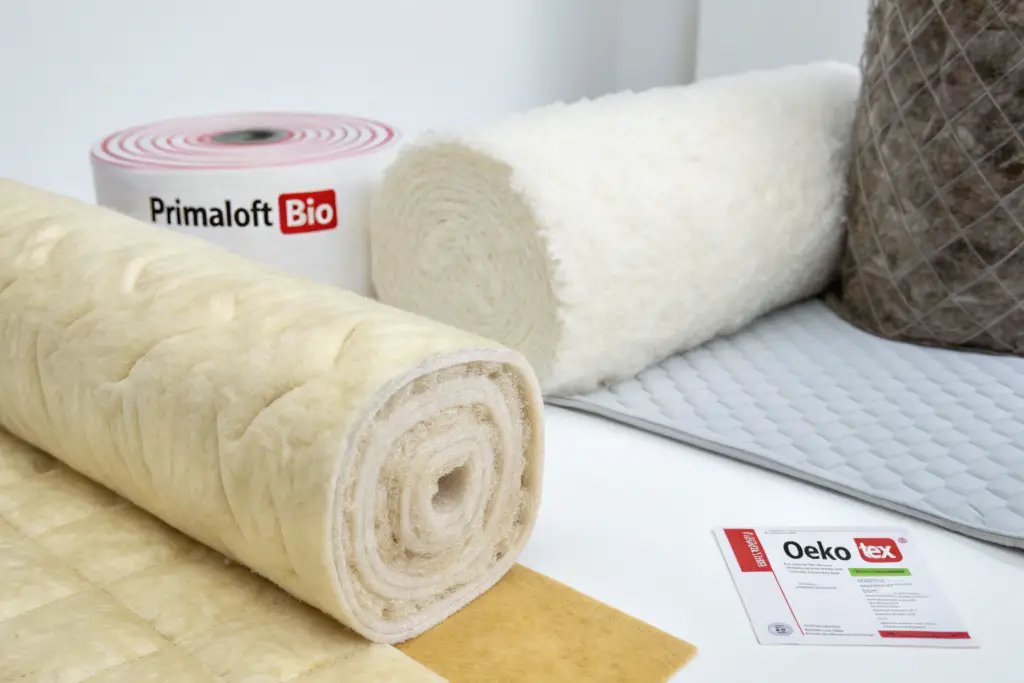
Common types include continuous filament insulations (like PrimaLoft® Bio) and shorter staple fiber insulations (common in many generic polyester fills). Leading brand-name manufacturers increasingly offer OEKO-TEX® certified product lines, but this is not universal, and certification must be verified per production lot. The insulation is treated as a separate "article" within the OEKO-TEX® system and must pass the same tests for harmful substances as fabrics.
Here is a breakdown of the certification landscape for key insulation types:
| Insulation Type | Common Brands/Examples | Typical OEKO-TEX® Status | Key Consideration for Brands |
|---|---|---|---|
| Premium Branded (Recycled Content) | PrimaLoft® Gold Insulation Eco, Thermore® Ecodown® | Often available with certification. Many of their eco-focused lines are specifically tested and certified. | Must request the specific certificate for the product line and lot number. Sustainability claims ≠ safety certification. |
| Premium Branded (Standard) | Thinsulate™, Some PrimaLoft® & Thermore® lines | May or may not be certified. Depends on the product's intended market and the manufacturer's client requirements. | Never assume. Always explicitly ask for the OEKO-TEX® certificate. |
| Generic Polyester Fiberfill | Various unbranded or mill-specific fills | Less commonly pre-certified. Often used in cost-sensitive applications where certification is not a priority. | To use these, the garment manufacturer (like us) must include the insulation as a component in the final product certification, requiring testing. This adds cost and complexity. |
The trend is clear: major material science companies are investing in certified product lines to meet brand demand. For instance, PrimaLoft® publicly lists several of its insulation products as OEKO-TEX® STANDARD 100 certified. However, the onus remains on the brand or manufacturer to obtain and verify the current, valid documentation for the material they are purchasing.
How Does the Construction of Insulation Affect Certifiability?
The physical form influences the testing protocol. Insulations are tested as a whole.
- Fibers: The chemical composition of the polyester or other synthetic polymer is assessed for residues like antimony (a common catalyst) or other heavy metals.
- Binder & Treatments: Most synthetic insulations use a binder (often a thermoplastic) to hold the lofty structure together, and may have water-repellent or other functional finishes. These chemical applications are a major focus of OEKO-TEX® testing, screening for formaldehyde, APEOs (alkylphenol ethoxylates), and phthalates.
- Recycled Content: Insulations made from recycled PET bottles undergo the same rigorous testing. The recycling process must effectively remove contaminants to meet the strict limits.
Therefore, a certification for a synthetic insulation validates the entire composite material—fiber, binder, and finish—as safe from harmful substance residues.
Why Can't I Just Rely on the Insulation Brand's Reputation?
Reputation is not a substitute for verification. A manufacturer may produce both certified and non-certified lines in the same factory. The specific product sold to your fabric mill or garment factory may come from a non-certified batch unless it was specifically ordered as certified. Furthermore, certificates expire and are updated. The only way to ensure compliance is to receive the official OEKO-TEX® certificate (or a detailed test report from an accredited lab) that references the exact insulation type, supplier, and preferably, the batch or purchase order number. This is a core part of our material validation process at Shanghai Fumao.
How to Verify OEKO-TEX® Certification for Insulation Materials?
Verification is a step-by-step process that moves from broad claims to precise documentation. Skipping steps introduces risk into your supply chain.
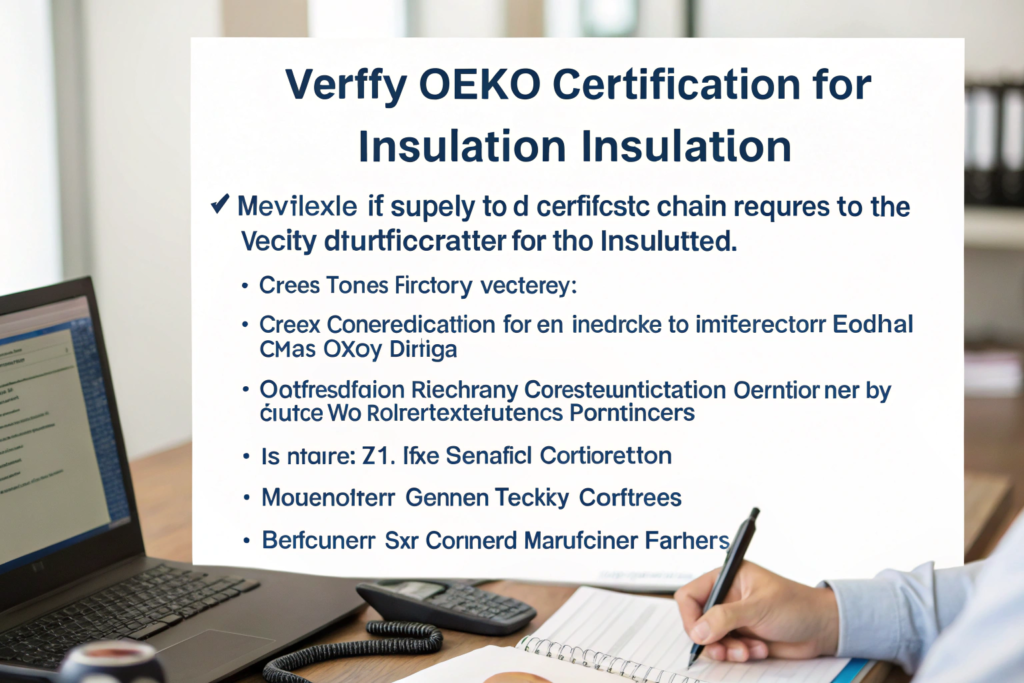
To verify OEKO-TEX® certification for insulation, you must move up the supply chain to request the certificate directly from the insulation manufacturer or their authorized distributor, then cross-reference the certificate details with the material you are receiving at the garment factory. This requires proactive communication and often the leverage of your manufacturing partner.
Follow this verification checklist:
- Request the Certificate: Ask your garment manufacturer or the fabric mill providing the insulated laminate for the OEKO-TEX® certificate for the insulation component. A credible partner will provide it promptly.
- Check Validity: Verify the certificate is current (not expired) using the OEKO-TEX® online certificate database. Enter the license number and company name.
- Match the Product: Ensure the product description on the certificate (e.g., "Polyester Fiberfill, Type XYZ, 100gsm") exactly matches the material specified in your tech pack.
- Confirm the Applicant: The certificate should be in the name of the insulation manufacturer (e.g., "PrimaLoft Inc.") or a master distributor. A certificate in the name of an unrelated trading company is a red flag.
- Batch Traceability: In an ideal scenario, the insulation delivery should be accompanied by a test report or a statement of conformity linking it to the master certificate. This provides batch-level assurance.
If your garment factory cannot provide this, they should be willing and able to facilitate contact with their insulation supplier to obtain it. Hesitation at this stage is a significant warning sign.
What if the Insulation is Not Pre-Certified?
You have two options, both with cost implications:
- Option A: Include it in Final Garment Certification. Your garment manufacturer submits the finished vest (with the uncertified insulation inside) for OEKO-TEX® testing. The insulation will be tested as part of the whole product. This is viable but can be costly and time-consuming for small batches, as it makes the entire garment's certification contingent on this one new component.
- Option B: Source an Alternative. Work with your manufacturer to find a comparable insulation that is pre-certified. This is almost always the more efficient and lower-risk path. A partner with a strong material sourcing network, like Shanghai Fumao, will have alternatives readily available.
What Questions Should You Ask Your Manufacturer?
Arm yourself with specific questions to gauge their expertise and control:
- "For this insulated vest, can you provide the OEKO-TEX® certificates for the shell fabric, the insulation, and the lining separately?"
- "Is the insulation you are proposing from a pre-certified lot? If not, what is the cost and timeline impact of certifying it as part of our garment?"
- "How do you store and handle certified insulation to prevent mix-up with non-certified materials in your warehouse?"
Their answers will reveal whether they have a systematic approach or are hoping to bypass the issue.
What About the Rest of the Vest? Shell, Lining, and Construction?
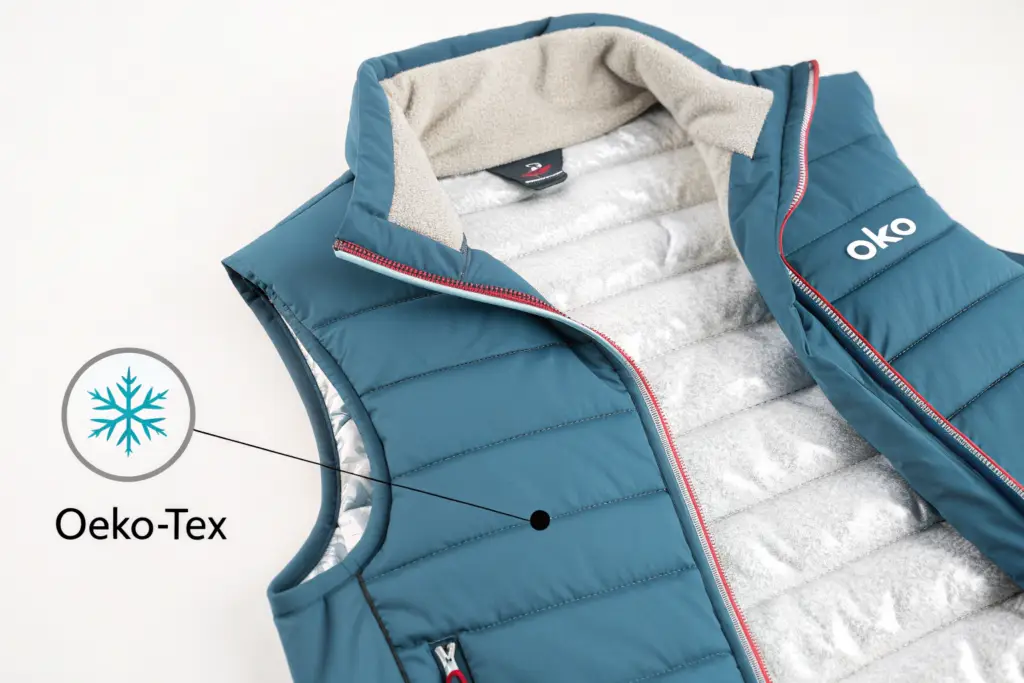
Certified insulation alone does not make a certified vest. OEKO-TEX® STANDARD 100 is an all-or-nothing proposition for the finished article.
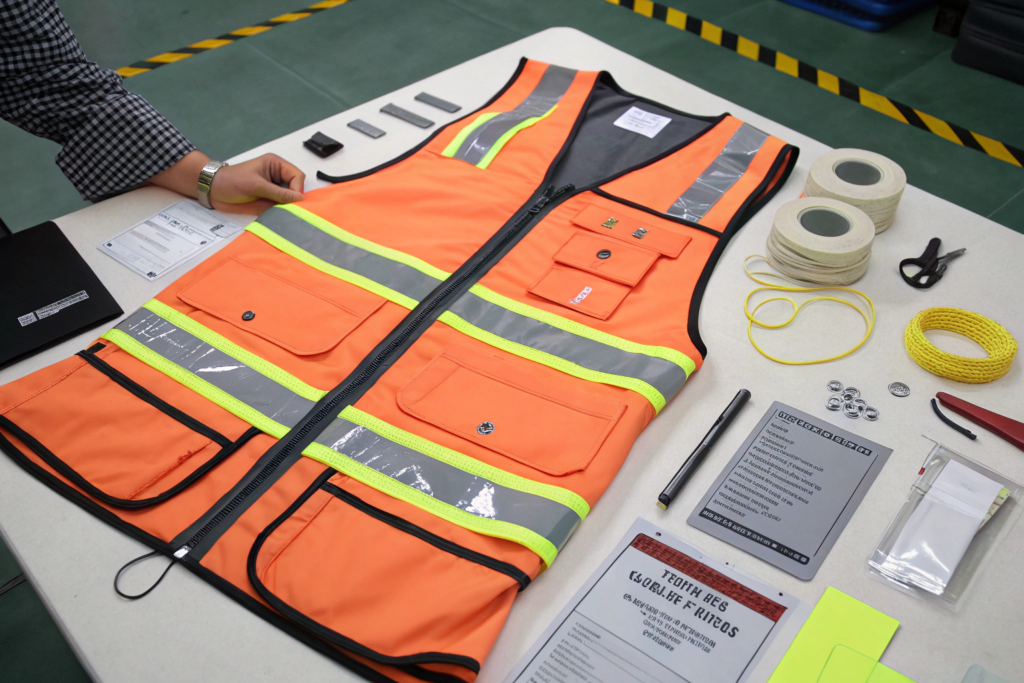
Every component that makes up more than 1% of the total weight of the finished vest must be certified. This includes the outer shell fabric, the inner lining, the insulation, the sewing thread, zippers, pullers, cords, and any labels. A failure in any one component voids the certification for the entire garment. This "chain of custody" is the core challenge and value of working with a full-package certified manufacturer.
Consider a typical ski vest construction:
- Outer Shell: Often a nylon or polyester with a DWR (Durable Water Repellent) finish. Must be certified.
- Insulation: Synthetic fill. Must be certified.
- Inner Lining: Usually a lightweight, breathable nylon or polyester. Must be certified.
- Trims: Zippers (including tape, slider, and puller), cord locks, elastic. Must be certified.
- Thread & Labels: Must be certified.
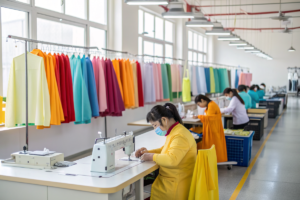
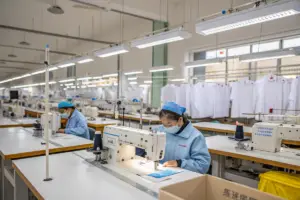
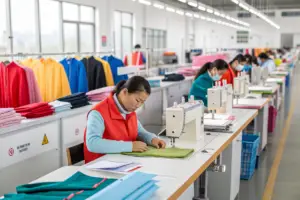
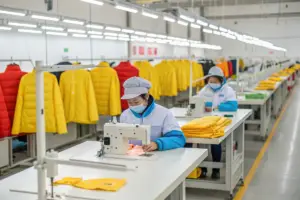
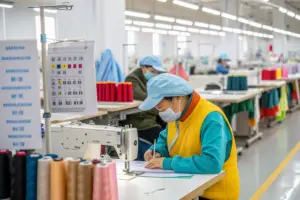
At Shanghai Fumao, our integrated system is designed for this complexity. We source from pre-vetted, certified suppliers for all these components. Our production control ensures that only certified materials are used on the line for certified orders. We then manage the final product certification process, providing our client with a certificate that covers the complete vest. This end-to-end control is what turns a collection of certified parts into a guaranteed certified product.
How is a Finished Vest Tested for Certification?
The certification body does not necessarily test every component separately for a finished garment. They rely on a combination of:
- Component Certificates: Verified certificates for each major material (shell, insulation, lining).
- Material Testing: They may take samples of the finished garment and test them, which indirectly tests the composite of all materials.
- Factory Production Control Audit: They audit the manufacturer's system (like ours) to ensure that certified materials are being used correctly and that there is no risk of substitution or contamination.
This system-based approach is efficient and robust, but it hinges entirely on the integrity of the manufacturer's control system.
What Are the Performance Implications of Using Certified Insulation?
A legitimate concern is whether the chemical restrictions of OEKO-TEX® compromise the technical performance of the insulation. The evidence and industry practice suggest otherwise.
Using OEKO-TEX® certified synthetic insulation does not inherently compromise its thermal performance, compressibility, or weight. Leading manufacturers reformulate their chemistries (binders, finishes) to meet the strict limits without sacrificing core functionality. The certification relates to chemical residues, not the physical engineering of the fiber loft or structure. In fact, the removal of certain harmful substances can lead to a more stable and consistent product.
However, there are nuanced considerations:
- DWR Finishes on Insulation: Some insulations have a water-repellent treatment. OEKO-TEX® compliant DWR finishes are available, but they may be based on newer, PFAS-free chemistry. This is a positive alignment with broader industry trends away from "forever chemicals."
- Odor Control: Insulations treated with silver-based or other antimicrobial agents for odor control must use OEKO-TEX® compliant application methods and levels. This may steer brands toward insulation that relies more on physical structure (like continuous filaments that wick moisture) for odor management rather than chemical treatments.
- Longevity: As with fabrics, the certification's fastness tests suggest that certified treatments are more durable to washing, helping the insulation maintain its performance over the garment's life.
The key is to work with your manufacturer to test prototypes for performance. The insulation should meet your technical specs for CLO value (warmth) and packability and be certified. These are not mutually exclusive goals.
Conclusion
Synthetic insulation materials are not only capable of being OEKO-TEX® certified but are increasingly being offered as such by forward-thinking manufacturers. The critical task for ski vest brands is to shift from asking "Is it possible?" to executing a diligent verification protocol. Success depends on sourcing specific, certified insulation lots and partnering with a garment manufacturer whose entire ecosystem—from shell to thread—is governed by the same rigorous standard.
This comprehensive approach ensures that the warmth and protection your vest provides are never undermined by hidden chemical risks. It future-proofs your product against evolving regulations and deepens consumer trust. In essence, a certified vest delivers clean warmth, inside and out.
If you are engineering ski vests where performance and responsibility are equally prioritized, partner with a manufacturer equipped to navigate this complex material landscape. At Shanghai Fumao, we specialize in integrating certified synthetic insulations into high-performance outerwear, ensuring every component meets the highest safety standards. Contact our Business Director Elaine to develop your next insulated collection with verified integrity: elaine@fumaoclothing.com.