You see the market shifting. Golfers are becoming more conscious, and retailers are demanding verifiable proof of product safety and sustainability. Your current line sells, but you know that transitioning to fully OEKO-TEX certified production is the next critical step for growth and risk reduction. The question isn’t “why,” but “how” without disrupting your business, blowing your budget, or missing a season.
Transitioning your golf line to fully OEKO-TEX certified production requires a phased, four-step strategy: conducting a gap analysis on current products, sourcing pre-certified materials, partnering with a certified full-package manufacturer, and implementing a rigorous documentation protocol. This systematic approach minimizes cost and timeline overruns while ensuring a credible, market-ready certified collection.
It’s a project, not an overnight switch. Let’s break down the actionable roadmap to get you from intention to certified inventory efficiently.
Phase 1: Assess Your Current Line and Set Clear Goals
Begin with a clear-eyed audit. You cannot transition what you don’t fully understand. This phase is about defining scope and identifying potential hurdles before any financial commitment.
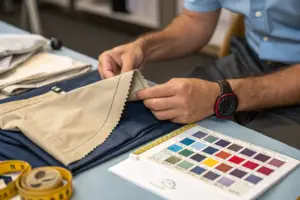
First, categorize your current best-selling golf items (e.g., polos, shorts, outerwear). For each, gather the complete tech pack and bill of materials (BOM). You need to list every component: main fabric, lining, interlining, sewing thread, zippers, buttons, prints, and labels. Then, contact your current suppliers and ask for the OEKO-TEX certification status of each component. This exercise is revealing. Often, a single non-compliant $0.10 button can hold up certification for a $85 polo shirt.
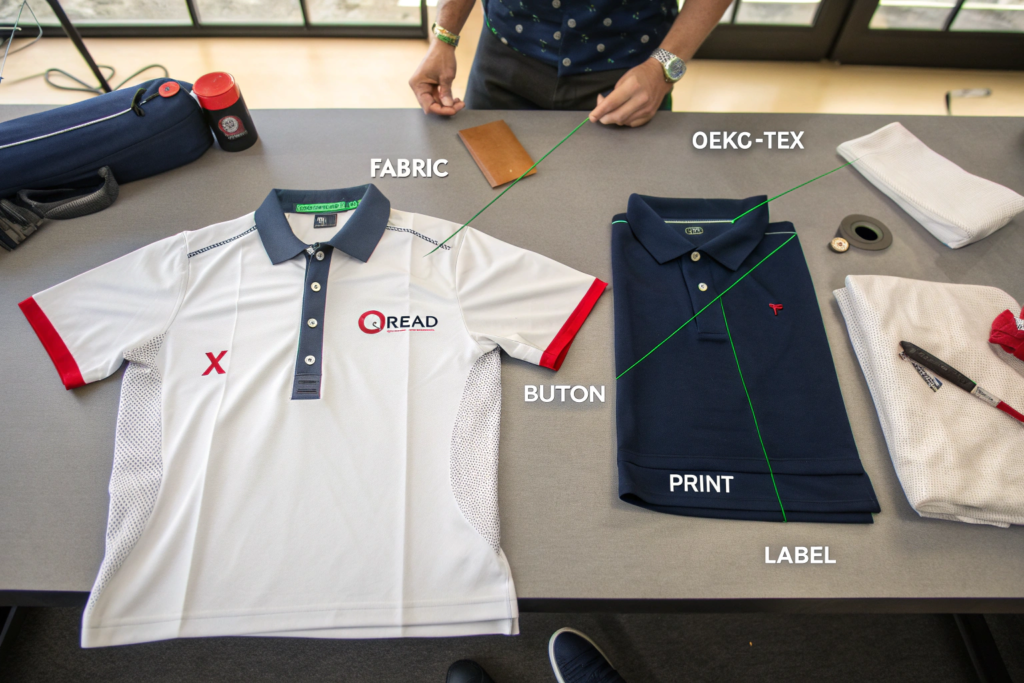
How to Conduct a Cost-Effective Gap Analysis?
You don’t need to lab-test every old item. Follow this pragmatic process:
- Request Certificates: From all material suppliers for current components.
- Verify Validity: Use the OEKO-TEX database to check certificate numbers and ensure they are for the correct product class (Class II for wear close to skin).
- Identify Gaps: Create a simple spreadsheet listing each component and its certification status. The uncertified items are your gaps.
In our experience, brands find that 60-70% of their core fabrics may already be certifiable, but trims and accessories are the common failure points. This audit provides your roadmap and initial budget estimate for replacement sourcing.
Should You Transition the Entire Line or Start with a Capsule?
Unless your line is very small, a full-season, all-SKU transition is high-risk. We strongly recommend a capsule collection strategy. Select 4-6 of your best-selling, simplest styles to transition first. This minimizes complexity, allows you to manage costs, and creates a marketable “Certified Collection” story. The learnings from this capsule will make scaling up smoother. For a Michigan-based brand we worked with, starting with three polo styles and one short style allowed them to launch their certified line in one season and fund the expansion with the profits.
Phase 2: Source Certified Materials and a Certified Partner
With your gaps identified, the next step is sourcing replacements. This is where choosing the right manufacturing partner becomes the single biggest leverage point for efficiency.
Do not try to source certified fabrics and trims yourself and then send them to an uncertified factory. The complexity of managing multiple certificates and ensuring the factory’s processes (like dyes and auxiliaries) are compliant is overwhelming. Instead, partner with a full-package manufacturer that already has an established library of OEKO-TEX certified materials and vetted trim suppliers. Their existing supply chain is your fastest path to compliance.
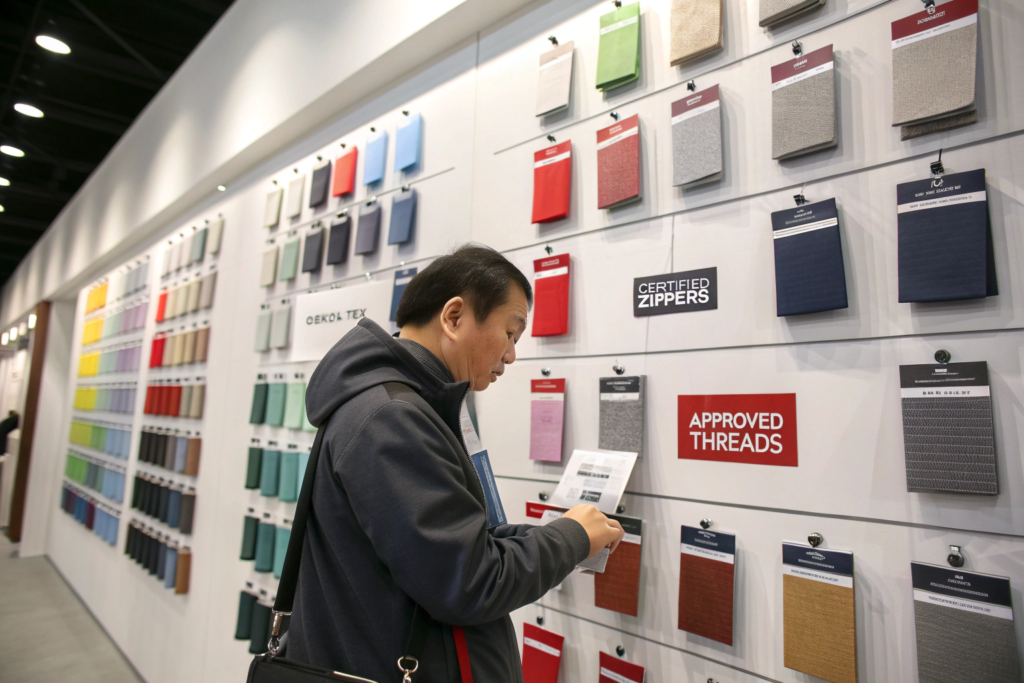
What to Look for in a Manufacturing Partner?
Your ideal partner should demonstrate:
- In-House OEKO-TEX Expertise: A dedicated compliance or QA officer who understands the standard.
- Pre-Certified Material Library: A range of certified fabrics you can choose from, accelerating development.
- STeP Certification: OEKO-TEX STeP certification for their facility shows a systemic commitment to sustainable production, which simplifies due diligence.
- Transparent Documentation: Willingness to provide test reports and support your certification application.
At Shanghai Fumao, our STeP-certified facility and curated library of certified materials allow us to guide clients through this phase in weeks, not months. We become your single point of contact for all certification logistics.
How to Negotiate Costs During Transition?
Be upfront with your manufacturer about your transition goal. Discuss:
- Fabric Minimums: Certified fabrics may have higher MOQs. A good partner can often use “stock” certified fabrics to lower this barrier for your capsule.
- Testing Costs: Clarify who pays for the mandatory lab testing of the final garment. In a full-package DDP model, this is often included or offered at a consolidated rate.
- Phased Pricing: Understand the cost differential between certified and non-certified production. This allows for accurate financial planning.
Phase 3: Manage the Certification Process During Production
Once you’ve finalized designs with certified materials, the formal certification process begins. Your manufacturer should manage this, but you must stay informed.
The process involves submitting applications and samples of the finished garment to an OEKO-TEX approved institute (like Hohenstein). The entire garment—every component—is tested. Your manufacturer must ensure that the bulk production uses the exact same materials as the submitted sample. Any deviation voids the certificate.
What is the Critical “Golden Sample” Protocol?
Implement this rule: The sample sent for OEKO-TEX testing is your “Golden Sample.” It must be sealed, signed by both you and the manufacturer, and used as the master reference for all bulk production quality checks. Any change in supplier for any component, no matter how small, requires a new test. This protocol eliminates the risk of last-minute, uncertified substitutions that lead to failed shipments.
How Long Does Certification Take and How to Plan Timelines?
From sample submission to receiving the certificate, plan for 4-6 weeks. This must be factored into your critical path. A reliable partner will have experience with this timeline and build it into the production schedule. For example, we always advise clients to add 5 weeks to the standard lead time for the first order of a newly certified style. This buffer is non-negotiable for ensuring reliable delivery of a fully compliant product.
Phase 4: Launch, Market, and Scale with Confidence
Receiving the certificate is not the end; it’s the beginning of your market advantage. Properly leveraging the certification maximizes your return on investment.
First, ensure your sales and marketing teams have the correct assets: the official OEKO-TEX label, the certificate number for retailer verification, and clear talking points about what the certification means for the golfer. Second, update your internal systems. The OEKO-TEX certificate and test reports must be filed and linked to that specific product SKU for future re-orders.
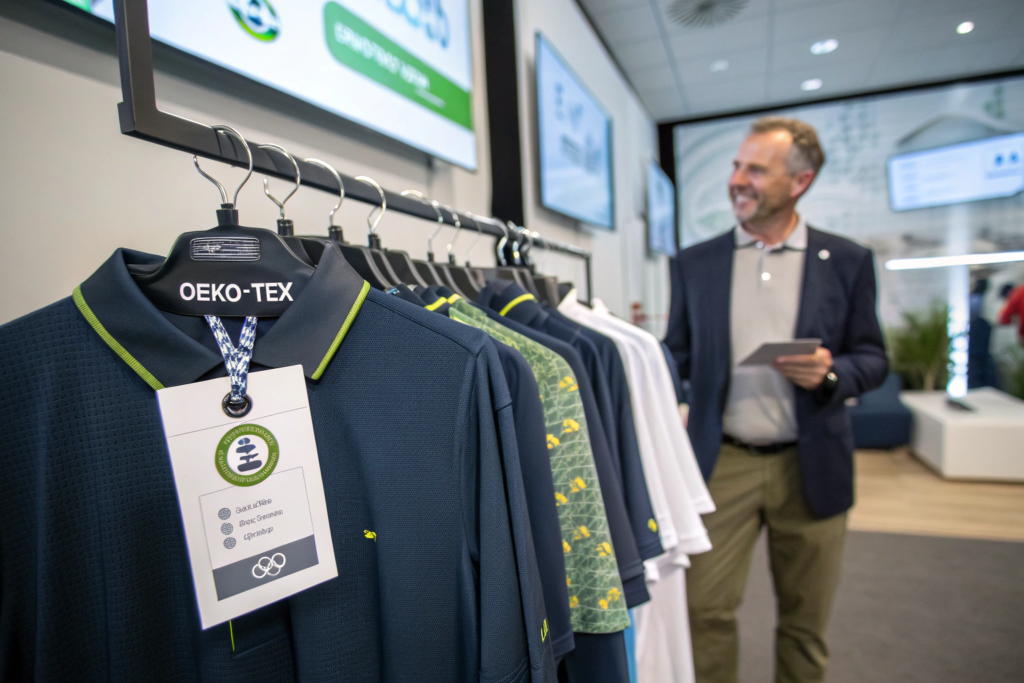
How to Communicate This Value to Retailers and Consumers?
For retailers, lead with compliance and risk reduction. Provide the certificate upfront in your sell-in sheets. It answers many of their safety questions immediately, streamlining their vendor onboarding. For consumers, translate the technicality into benefit. Use language like: “Independently certified free from harmful substances for confidence on and off the course.” This bridges the gap between a complex standard and a simple customer promise.
What is the Strategy for Scaling Beyond the Capsule?
Use the proven template from your capsule collection. For each subsequent season, transition another set of styles, applying the same material selection and certification process. Your manufacturer should now be a true partner in this scaling, able to replicate the process efficiently. The goal is to make “certified by default” your new standard operating procedure, embedding it into your brand’s DNA for long-term resilience and value.
Conclusion
Transitioning your golf line to full OEKO-TEX certification is a strategic investment that de-risks your supply chain and elevates your brand. By following a phased approach—audit, source with the right partner, manage the process meticulously, and launch with conviction—you transform a complex technical challenge into a structured, manageable project. The result is a product line you can stand behind with unparalleled confidence, ready to meet the demands of the modern market.
The journey is significantly smoother with an experienced guide. Shanghai Fumao has been the trusted partner for numerous U.S. brands making this exact transition. We provide the certified materials, the STeP-certified production facility, and the end-to-end project management to make your certified vision a reality. Contact our Business Director Elaine at elaine@fumaoclothing.com to schedule a gap analysis and build your transition roadmap.