Every season, I watch brands face the same high-stakes race: getting their premium ski collections to market on time. The pressure doubles when the collection is OEKO-TEX certified. A brand owner once told me, "A delayed shipment of certified goods is worse than a late regular order. I've paid a premium for safety and trust, and now I'm missing the selling season." The complexity of certification can become a bottleneck, but it doesn't have to be.
To ensure on-time delivery for OEKO-TEX certified ski collections, brands must integrate certification into the core timeline from the very first design meeting. This means pre-approving certified fabrics, conducting pilot batch testing early, and partnering with a manufacturer experienced in managing the certification workflow within the production schedule. Proactive planning, not reactive testing, is the key.
The challenge is real. Last year, a client came to us with a half-finished development for a ski jacket line. Their previous factory had sourced beautiful fabrics, but none were OEKO-TEX certified. Starting the certification process from scratch at that stage meant a guaranteed 8-week delay. We had to help them pivot quickly. This experience taught us that on-time delivery for certified goods is a discipline that starts long before the sewing machines start.
Why Does OEKO-TEX Certification Often Cause Delays?
The delay rarely comes from the test itself. It comes from the surprises discovered during the test. Most brands and factories treat certification as a final inspection step—a box to check before shipping. This is a fundamental mistake.
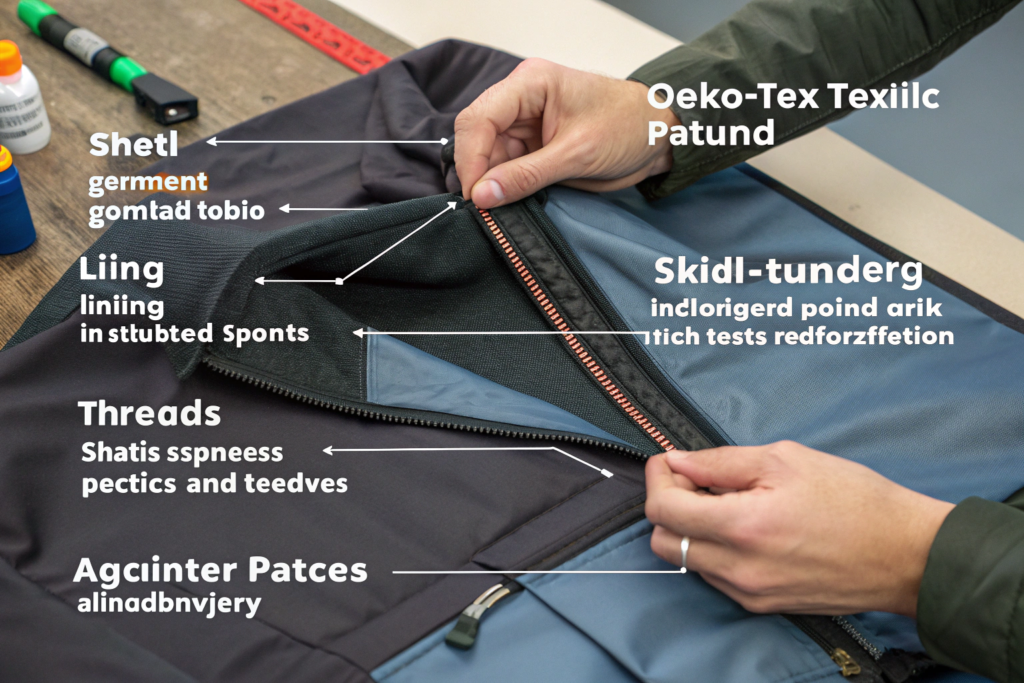
The OEKO-TEX STANDARD 100 test is thorough. It examines every component: shell fabric, lining, insulation, zippers, threads, prints, and even adhesives. A failure in any single component fails the entire garment. Common failure points are not the main fabrics, which are often sourced pre-certified, but the auxiliary materials. We've seen delays caused by:
- A specific dye lot of sewing thread.
- The plastic slider on a zipper.
- The ink used for size labels.
- The bonding agent in laminated patches.
Each failure requires sourcing a new component, resubmitting samples, and waiting for a new test report. This "trial and error" cycle during bulk production is what kills timelines.
People often underestimate the administrative and logistical lead time. Consider this real-world sequence:
- Sample Preparation (3-5 days): Cutting and preparing identical sets of material swatches and finished garment samples for the lab.
- Courier & Lab Queue (7-10 days): Shipping samples to the accredited lab (e.g., in Hong Kong or Europe) and waiting for your turn in their testing queue.
- Testing Duration (10-14 days): The actual scientific analysis.
- Report Issuance (3-5 days): Receiving the official certificate.
This is over a month of just waiting time if you start from zero during production. If a failure occurs, you loop back to Step 1, adding another 4-6 weeks.
How can unexpected material issues derail a schedule?
Let's take a practical example. A brand designs a jacket with a bold, screen-printed graphic. The main fabric is OEKO-TEX certified. However, the vibrant orange printing ink, while environmentally friendly, contains a pigment not on the mill's pre-approved chemical list for that specific fabric composite. The lab test fails for "unidentified substances." Now, the brand must:
- Find a new ink formulation that matches the color and works with the printer.
- Test the new ink on the fabric for adhesion and wash fastness.
- Resubmit new printed fabric swatches for OEKO-TEX testing.
This can easily consume 5-7 weeks, pushing the production completion date past the ship-by date.
How to Build a Timeline That Accounts for Certification?
The solution is to design your production schedule backwards from the final shipping date, with certification milestones as fixed, non-negotiable points. Certification is not an event; it's a parallel track that runs alongside development and production.
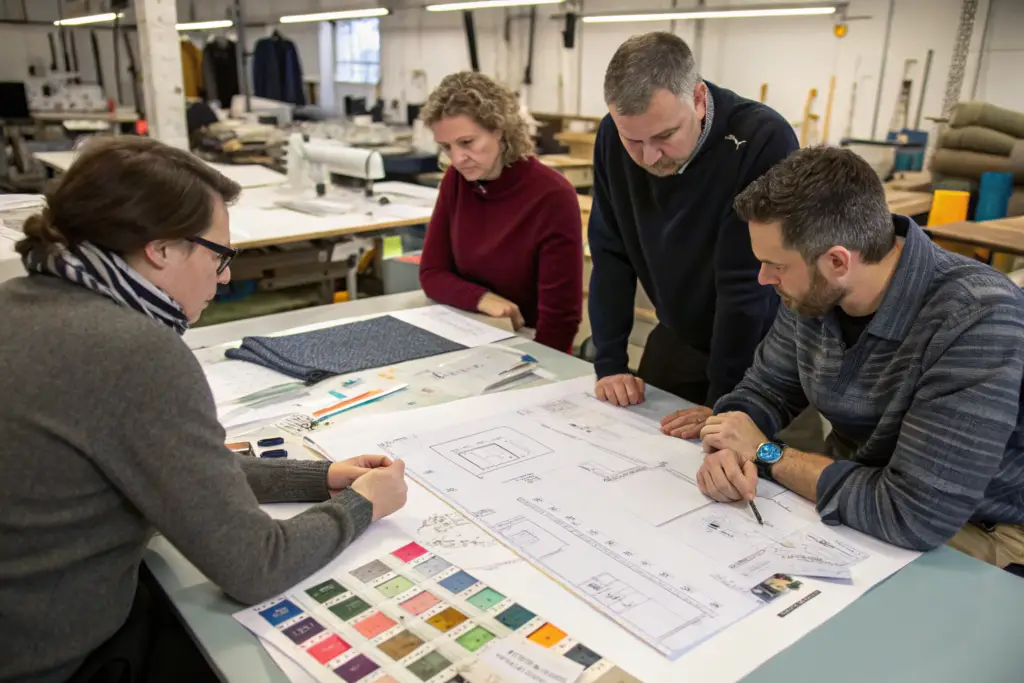
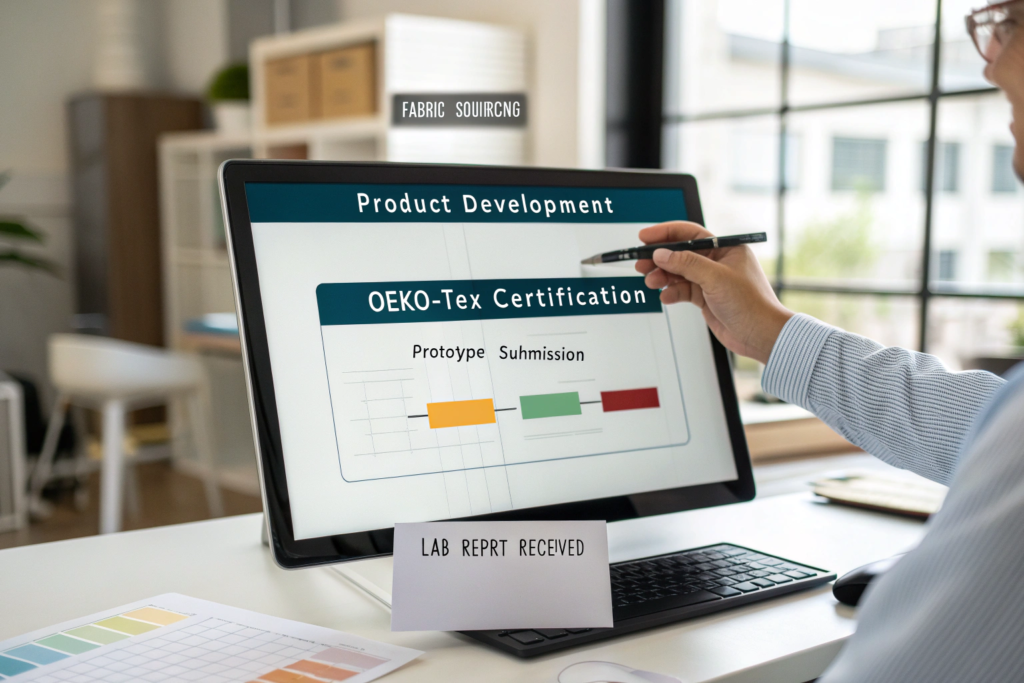
At Shanghai Fumao, we use a phased timeline model for certified collections. The critical shift is moving the certification sample submission to the prototype stage, not the pre-production sample stage. This means the first fully representative sample is sent for testing while the brand is still confirming fit and trims. Any material failures are discovered when there is still time to change components without affecting bulk fabric ordering.
Here is a simplified version of our integrated timeline structure:
| Phase | Production Activity | Parallel Certification Activity | Goal |
|---|---|---|---|
| Phase 1: Development (Week 1-4) | Design, initial fabric sourcing, prototype making. | Identify & source all components from OEKO-TEX certified suppliers or submit them for pre-testing. | Freeze all materials with lab-verified safety. |
| Phase 2: Pre-Production (Week 5-8) | Fit approval, pre-production sample (PPS) making, bulk fabric cutting. | Submit prototype for full OEKO-TEX testing. Receive certificate. | Secure the certificate before bulk sewing begins. |
| Phase 3: Production (Week 9-14) | Bulk sewing, quality control, finishing. | Zero certification risk. Use only pre-certified materials. Maintain chain of custody documentation. | Uninterrupted production flow. |
| Phase 4: Shipment (Week 15) | Final inspection, packing, export logistics. | Include OEKO-TEX labels and certificates in shipping documents. | Smooth customs clearance with all compliance docs. |
This model removes the certification bottleneck from the critical path of production. When we implemented this for a client's ski bib collection, we reduced their total lead time from 22 weeks to a reliable 16 weeks, with zero certification-related delays.
What is the role of a "Certification BOM"?
A Bill of Materials (BOM) is standard. For certified production, you need a Certification BOM. This is a living document that lists every single component with its:
- Supplier name
- OEKO-TEX certificate number (if pre-certified)
- Lab test report reference (if tested as part of the garment)
- Approval status
This document is managed by our project managers and shared transparently with the brand. Any component change, even a new button supplier, triggers a review and potential re-testing protocol.
How does early testing impact cost?
There is a perception that testing early costs more because you might test a prototype that changes. In reality, it is far less expensive than the alternative. The cost of testing one prototype is fixed. The cost of delaying a 5,000-piece shipment, missing peak season, and discounting inventory is catastrophic. Early testing is the ultimate form of supply chain risk management.
What Makes a Factory a Reliable Partner for Certified Collections?
Not all factories are created equal for this task. A reliable partner doesn't just have a sewing floor; it has a systematized approach to managing compliance and complexity. Choosing the right partner is the single biggest factor in ensuring on-time delivery.
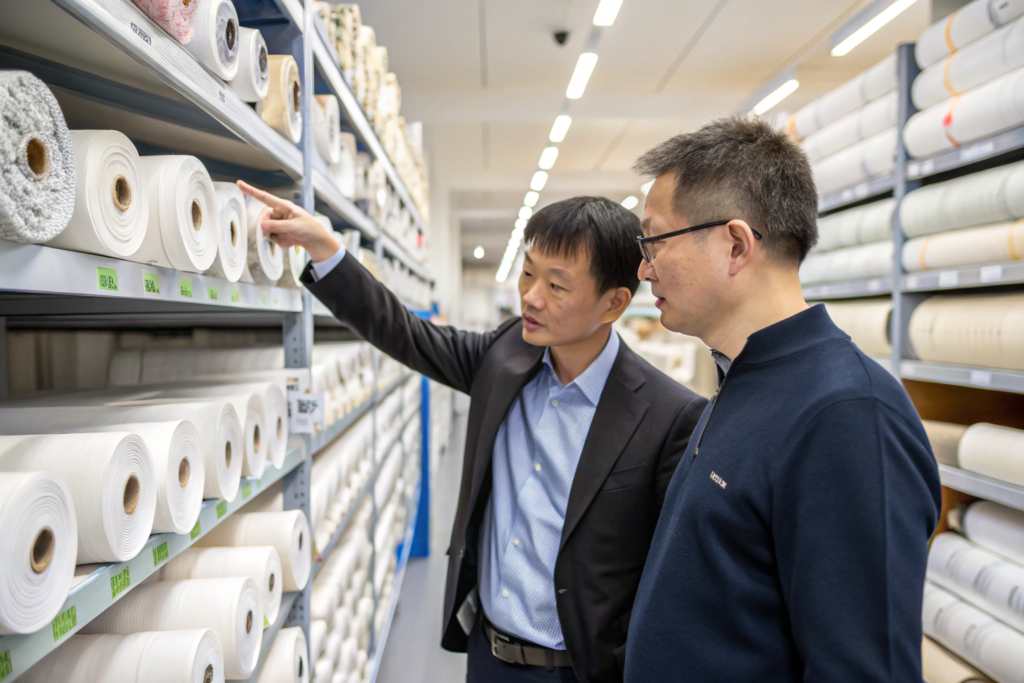
First, they must have established certified supply chains. A factory like ours has long-term relationships with mills that produce OEKO-TEX certified fabrics as standard. This means we have access to a curated library of pre-tested materials for shell fabrics, insulation like PrimaLoft, and linings. We're not starting from scratch with every order; we're selecting from a vetted portfolio. This alone saves 4-6 weeks of sourcing and initial testing time.
Second, look for in-house technical expertise. Does the factory have a dedicated compliance or quality engineer who understands the OEKO-TEX standard's nuances? For instance, they should know that a fabric certified for "Article Class I" (babies) is acceptable for "Article Class II" (skin contact), but not vice-versa. This knowledge prevents costly specification errors. Our technical team once caught a client's request to use a Class III (outerwear) certified fabric for a sweater lining (which requires Class II). Correcting this before ordering saved the project.
How does a factory's internal QC prevent certification delays?
Robust in-house quality control acts as a pre-filter for the official lab. We perform preliminary tests on incoming materials. While we can't replicate the full OEKO-TEX suite, we can check for common red flags using pH test strips, formaldehyde test kits, and basic colorfastness rub tests. If a material fails our internal check, we quarantine it and request a new batch from the supplier before it goes into production and long before it reaches the external lab. This internal gatekeeping is crucial for flow.
What communication systems are necessary?
Efficient communication is vital. The factory must provide clear, regular updates not just on sewing progress, but on certification milestones. At Shanghai Fumao, clients receive weekly reports that include:
- Status of lab sample submission/report.
- Photos of material certificates.
- Any deviations from the Certification BOM.
This transparency allows for collaborative problem-solving. Last fall, when a lab report for a glove lining was delayed due to a backlog, we immediately informed the brand and proposed a parallel path: we started cutting the shell materials (which were certified) while awaiting the lining report, preventing a full production halt.
How to Mitigate Risks in Logistics and Final Shipping?
Securing the OEKO-TEX certificate is only half the battle. Getting the certified goods physically to your warehouse on time is the final hurdle. Logistics for certified goods require extra attention to documentation.
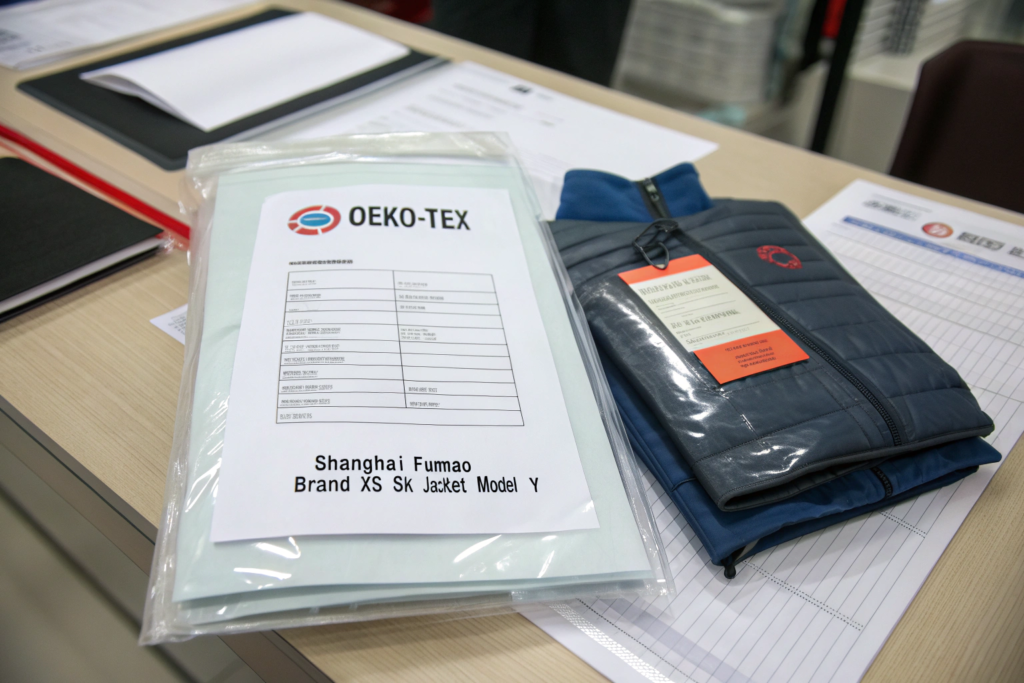
All OEKO-TEX certificates are product and supplier-specific. The certificate issued to Shanghai Fumao for "Brand X's Ski Jacket Model Y" cannot be used for a different brand or style. The shipping documents must precisely match the certificate details. We create a "compliance packet" for each shipment, which includes:
- The original OEKO-TEX certificate.
- A detailed packing list matching the certificate's product description.
- The commercial invoice with the correct Harmonized System (HS) codes.
Having this packet ready speeds up customs clearance, as officials can quickly verify the product's safety claims. Delays at customs often happen due to missing or mismatched paperwork, not the physical inspection.
What are the best Incoterms for certified collections?
For maximum control and to avoid last-minute port delays, we strongly recommend DDP (Delivered Duty Paid) shipping for certified collections. Under DDP, the supplier (us) handles all logistics, duties, and risks until the goods arrive at the brand's designated warehouse in the USA or Europe. This gives us, as the experts in the documentation, full control over the process. We ensure the compliance packet is presented correctly at every transit point. For a client last season, switching from FOB to DDP for their certified collection eliminated 10 days of uncertainty and handling at the destination port, ensuring they received stock by their hard deadline.
How to prepare for unforeseen shipping disruptions?
Even with perfect planning, global logistics face disruptions. The key is proactive contingency planning. We always:
- Book shipping space early: We confirm freight space as soon as the production order is placed, not when it's finished.
- Identify alternate routes: For time-sensitive ski wear, we may plan for air freight as a backup, even if sea freight is the primary plan. We calculate this potential cost into the initial budget for the client's approval.
- Use track-and-trace technology: We provide clients with real-time container tracking, so they know the exact location of their goods.
By managing the entire chain—from certified material sourcing to doorstep delivery—we turn a complex, risky process into a predictable, reliable one. This end-to-end ownership is what allows brands to confidently market their OEKO-TEX certified ski collections for the upcoming season, knowing the stock will be there to meet the demand.
Conclusion
Ensuring on-time delivery for OEKO-TEX certified ski collections is a strategic operation that demands foresight, integration, and the right partnership. It's about baking certification into your DNA, not bolting it on at the end. The brands that succeed are those that view their manufacturer not as a vendor, but as a logistics and compliance co-pilot.
By front-loading the certification work, leveraging a factory with certified supply chains and systematic processes, and controlling the logistics with precise documentation, you transform certification from a lead-time liability into a competitive advantage—a promise of safety that you can deliver on time, every time.
If you are tired of navigating certification delays and logistical nightmares, let's build a predictable schedule for your next collection. Our team is specialized in streamlining certified production from concept to delivery. Contact our Business Director, Elaine, at elaine@fumaoclothing.com to plan a ski collection that is as reliable in its arrival as it is in its performance. Partner with Shanghai Fumao, and let's ensure your safest collection is also your most punctual.