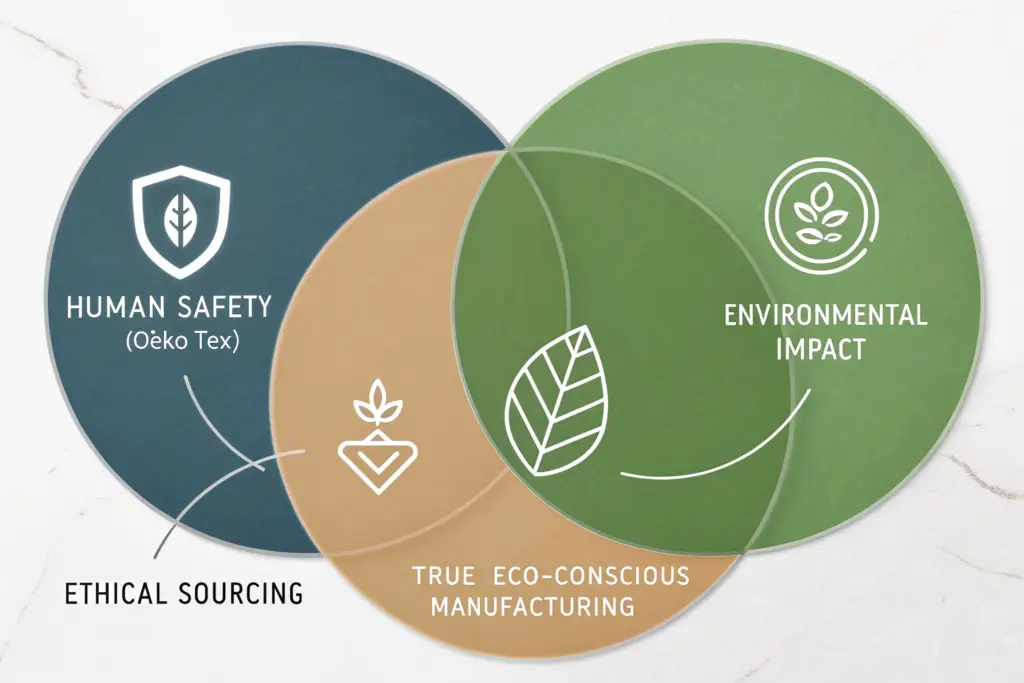
As a brand committed to sustainability, you face a complex web of claims: recycled fabrics, waterless dyeing, carbon-neutral shipping. In this landscape, OEKO-TEX certification is a constant, trusted presence. But is it the definitive answer to creating truly eco-conscious golf apparel? The truth is, OEKO-TEX is a critical, non-negotiable part of the answer—a foundational pillar of safety and responsible chemistry—but it is not the entire solution. Viewing it as the finish line, rather than a crucial checkpoint, is a common and limiting mistake.
OEKO-TEX is the definitive answer for human-ecological safety—guaranteeing the final product is free from harmful levels of chemicals for the wearer and the factory worker. However, true eco-conscious manufacturing requires a broader system that also addresses environmental impact (water, energy, waste), material sourcing ethics, and end-of-life, where standards like GOTS, bluesign®, and GRSC come into play. For the modern golf brand, OEKO-TEX is the essential baseline upon which a comprehensive sustainability strategy must be built.
Let’s map out where OEKO-TEX fits perfectly and where you need to look further.
What Does OEKO-TEX Actually Guarantee for the Planet and the Wearer?
It’s crucial to understand the precise scope of OEKO-TEX STANDARD 100. Its core mission is product safety. It tests the final product for over 100 regulated and non-regulated substances harmful to human health, ensuring they are absent or below strict limits. This is a profound achievement for eco-consciousness because:
- It Protects the Wearer: It ensures the golfer is not exposed to skin irritants, allergens, or toxins during hours of sweaty activity.
- It Protects the Worker: By restricting harmful substances in the final product, it inherently reduces worker exposure to these chemicals in the manufacturing process, especially in dyeing and finishing.
- It Prevents Water Pollution Downstream: By prohibiting or limiting substances like heavy metals and certain dyes, it helps ensure that factory wastewater (if treated) is less toxic.
This focus on output safety is invaluable. For example, a golf polo can be made from recycled polyester (an environmental win) but dyed with harmful AZO dyes (a human health loss). OEKO-TEX catches that failure. This is why at Shanghai Fumao, we consider it the non-negotiable first step for any “eco” line—you cannot claim responsibility if your product is chemically unsafe.
Where Are the Limits of Its Environmental Scope?
OEKO-TEX does not certify:
- The use of recycled or organic materials. A fabric can be 100% virgin polyester and be OEKO-TEX certified if it passes chemical tests.
- Water or energy consumption during manufacturing.
- Carbon footprint or greenhouse gas emissions.
- Social welfare or fair labor practices in the factory.
- Biodegradability or recyclability of the product at end-of-life.
This is the critical distinction: OEKO-TEX is about chemical safety, not overall environmental sustainability. It answers “Is this product safe to wear?” not “Was this product made in an environmentally friendly way?”
How Do You Build on OEKO-TEX for a Complete Eco-Strategy?
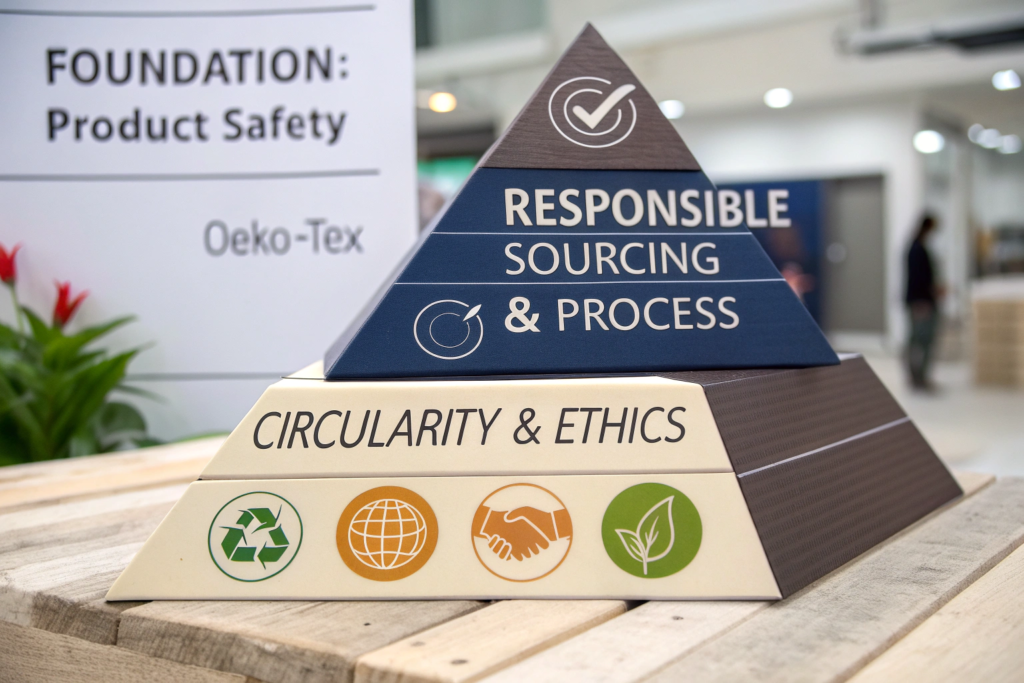
The most credible golf apparel brands use OEKO-TEX as their safety foundation and then layer on additional certifications and practices to address the full product lifecycle. Think of it as building a house: OEKO-TEX is the concrete slab—essential for stability and safety—but you still need walls, a roof, and insulation.
A comprehensive strategy involves three additional pillars:

1. Material Origin and Environmental Impact (The Inputs)
This is where you choose what your product is made from.
- GOTS (Global Organic Textile Standard): The gold standard for organic fibers (like cotton). It covers environmental and social criteria along the entire supply chain, from harvesting to labeling. A GOTS-certified organic cotton polo is also typically OEKO-TEX certified as part of its requirements.
- Recycled Content Standards (GRS, RCS): These verify the chain of custody and percentage of recycled materials (e.g., recycled polyester from plastic bottles).
- bluesign®: A system that focuses on the input stream, approving safe and environmentally friendly chemicals and processes for textile manufacturing. It’s more focused on the factory’s environmental management than the final product.
2. Manufacturing Ethics and Social Responsibility (The Process)
OEKO-TEX doesn’t audit labor conditions. For this, you need:
- Social Compliance Audits (e.g., SMETA, BSCI): These ensure fair wages, safe working hours, and ethical treatment of workers in the final assembly factory.
- Fair Trade Certification: Goes further, ensuring a premium is paid back to worker communities.
3. Circularity and End-of-Life (The Output’s Future)
This is the next frontier. OEKO-TEX says nothing about what happens to the garment after use. Strategies here include:
- Designing for durability and mono-material construction (easier to recycle).
- Take-back programs.
- Exploring biodegradable material options where performance allows.
A factory partner that understands this matrix is key. Our approach at Shanghai Fumao is to offer OEKO-TEX as our baseline and guide clients through integrating GOTS-certified organic cottons or recycled fabrics into their certified production system, creating a layered, verifiable story.
What Are the Market Risks of Using OEKO-TEX as Your Only "Eco" Claim?
In a market of increasingly savvy consumers and regulators, leaning solely on OEKO-TEX for your environmental credentials is a practice known as “greenwashing lite.” It can backfire.
If you market a golf shirt as “eco-friendly” and only highlight OEKO-TEX, a knowledgeable consumer or journalist may ask: “But is it made from recycled materials? How much water was used? What about the factory’s carbon emissions?” Your single claim then appears insufficient or even deceptive. The brand can be accused of using a human safety standard to imply broader environmental stewardship.
The safe and powerful approach is to be precise: “OEKO-TEX certified for your safety, and made from 50% recycled polyester to reduce plastic waste.” This combines a safety benefit with an environmental action, creating a credible, multi-faceted story. For instance, we helped a client launch a line marketed as “Safe on Skin, Kind on Planet,” pairing OEKO-TEX with post-consumer recycled fabric and clean dyeing processes—a combination that resonated powerfully at retail.
How Do Retailer Requirements Reflect This Broader View?
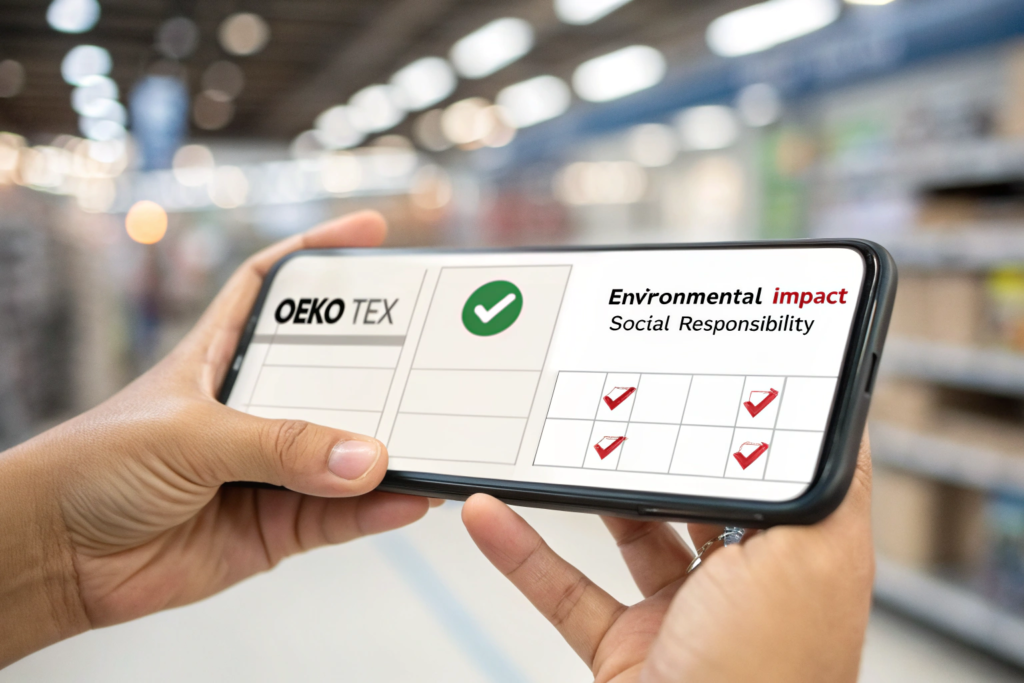
Leading retailers are now asking for this layered approach. Their vendor questionnaires often have separate sections for:
- Product Safety & Chemistry (where OEKO-TEX fits)
- Environmental Management (where recycled content, water stewardship, and carbon data fit)
- Social Compliance (where audit reports fit)
Having only an OEKO-TEX certificate leaves the other sections blank, putting you at a disadvantage against competitors with more complete documentation.
How to Find a Factory Partner for Truly Eco-Conscious Production?
Your factory is your most important ally in this journey. You need a partner that does more than just attach a certificate; they must have the systems and knowledge to navigate this complex landscape.
Ask these revealing questions:
- “Can you produce using OEKO-TEX certified fabrics that are also GOTS organic or recycled (GRS)?” This tests their material network.
- “What measures do you take in your own factory to reduce water and energy consumption?” This probes their internal environmental management.
- “Can you provide a recent social compliance audit report for your facility?” This addresses ethics.
- “How do you help clients build a layered sustainability story?” This reveals their strategic capability as a partner.
A factory that is merely a certificate processor will struggle with these questions. A true partner, like our team, will have answers rooted in practice: we track and reduce our in-house resource use, can source multi-certified materials, and actively collaborate with clients to build credible, market-ready narratives around their products.
Is This Approach Feasible for a Growing Brand?
Absolutely. You don’t need to do everything at once. A smart, phased approach is:
- Phase 1: Safety First. Ensure your entire line is OEKO-TEX certified. This is non-negotiable and builds trust.
- Phase 2: Material Evolution. Transition one best-selling style to a combination of OEKO-TEX + Recycled Content or OEKO-TEX + GOTS Organic Cotton.
- Phase 3: Process Improvement. Work with your factory to measure and reduce waste in your specific production runs.
- Phase 4: Full Transparency. Communicate the entire journey clearly to your customer.
This scalable path, supported by the right factory, makes true eco-conscious manufacturing achievable and authentic.
Conclusion
OEKO-TEX is not the complete answer to eco-conscious golf apparel manufacturing, but it is an absolutely essential part of the answer. It provides the critical, non-negotiable foundation of human-ecological safety. Without it, no product can legitimately claim to be responsible.
The complete answer lies in a holistic strategy that uses OEKO-TEX as the safety cornerstone and builds upon it with ethical material sourcing, environmentally optimized manufacturing processes, and fair labor practices. For the modern golf brand, this layered approach is no longer a niche luxury; it is a market expectation and a blueprint for long-term resilience and brand equity.
Start with the unwavering commitment to safety that OEKO-TEX represents. Then, partner with a manufacturer that can help you build upwards from that solid base. If you are ready to develop golf apparel that is genuinely safe, responsible, and market-ready, we are here to be that partner. Contact Shanghai Fumao’s Business Director Elaine today. Let’s discuss how to integrate OEKO-TEX certification with other sustainable practices to build a credible, competitive, and truly eco-conscious product line for your brand. Reach her at elaine@fumaoclothing.com. Let's craft a legacy of responsible performance.