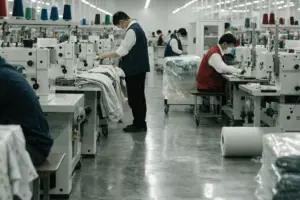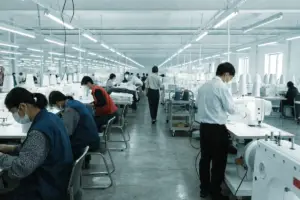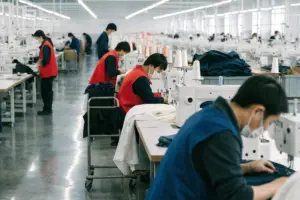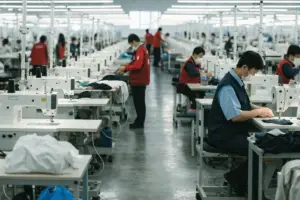
Quoting a custom clothing order involves far more than just multiplying the fabric cost by the number of pieces. Many emerging brands focus solely on the FOB (Free On Board) price per unit, only to be blindsided by a dozen additional costs that emerge throughout the development and logistics process. Accurately calculating the total landed cost—the final amount you pay to have sellable goods in your warehouse—is the difference between a profitable collection and a financial failure.
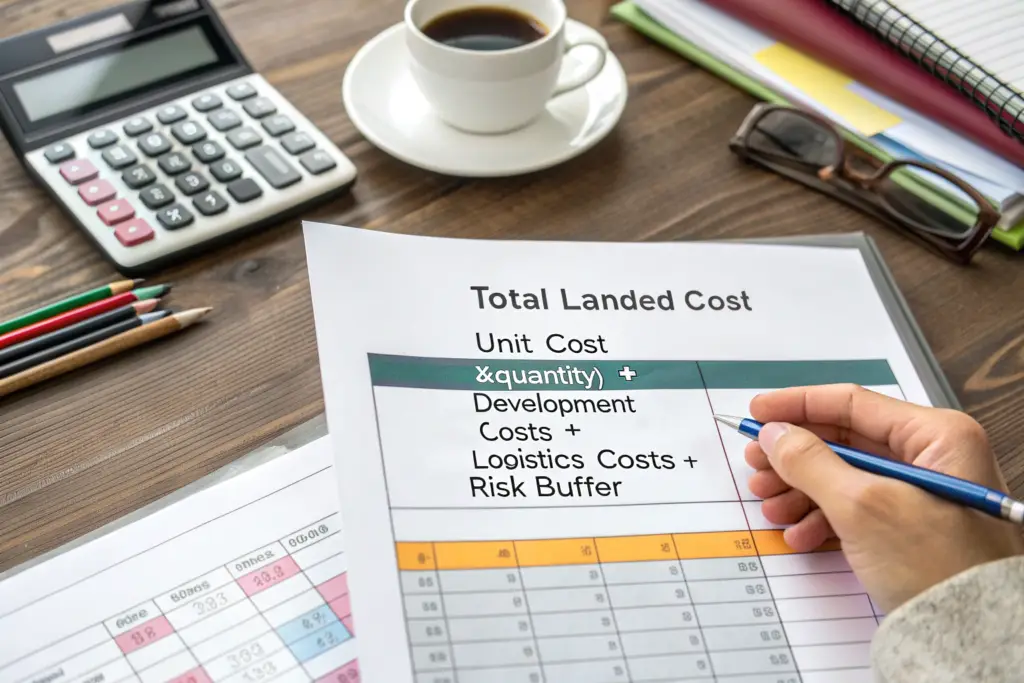
To calculate the total cost of custom clothing production, you must sum all expenses from development through delivery: fabric & trims, labor & manufacturing, samples & testing, logistics & duties, and overheads like agent fees. The formula is: Total Landed Cost = (Unit Cost x Quantity) + Development Costs + Logistics Costs + Risk Buffer.
This comprehensive guide will break down each cost component with real-world examples, providing a clear framework to build an accurate budget and negotiate effectively with suppliers.
What Constitutes the Core Manufacturing Cost (FOB)?
The FOB (Free On Board) price is the foundational cost, covering everything to get your goods onto the ship at the origin port. It’s the most quoted figure but is itself an aggregate of several key sub-costs. Understanding its composition allows you to negotiate smarter, not just cheaper.
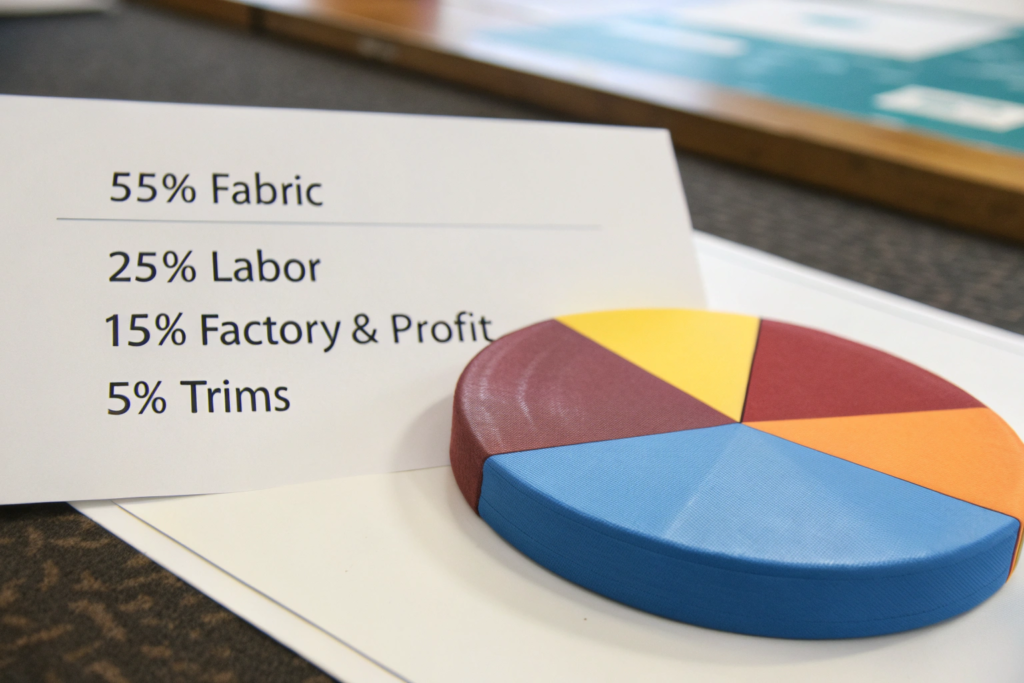
The core FOB cost consists of three primary elements: raw material costs (fabric, thread, trims), direct labor costs (cutting, sewing, finishing), and factory overheads (profit margin, utilities, management). A precise FOB calculation requires detailed specifications in your tech pack.
Let’s dissect what goes into each slice of that pie.
How to Accurately Calculate Fabric and Trim Costs?
This is typically 50-70% of the FOB cost. The calculation is:
Fabric Cost = (Garment Fabric Consumption in meters/yards x Price per meter/yard) + Wastage %
- Fabric Consumption: Your factory’s pattern maker determines this based on your tech pack and marker efficiency. For a simple men’s t-shirt, it might be 1.5 meters. For a complex coat, it could be 3 meters.
- Price per Meter: Varies wildly by material (e.g., basic cotton vs. technical Gore-Tex). Always get fabric swatches and quotes from the factory’s mill.
- Trims: Don’t forget zippers, buttons, labels, hangtags, interlining, and thread. A client once overlooked the cost of custom embellished buttons at $0.80 per piece, adding $1,600 to an order of 2,000 units.
What is Included in Labor and Overhead?
- Direct Labor: The cost per hour of operators for cutting, sewing, and finishing. Complex designs with many panels (seams) or special stitches (flatlock, bartack) increase labor time.
- Factory Overhead & Profit: This covers the factory’s rent, electricity, machinery depreciation, quality control staff, and their profit margin (typically 10-20%). A professional factory like Shanghai Fumao will provide a transparent cost breakdown upon request, showing how the FOB is built, which builds trust and allows for value engineering discussions.
What Are the Often-Forgotten Pre-Production Costs?
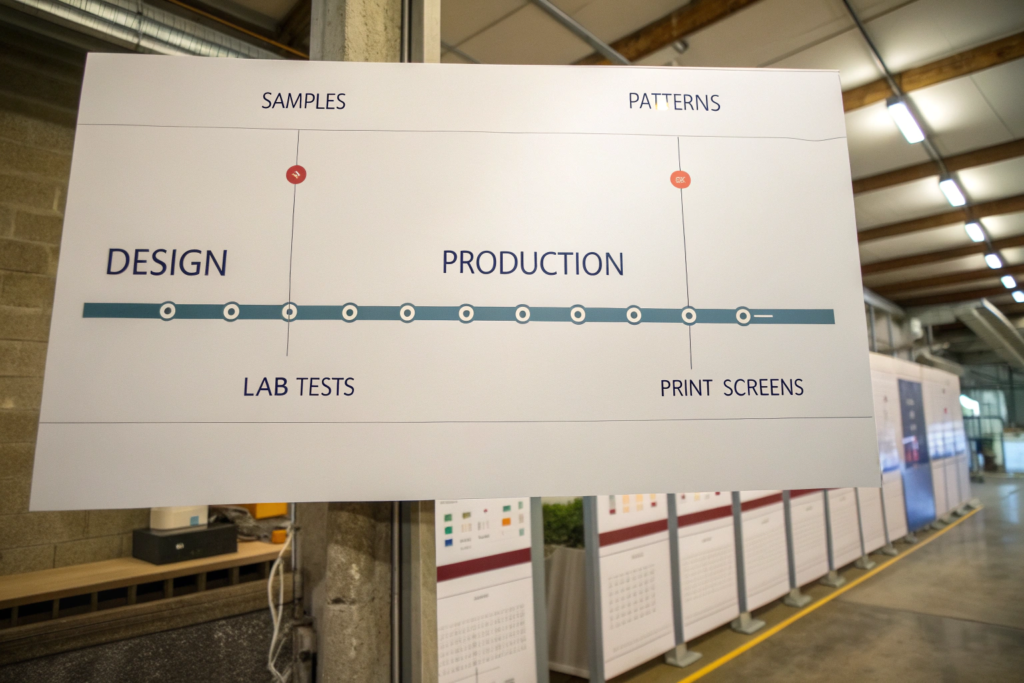
Before a single piece of bulk fabric is cut, significant costs are incurred to perfect your design and ensure production feasibility. These pre-production costs are usually one-time fees that can be substantial, especially for new brands.
The often-forgotten pre-production costs include sampling (proto, fit, PP samples), pattern making and grading, lab testing for fabrics (colorfastness, shrinkage), and development of custom trims or prints. These are essential investments to de-risk bulk production.
Budgeting for these items separately prevents surprises.
Why are Samples a Necessary Cost, Not a Free Service?
Each sample round involves labor, materials, and skilled technicians. Expect to pay for:
- Proto Sample: $50-$150 to check design.
- Fit Sample: $80-$200 to perfect sizing.
- Pre-Production (PP) Sample: $100-$300 (made from bulk fabrics).
Some factories waive sample fees for confirmed large orders, but it’s standard practice to pay for them, especially for new clients. Last year, a brand went through four fit sample rounds for a tailored blazer, incurring $600 in sample costs. This was far cheaper than producing 500 ill-fitting blazers.
What are Lab Tests and Why are They Crucial?
If you care about quality and compliance, lab testing is non-negotiable. Tests include:
- Colorfastness (to washing, rubbing, light).
- Shrinkage (after washing).
- Fabric Composition verification.
- Performance tests (water resistance, UV protection).
Costs range from $50-$300 per test. A European client once skipped flammability testing on children’s sleepwear to save $200. The entire shipment was rejected at EU customs, resulting in a $15,000 loss—a catastrophic saving.
How Do Logistics and Duties Become a Major Factor?
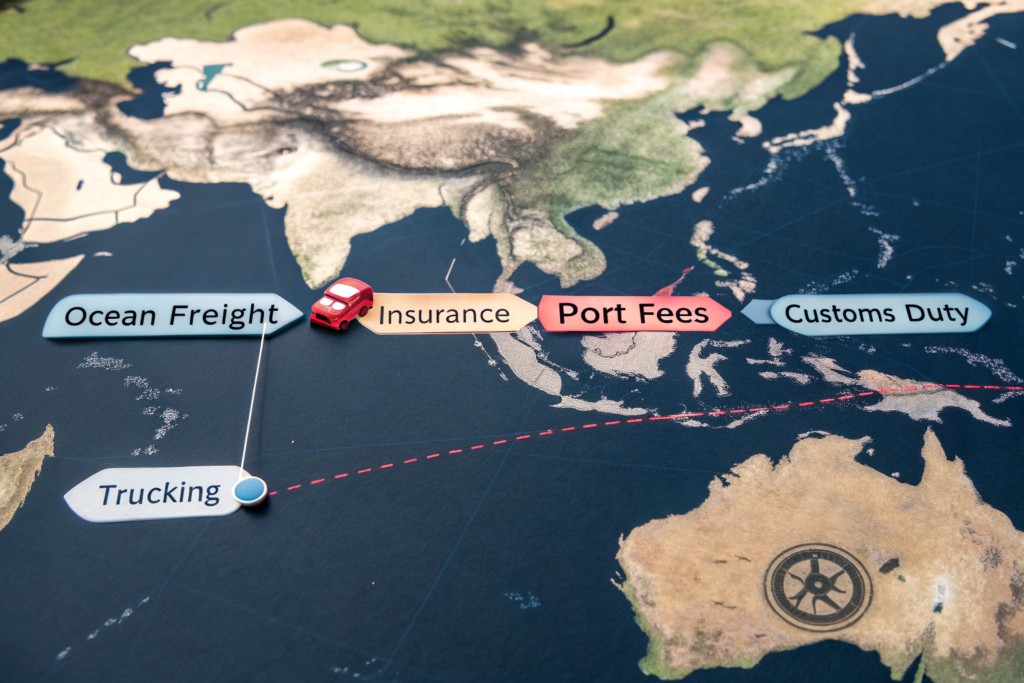
The journey from the factory floor to your warehouse involves a maze of fees that can add 15-40% to your FOB cost. This is where the FOB price transforms into the Landed Cost. Ignoring this stage is the single biggest budgeting mistake.
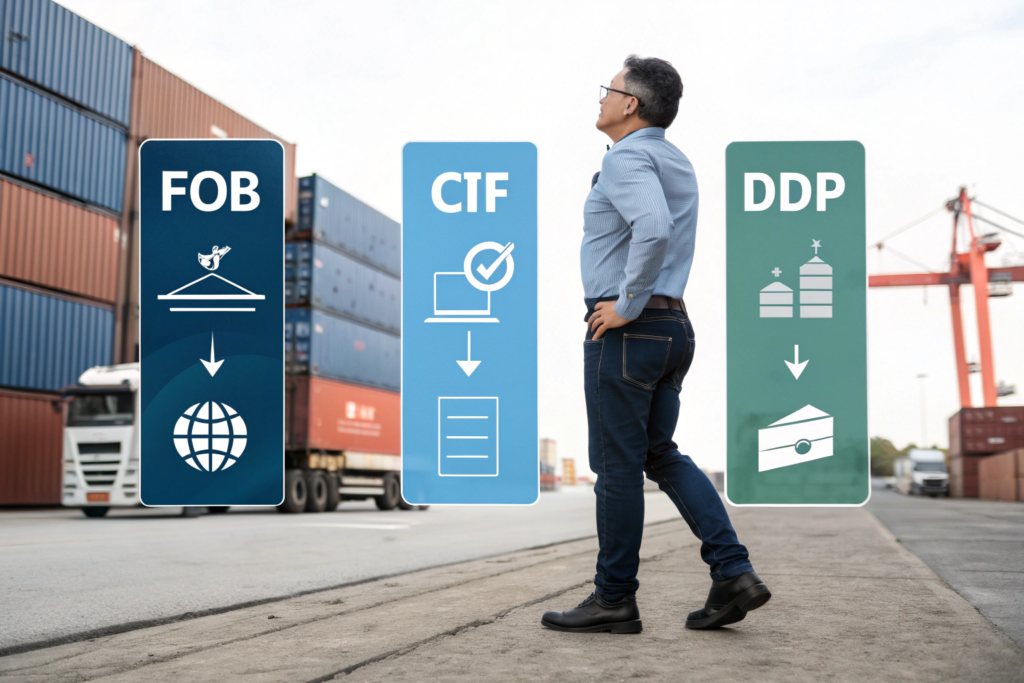
Logistics and duties become a major factor through international freight charges, insurance, customs brokerage, import duties & taxes, and domestic delivery. These are determined by your chosen Incoterms (e.g., FOB, CIF, DDP) and your destination country.
Your choice of shipping terms dictates which of these costs you pay.
What’s the Difference Between FOB, CIF, and DDP Costs?
- FOB (Your Risk): You pay FOB price + freight + insurance + customs clearance + duties + domestic trucking. You control the process but bear all risk and hidden fees (e.g., demurrage if customs is slow).
- CIF (Partial Risk): Factory pays freight & insurance to your port. You still handle customs, duties, and final delivery. Offers less control over shipping quality.
- DDP (Factory’s Risk): The factory quotes a single, all-inclusive price to your door. This is the simplest for budgeting. For example, our DDP service at Shanghai Fumao provides clients with one clear price covering everything from our production line to their US warehouse, eliminating budgeting nightmares.
How to Calculate and Pay Import Duties?
Duties are a percentage of your goods’ declared value. The rate depends on the HTS (Harmonized Tariff Schedule) code for your product type, country of origin, and destination.
Duty Cost = (FOB Value + Freight Cost + Insurance) x Duty Rate
For example, US duty on men’s cotton knit t-shirts (HTS 6109.10.00) is 16.5%. On a $10,000 FOB shipment with $1,500 freight, duty would be about $1,897.50. Use your country’s customs website or a customs broker to determine the correct rate.
Should You Include a Contingency Buffer?
No production run goes 100% perfectly. From fabric defects to slight order quantity overruns, unplanned expenses are a reality of manufacturing. A prudent budget includes a contingency buffer to absorb these shocks without jeopardizing your project’s financial viability.
Yes, you should always include a contingency buffer of 5-10% of your total estimated landed cost. This covers fabric overage, unexpected rework, currency fluctuation, and minor logistical surcharges. It is not a slush fund but a risk management tool.
This buffer protects you from two of the most common surprises.
Why is Fabric "Overage" Standard?
Factories order 3-10% more fabric than the theoretical consumption to account for defects, pattern alignment (matching stripes/plaids), and cutting mistakes. This "overage" is usually billed to you. If your contract states "fist-quality goods only," you shouldn’t pay for defects, but you do pay for the usable extra yardage needed for efficient cutting.
How to Plan for Quality-Related Rework?
Even with the best QC, a small percentage of goods may need repair. Your contract should define an AQL (Acceptable Quality Level) standard (e.g., AQL 2.5). If the defect rate is within AQL, you typically accept the goods. If it exceeds AQL, the factory should repair or replace at their cost. However, the buffer covers the time and potential minor costs of managing this process. One brand’s order had a correctable stitch flaw in 5% of units. The factory fixed them, but the buffer covered the cost of a delayed container and extra inspection time.
Conclusion
Calculating the total cost of custom clothing production is a meticulous exercise in foresight and detail. It requires looking beyond the unit FOB price to account for the essential investments in development, the inevitable complexities of global logistics, and the wise inclusion of a contingency fund. By building a comprehensive cost model that includes FOB, pre-production, logistics/duties, and a buffer, you transform your sourcing from a hopeful guess into a controlled, professional operation.
This disciplined approach not only ensures profitability but also empowers you to negotiate from a position of knowledge. It allows you to discuss true value engineering with your factory and make informed trade-offs. At Shanghai Fumao, we partner with clients to build these transparent, end-to-end cost analyses because we believe an informed client is a successful partner. To get a detailed and accurate cost breakdown for your next collection, contact our Business Director, Elaine, at elaine@fumaoclothing.com.