For fashion brands making large-scale investments in overseas production, securing a Letter of Credit (L/C) is a critical financial safeguard. Unlike standard T/T payments, an L/C places a bank's guarantee between you and the supplier, fundamentally shifting the risk dynamics. In an industry where cash flow is king and trust must be earned, an L/C provides a structured, document-driven mechanism to protect your capital from common, catastrophic risks.
A Letter of Credit (L/C) protects your brand's clothing investment by ensuring you only pay the supplier when they provide verifiable evidence—via bank-scrutinized documents—that they have shipped conforming goods as specified in the contract. It mitigates risks of fraud, non-performance, and quality deviations before payment is released.
This article explains the mechanics of an L/C, how it acts as a risk management tool, and provides a clear framework for deciding when its benefits outweigh its costs for your specific order.
How Does an L/C Create a Bank-Guaranteed Safety Net?
An L/C transforms your payment from a direct transfer of trust in a factory to a transaction guaranteed by the international banking system. It introduces a neutral third party—the bank—that enforces the terms of your contract through documentary evidence.
An L/C creates a safety net by making the supplier's bank (and ultimately, your bank) responsible for verifying that the supplier has fulfilled their contractual obligations before any funds are transferred. Your payment is conditional on the presentation of precise, pre-agreed shipping and compliance documents.
This documentary process is the core of the L/C's protective power. Let's break down the key players and the documentary chain.

What Are the Key Roles in an L/C Transaction?
- Applicant (Buyer/Your Brand): You apply to your bank to open the L/C.
- Issuing Bank (Your Bank): Your bank issues the L/C, guaranteeing payment to the supplier upon compliant document presentation.
- Beneficiary (Supplier/Factory): The party who receives payment.
- Advising Bank (Supplier's Bank): Authenticates the L/C and advises it to the supplier.
- Negotiating Bank: Often the same as the Advising Bank, it checks the documents and claims payment from the Issuing Bank.
The banks act as intermediaries that only care about one thing: documentary compliance, not the physical quality of the goods. This is both a strength and a critical point of understanding.
What is the "Documentary Chain" That Triggers Payment?
Payment is released only when the supplier presents a specific set of documents to their bank. These typically must include:
- Commercial Invoice: Matching the L/C value and description.
- Packing List: Detailing quantities per carton.
- Bill of Lading (B/L): The title document proving shipment.
- Inspection Certificate: Often from a pre-agreed third-party agency (e.g., SGS, Bureau Veritas), confirming the goods passed AQL standards before shipment.
- Certificate of Origin.
The bank meticulously checks that these documents match exactly the requirements stipulated in the L/C. Any discrepancy (a typo, a missing stamp) can give the bank grounds to refuse payment, forcing the supplier to correct the issue. This gives you, the buyer, immense leverage: the goods cannot be paid for unless they are shipped and an independent party confirms they meet quality standards, if you required that certificate.
What Specific Investment Risks Does an L/C Mitigate?
Investing in a large clothing production run exposes you to several high-impact risks. An L/C is uniquely designed to address these by tying payment to performance proofs, rather than promises.
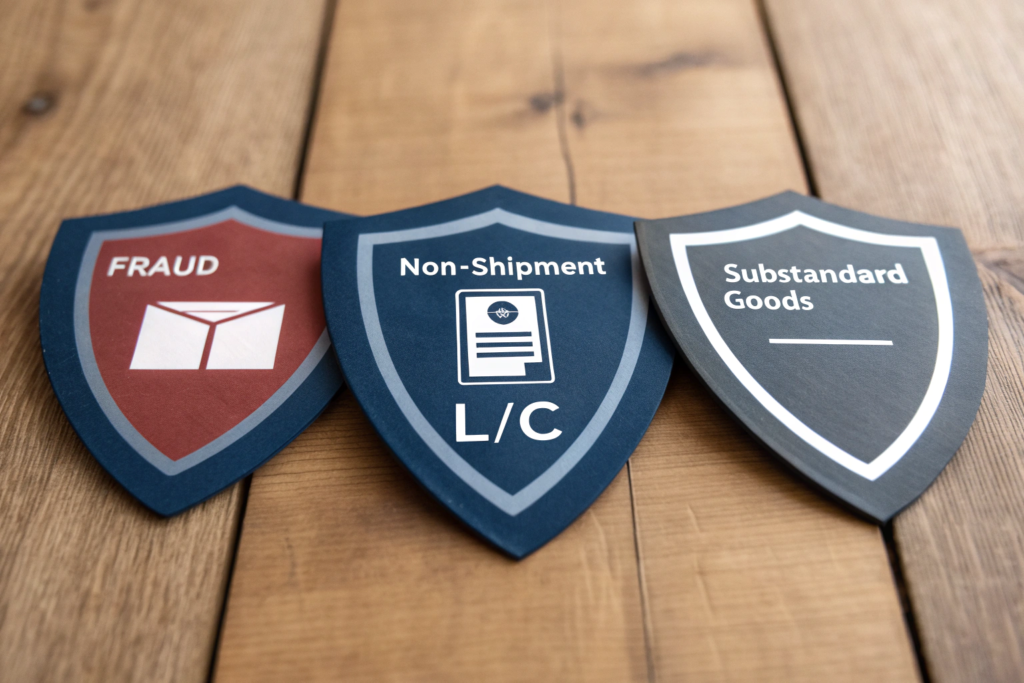
An L/C specifically mitigates the risk of advance payment fraud, supplier non-shipment after payment, shipment of grossly non-conforming goods, and political or transfer risks in the supplier's country. It formalizes quality and timing requirements into bank-enforceable conditions.
Understanding these protections in detail helps justify the L/C's administrative burden.
How Does It Prevent Fraud and Non-Shipment?
With a standard T/T payment of a 30-50% deposit, you send money based on trust. A fraudulent entity can disappear. With an L/C, no payment is made from your account until after the supplier provides a Bill of Lading issued by a shipping company, which is a legal proof that the goods are on a vessel. The bank's guarantee is to pay upon document proof, not before. This eliminates the risk of paying for goods that never ship. Last year, a client of ours was negotiating a $120,000 order with a new factory that resisted an L/C and demanded 50% T/T upfront. Our team at Shanghai Fumao advised the client to insist on the L/C. The factory subsequently withdrew, revealing they likely could not meet the bank's scrutiny or fulfill the order, saving the client from a significant potential fraud.
How Does It Enforce Quality and Compliance Before Payment?
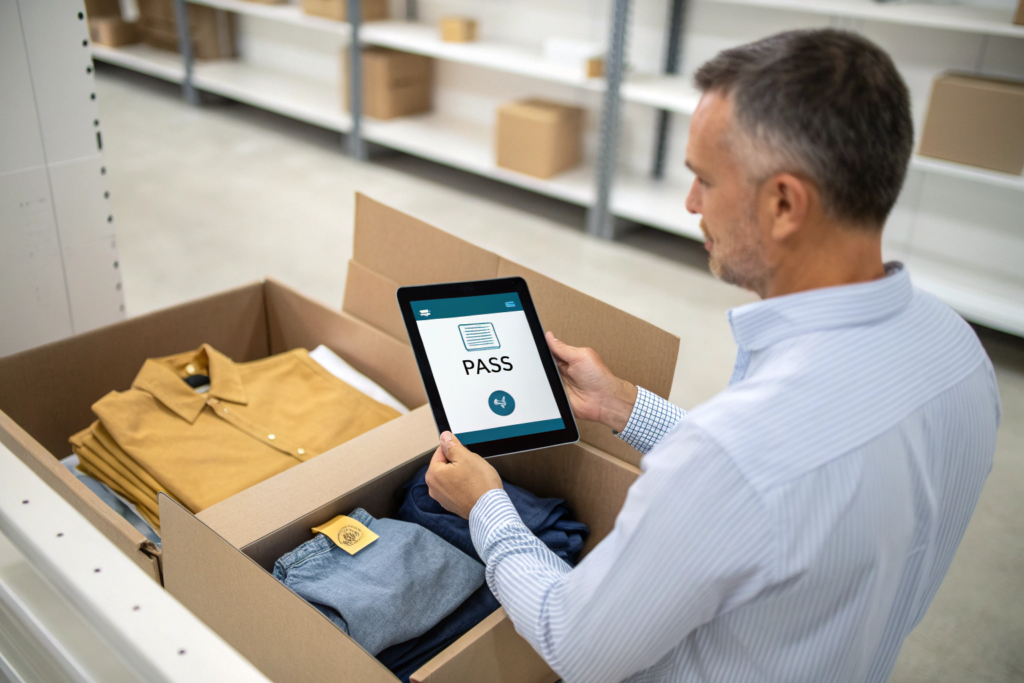
This is the L/C's most powerful feature for protecting product investment. You can (and must) stipulate in the L/C terms that payment requires an Inspection Certificate issued by a named, independent third-party inspection company (e.g., "Pre-shipment inspection report from Intertek indicating pass against AQL 2.5"). The factory cannot get paid without passing this inspection. This moves quality assurance from a hopeful request to a contractual prerequisite for payment. Without an L/C, if you discover quality issues after paying a 70% balance, your leverage to negotiate is severely diminished.
When Does Using an L/C Make Financial Sense?
An L/C is not free; it involves bank fees (typically 0.5%-2% of the L/C value), administrative work, and requires precision. Therefore, it's not optimal for every order. The decision should be based on a clear risk-versus-cost analysis.
Using an L/C makes financial sense when the order value is high enough to justify the fees, when dealing with a new or higher-risk supplier, when sourcing from politically or economically unstable regions, or when the goods are highly customized and difficult to resell.
Weighing these factors will guide you to the right choice.
What is the Minimum Order Value to Justify an L/C?
There's no fixed rule, but as a guideline, the value of risk mitigation should exceed the cost. If an L/C costs $1,500 in bank fees but protects a $30,000 deposit from fraud or a $100,000 total order from failure, it's justified. Many brands use a threshold, such as orders over $50,000 or any first order with a new supplier regardless of size. For smaller, repeat orders with a trusted partner like Shanghai Fumao, simpler T/T terms are more efficient, as the established relationship and track record reduce the need for bank intermediation.
Are There Alternatives That Offer Similar Protection?
Yes, but with trade-offs:
- Escrow Services (e.g., through Alibaba): Holds payment until you confirm receipt. This protects against non-shipment but often lacks the deep documentary control and quality inspection linkage of an L/C. It's better for smaller transactions.
- Standby Letter of Credit (SBLC): Functions more like a performance bond; the bank pays only if the supplier fails. It's less common for standard trade.
- Documentary Collection (D/P): Banks handle documents but do not guarantee payment. It's cheaper than an L/C but offers less security.
For comprehensive protection of a major investment, a well-drafted Commercial L/C remains the gold standard.
What Are the Common Pitfalls and How to Avoid Them?
The protective power of an L/C is entirely dependent on its precise wording. A poorly drafted L/C can be worse than no L/C at all, giving a false sense of security while leaving you exposed to documentary tricks or unfulfilled requirements.
Common pitfalls include ambiguous document requirements, unrealistic deadlines, failing to include an independent inspection clause, and not allowing enough time for document review and correction. Avoiding these requires meticulous drafting and expert review.
Your defense is in the details. Collaborate closely with your bank and, if possible, a freight forwarder or trade advisor when drafting.

How to Draft an Iron-Clad L/C for Garment Orders?
- Be Specific in Product Description: Instead of "men's jackets," write "Men's quilted nylon jackets as per Proforma Invoice #PI-2023-101 and Tech Pack v2.0 dated [Date], order quantity 2,000 pcs."
- Mandate a Clean, On-Board Bill of Lading: Specify this to ensure the goods are actually loaded and the carrier has no major issues with the cargo.
- Incorporate the Inspection Certificate Requirement: Crucially, name the inspection company and the standard. E.g., "Certificate of Inspection issued by SGS, Shanghai branch, evidencing that goods conform to AQL Level II, Single Sampling Plan with Major Defects AQL 2.5 and Minor Defects AQL 4.0."
- Set Achievable Dates: Allow buffer time between the shipment date, the document presentation date, and the L/C expiry date. A rushed schedule invites discrepancies.
One of our clients once had an L/C rejected because the inspection certificate was dated one day after the Bill of Lading date—an impossible sequence that suggested the inspection was faked. The bank's strict enforcement of document logic protected the client.
Who Should Review the L/C Before It's Opened?
Do not treat this as a bank-only task. Your production manager or sourcing agent must review it to ensure commercial and logistical terms align with the contract. The nominated inspection company should confirm they can meet the stipulated requirements and timeline. Finally, send a copy to the supplier before it is formally issued to ensure they agree they can meet all conditions. This pre-issuance review prevents 80% of future disputes.
Conclusion
A Letter of Credit is a powerful financial instrument that, when used strategically, transforms risk from an amorphous worry into a managed, documented process. It protects your clothing investment by ensuring your capital is only exchanged for verifiable proof of performance—correct shipment and, critically, verified quality. While its cost and complexity mean it's not for every transaction, for high-value orders, new supplier relationships, or high-risk scenarios, it provides an unparalleled safety net that no other common payment method can match.
Ultimately, an L/C is a tool for enabling confident growth. It allows you to scale your production and explore new supply chains with a predefined level of security. At Shanghai Fumao, we work transparently with clients who choose to use L/Cs, ensuring all documentation is precise and timely, because we understand that your financial security is the foundation of a long-term partnership. To discuss whether an L/C is the right choice to protect your next major order, contact our Business Director, Elaine, at elaine@fumaoclothing.com.