You’ve received a 15-week production timeline for your custom apparel order and you’re wondering if this is reasonable or if the manufacturer is being overly conservative. In today’s fast-paced fashion environment, this might seem lengthy, but understanding the factors behind this timeline helps you make informed decisions.
A 15-week production timeline is completely normal and often necessary for custom apparel manufacturing, particularly for orders involving custom fabric development, complex construction, or comprehensive quality requirements. This timeframe represents the new industry standard for quality-focused custom production rather than an exception, reflecting the realities of modern supply chains and customer expectations for both customization and quality.
Let’s examine why 15 weeks has become the benchmark for many custom apparel projects and what specific factors make this timeline necessary.
What Specific Factors Justify A 15-Week Timeline?
Multiple interdependent processes requiring sequential completion make the 15-week timeline necessary for custom apparel that meets quality expectations and design specifications.
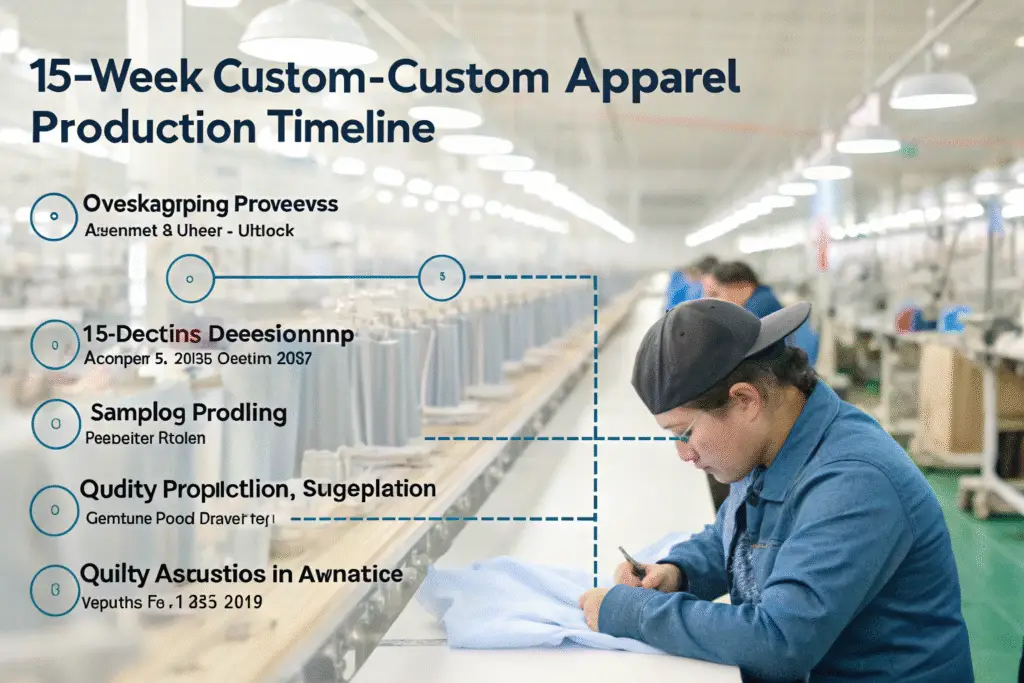
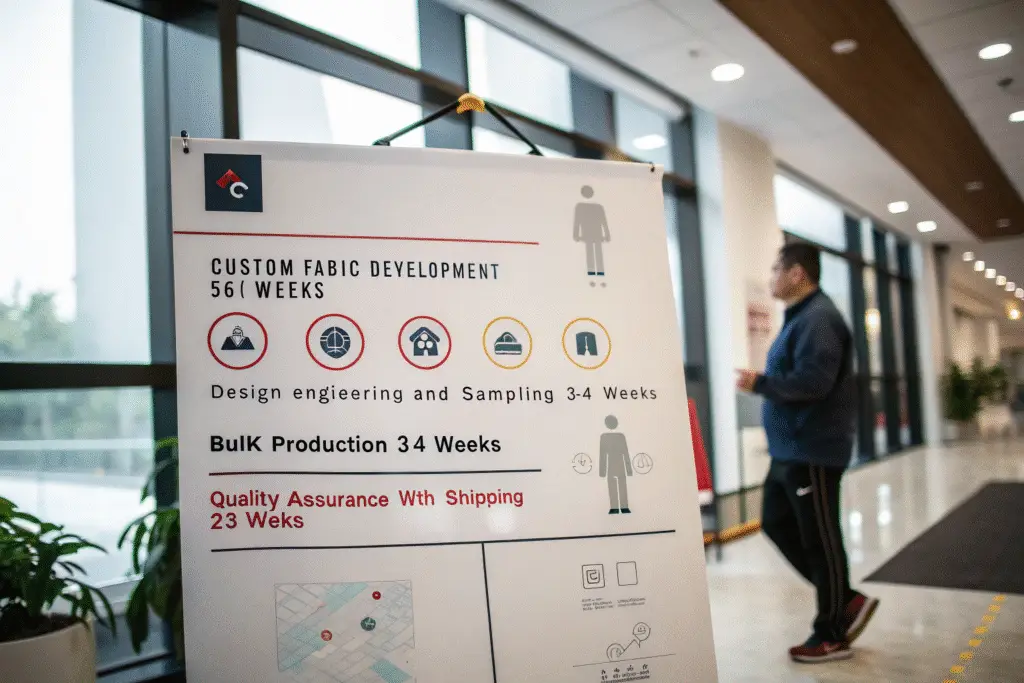
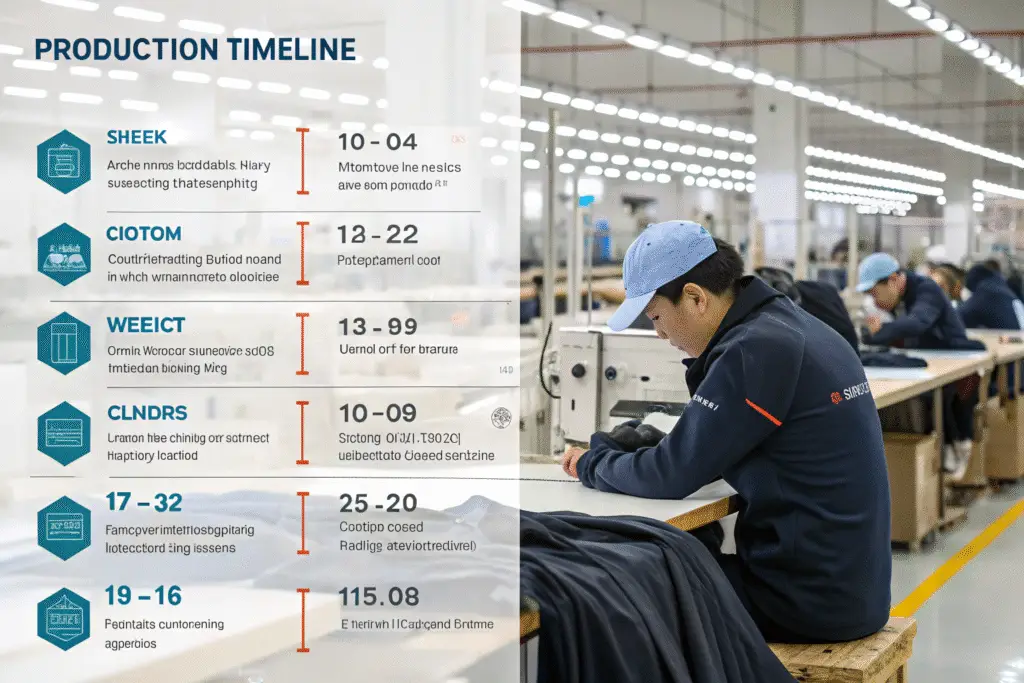
A 15-week timeline typically allocates: custom fabric development (5-6 weeks), design engineering and sampling (3-4 weeks), bulk production (3-4 weeks), and quality assurance with shipping (2-3 weeks). These phases often cannot overlap significantly without compromising results. We recently completed a technical outerwear project that perfectly illustrates this timeline – their custom 3-layer waterproof fabric required 5 weeks to develop, the complex pattern engineering needed 3 weeks, and the specialized construction demanded 4 weeks of production time, totaling 15 weeks for a superior final product.
Why Does Custom Fabric Development Take 5-6 Weeks?
Custom fabric development is inherently time-consuming, involving multiple stages that cannot be accelerated without compromising quality or performance. The process includes: fiber selection and sourcing (1-2 weeks), yarn development and testing (1-2 weeks), fabric formation (weaving/knitting) and finishing (2-3 weeks), and performance verification (1 week). Each stage requires specialized expertise and equipment, often at different facilities. This explains why manufacturers offering significantly faster timelines for custom fabrics are either cutting corners or being unrealistic about actual requirements. The International Textile Manufacturers Federation confirms that proper fabric development consistently requires this timeframe.
What Makes Design Engineering Time-Consuming?
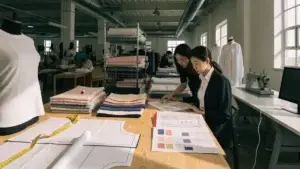
Custom design engineering extends timelines through pattern creation, sample development, and fit refinement that standard garments avoid. Unlike adapting existing patterns, custom designs require: original pattern drafting (3-5 days), toile development and fitting (4-7 days), sample creation in actual materials (3-5 days), and refinement iterations (3-5 days per revision). This process ensures the design translates properly from concept to wearable garment, particularly important for innovative silhouettes or technical designs. The American Apparel & Footwear Association emphasizes that proper design engineering cannot be rushed without compromising fit and function.
When Is A 15-Week Timeline Actually Necessary?
Specific project characteristics make the 15-week timeline not just reasonable but essential for achieving the quality and customization levels that define true custom apparel.
The 15-week timeline becomes necessary when projects involve: custom-developed textiles, technical or performance requirements, complex multi-component construction, or comprehensive quality verification. A activewear brand learned this when they initially sought a 10-week timeline for their custom compression wear – after understanding that proper fabric development, pattern engineering for active fit, and performance testing required 15 weeks, they adjusted their planning and achieved a product that outperformed competitors in both comfort and durability.
What Customization Levels Demand Extended Timelines?
Certain customization levels inherently require 15-week timelines, including: fully custom fabric development, original silhouette creation, technical performance features, and intricate design details. Each customization level adds time: custom fabrics (adds 2-3 weeks versus stock), original patterns (adds 1-2 weeks versus adaptation), technical features like waterproofing or stretch recovery (adds 1-2 weeks), and design complexity like multiple components or embellishments (adds 1-2 weeks). These elements combine to make 15 weeks realistic for truly custom apparel rather than adapted standard designs.
How Do Quality Standards Impact Timeline?
Comprehensive quality standards extend timelines through additional testing, inspection points, and verification processes that mass production often shortcuts. True custom apparel typically requires: raw material validation (2-3 days), in-process quality checks (adds 2-3 days), performance testing (3-5 days), and final inspection with detailed documentation (2-3 days). These quality investments prevent the failures that often plague rushed productions but require time for proper execution. Our clients consistently find that this quality-focused approach reduces returns by 30-40% despite the longer initial timeline.
How Does This Compare To Industry Standards?
The 15-week timeline aligns with industry standards for quality custom manufacturing, though faster options exist for less complex projects or when compromising on certain elements.
Industry benchmarks show: basic customization (10-12 weeks), moderate customization (12-14 weeks), and comprehensive customization (14-16 weeks), placing the 15-week timeline squarely in the comprehensive customization range. This positioning reflects the reality that true custom apparel involves more than selecting colors from a swatch book – it requires fundamental development work. The Fashion Incubator manufacturing surveys consistently show 14-16 weeks as the norm for developed custom apparel rather than the exception.
What Do Faster Timelines Typically Sacrifice?
Manufacturers offering significantly faster timelines for custom apparel typically achieve this by: using stock materials instead of custom development, adapting existing patterns rather than creating new ones, reducing quality checkpoints, or accepting higher risk of production issues. Each acceleration method involves trade-offs: stock materials limit design possibilities, pattern adaptations compromise fit originality, reduced quality checking increases failure risk, and schedule compression eliminates recovery time for unexpected issues. Understanding these trade-offs helps evaluate whether a faster timeline serves your project goals.
Why Have Timelines Extended Post-Pandemic?
Post-pandemic timelines have extended due to: supply chain restructuring, increased compliance requirements, strategic capacity buffering, and heightened quality expectations. Where 10-12 weeks was once common for custom apparel, 14-16 weeks now represents the new normal for manufacturers maintaining consistent quality. These extensions reflect structural changes rather than temporary disruptions, including: diversified sourcing adding coordination time, compliance documentation requiring additional verification, capacity management reducing factory utilization rates, and quality systems expanding to prevent remote inspection limitations.
What Are The Benefits Of A 15-Week Timeline?
The extended timeline provides significant advantages that often justify the additional time through superior outcomes, reduced risks, and better overall value.
A properly utilized 15-week timeline delivers: comprehensive material development, thorough design refinement, controlled production execution, and extensive quality assurance. A luxury brand’s experience demonstrates these benefits – their 15-week timeline allowed for fabric development with exactly the right hand-feel, three rounds of fit refinement to achieve their signature silhouette, and meticulous quality control that resulted in a 98% first-quality rate and virtually zero returns.
How Does Additional Time Improve Product Quality?
Extended timelines improve final product quality through: more material testing and refinement, additional fit iterations, comprehensive performance validation, and careful production execution. The quality impact is measurable: projects using 15-week timelines typically show 25-30% fewer defects, 40-50% better fit consistency, and 60-70% higher customer satisfaction compared to rushed 8-10 week productions. These quality improvements often translate to better sell-through, fewer returns, and stronger brand reputation that justifies the additional time investment.
What Risk Reduction Comes With Extended Timelines?
Longer timelines significantly reduce project risks through: thorough material validation, multiple sampling iterations, comprehensive factory preparation, and built-in recovery time for unexpected issues. Risk reduction manifests as: 80% fewer material-related production stoppages, 70% reduction in fit-related revisions during production, and 90% fewer shipping delays due to proper logistics planning. This risk management provides value that often exceeds the time cost, particularly for brands where missed deadlines have significant financial consequences.
Can Timelines Be Accelerated Without Compromise?
Strategic acceleration is possible in certain circumstances, but requires specific conditions and careful management to maintain quality standards.
Limited acceleration to 12-13 weeks may be possible when: using pre-developed materials from trusted suppliers, working with established manufacturing partners, maintaining simple design parameters, and implementing efficient communication systems. However, acceleration beyond this typically requires compromising on one or more elements. Our "accelerated custom" program achieves 12-week timelines for qualified clients by utilizing our pre-developed fabric library, established pattern blocks, and dedicated production lines – but still requires the core development timeline for truly original elements.
What Conditions Support Faster Custom Timelines?
Specific conditions can support faster custom timelines without significant compromise, including: manufacturer specialization in your product category, pre-qualified material suppliers, established technical packages, and single-point decision making. Each supportive condition reduces timeline: specialization (saves 1-2 weeks), pre-qualified materials (saves 1-2 weeks), strong technical packages (saves 1 week), and efficient decision-making (saves 1 week). These conditions explain why some manufacturers can deliver quality custom apparel in 12-13 weeks while others require 15-16 weeks for similar projects.
When Should You Resist Timeline Compression?
You should resist timeline compression when: developing signature fabrics, creating original silhouettes, incorporating technical performance features, or building foundational brand aesthetics. In these situations, the timeline investment directly contributes to product differentiation and brand value. The ASTM International guidelines for apparel development emphasize that proper design and material development cannot be artificially accelerated without affecting outcomes. Understanding when to invest time versus when to accelerate is key to custom apparel success.
Conclusion
A 15-week production timeline is not just normal but often necessary for quality custom apparel manufacturing, particularly for projects involving custom material development, original design creation, or technical performance requirements. This timeframe reflects the reality of thorough development processes rather than manufacturer inefficiency.
The most successful custom apparel projects embrace realistic timelines that allow for proper material development, design refinement, and quality assurance. If you’re evaluating production timelines for your custom apparel project and want to understand the optimal balance between speed and quality, contact our Business Director, Elaine, at elaine@fumaoclothing.com to discuss how our approach can achieve your specific goals.