Many wholesale buyers are drawn to suppliers who advertise a low Minimum Order Quantity (MOQ). It seems like a low-risk way to test a new partnership or product line. But is a low MOQ always the best strategy for businesses focused on bulk purchasing and long-term growth? While it offers initial flexibility, it can sometimes come with hidden costs and complexities that impact your bottom line.
A low MOQ can be beneficial for testing new markets, but for established bulk wholesale operations, it often leads to higher per-unit costs and can strain supplier relationships, potentially affecting quality and reliability. The key is to find a supplier who offers a balanced MOQ that aligns with your sales volume without compromising on the economies of scale critical for wholesale profit.
This article will delve into the real-world implications of MOQs for wholesale businesses. We will explore how MOQs affect pricing, quality control, and your overall sourcing strategy, helping you make an informed decision for your brand.
What is a typical MOQ for clothing manufacturers?
When you start sourcing apparel, one of the first questions is about the Minimum Order Quantity. MOQs vary widely across the industry. They depend on the factory's size, the product's complexity, and the materials used. A simple cotton t-shirt will have a much lower MOQ than a technical jacket with multiple fabrics and waterproof zippers.
For standard items like basic tees or polos, some factories might offer MOQs as low as 100-300 pieces per style and color. This is common for smaller workshops. For more complex items like dresses or outerwear, MOQs can jump to 500-1000 pieces. As a full-scale factory, we typically advise our partners that our MOQs start at 500 pieces per item. This allows us to maintain efficient production lines and offer competitive bulk pricing. We have found this quantity strikes the right balance for our clients, giving them enough volume for their market without being overly burdensome.

How does product complexity influence MOQ?
The more complex your garment design, the higher the MOQ will likely be. Here's a simple breakdown:
| Product Type | Typical MOQ Range | Key Complexity Factors |
|---|---|---|
| Basic T-Shirt | 100 - 500 pieces | Simple fabric, few components. |
| Woven Shirt | 500 - 1000 pieces | Collar, cuffs, buttons, more sewing steps. |
| Technical Jacket | 1000+ pieces | Multiple fabrics, insulation, zippers, waterproof sealing. |
A complex item requires more machine setup, specialized labor, and intricate fabric sourcing. For instance, last year, a client from Texas wanted a line of quilted jackets. The initial low-MOQ supplier they approached could not handle the technical specs. They came to us with an order of 1,200 units. Our higher MOQ allowed us to properly source the specific nylon and down insulation, resulting in a superior product that had zero quality complaints.
Why can't all manufacturers offer low MOQs?
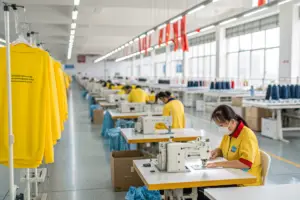
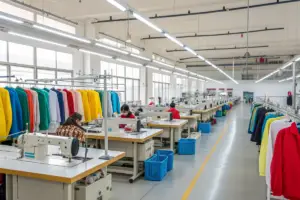
Factories have significant fixed costs. These include sample development, pattern making, and setting up cutting and sewing lines. Spreading these costs over a small number of units makes the per-garment price very high. For a sustainable operation, a factory needs orders that keep its production lines running efficiently. A very low MOQ often means frequent line changes and downtime, which is inefficient. We invest in advanced production planning software to optimize our 5 production lines. Accepting numerous tiny orders would disrupt this flow and ultimately harm our ability to deliver on time for all our clients. Our standard MOQ ensures we can provide reliable service and stable prices.
How does MOQ affect wholesale clothing prices?
The relationship between MOQ and price is direct and powerful. In manufacturing, higher volumes almost always lead to lower costs per unit. This is the core principle of economies of scale. When you order more, the factory's fixed costs are divided across more items. This includes the cost of creating samples, making patterns, and setting up the production line.
For example, the setup cost for a polo shirt line might be $1000. For an order of 100 pieces, that's an added $10 per shirt. For an order of 1000 pieces, it's only $1 per shirt. This logic applies to fabric procurement as well. Buying raw materials in large quantities gives us, the manufacturer, a better price from our mills. We then pass these savings on to you. A client who consistently orders 2000-unit batches will get a significantly better price than someone who orders 200 units at a time.
A low MOQ might seem cheaper upfront, but it can hide several extra costs. The most obvious is the higher price per garment, as we just discussed. Less obvious are the costs of potential inconsistency. If you place ten small orders with a low-MOQ supplier throughout the year, you might get ten slightly different products. Fabric dye lots can vary, and small工艺 changes can happen.
This leads to what we call quality assurance challenges. It is harder for a factory to maintain strict quality control across many small batches than across a few large, continuous runs. We experienced this with a startup brand last spring. They sourced small batches of 50 pieces from various low-MOQ suppliers. The color mismatch between batches was so severe they couldn't sell the items together as a collection. They lost money and time.

Can you get competitive pricing without a huge MOQ?
Yes, it is possible. The key is building a strategic partnership with your manufacturer. Instead of focusing on a single order, discuss your annual volume. If you can commit to a certain total volume over the year, even across different styles, a good factory may offer you a more favorable MOQ per style and better pricing. This shows you are a serious long-term partner. We have several clients who use this model. They might order 800 units of one style and 600 of another, but their total quarterly volume is 3000 units. This allows us to plan our production capacity effectively and offer them pricing close to that of a single large batch order.
Can a low MOQ guarantee faster production times?
A common misconception is that a smaller order will be produced and shipped faster. This is not always true. Factories plan their schedules around larger orders that utilize their production lines for extended periods. A small, low-MOQ order is often fitted into gaps in the schedule or batched with other small orders.
This can lead to unpredictable delays. Your production might be paused multiple times to accommodate larger, more prioritized runs. We prioritize reliability. When we agree on an MOQ and a timeline, we block out the necessary production capacity on our lines. For instance, we guaranteed a 45-day production timeline for a recent order of 1,500 woven shirts from a Chicago-based brand. Because the order size justified dedicated line time, we completed it on schedule, allowing them to hit their key selling season perfectly.

How does order size impact production scheduling?
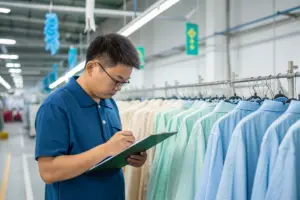
Think of a production line like a restaurant kitchen. A large order is like a wedding banquet—the kitchen prepares for it, dedicates resources, and executes it efficiently. Many small, low-MOQ orders are like a stream of individual takeaway orders. The cooks constantly switch between different recipes, which is less efficient and more prone to errors. This is why efficient logistics start on the factory floor. A stable, planned production flow minimizes errors and delays. It allows our quality control team to inspect garments at every stage systematically. With fragmented small orders, this rigorous process is harder to maintain, increasing the risk of defects slipping through.
Why might a low-MOQ supplier cause shipment delays?
Suppliers who specialize in very low MOQs often aggregate orders until they have enough to run a full production cycle. This means your order might wait until enough other small orders are collected. This directly contradicts the expectation of faster turnaround. Furthermore, from a logistics management perspective, consolidating many small shipments is complex and can lead to documentation errors or port delays. We operate on a different model. Our standard MOQ means your order is shipped as a complete, consolidated shipment, with all documentation prepared accurately for smooth customs clearance to the U.S. and Europe.
How to choose the right MOQ for your business?
Selecting the right MOQ is not about finding the lowest number. It's about finding the most strategic number for your business growth. The right MOQ balances your budget, inventory risk, and sales velocity. It should be a decision made with a clear understanding of your own market.
Start by analyzing your sales data. How many units of a similar item do you typically sell in a season? Then, factor in a buffer for testing new designs. An open conversation with your manufacturer is crucial. Ask them to explain the cost breakdown between a 500-unit order and a 1500-unit order. This will help you see the concrete cost savings of a slightly higher commitment. A good partner will be transparent with this data.

What questions should you ask your supplier about MOQ?
Don't just ask, "What is your MOQ?" Dig deeper. Ask these questions:
- "Is the MOQ per style, per color, or per color/size combination?"
- "How flexible is the MOQ for repeat orders?"
- "Can you explain the price difference if I increase my order by 30%?"
- "How does a higher MOQ impact your
quality controlprocesses?"
Answers to these questions will reveal much about the supplier's operations and reliability. For example, we always clarify that our 500-piece MOQ is per style, but we offer flexibility in color and size combinations within that count. This gives our partners the variety they need without the burden of an excessively high volume per SKU.
How can a partnership model benefit your brand?
View your manufacturer not just as a vendor but as a production partner. A partner understands your business goals and works with you to achieve them. This might mean agreeing on an MOQ that is viable for the factory but also includes value-added services like better product development support. We have a client who moved from a low-MOQ supplier to us. By accepting a reasonable 800-piece MOQ, they gained access to our in-house design team. We helped them refine their tech packs, which improved the fit of their garments and reduced their sample rejection rate by half. The slightly higher MOQ was a smart investment that significantly elevated their brand's quality.
Conclusion
The allure of a low Minimum Order Quantity is understandable, especially for new businesses. However, for established wholesale brands focused on scalability and profit, a strategic MOQ is far more valuable than a simply low one. A well-considered order quantity fosters a stronger partnership with your manufacturer, leading to better pricing, consistent quality, and more reliable delivery. It aligns your business with the realities of efficient production and creates a foundation for sustainable growth.
If you are looking for a manufacturing partner who provides transparent MOQs, competitive bulk pricing, and unwavering commitment to quality and delivery, Shanghai Fumao is ready to assist. Let's discuss how we can support your brand's growth. For a personalized consultation on your next apparel order, please contact our Business Director, Elaine, at elaine@fumaoclothing.com.