You’re planning your next selling season, trying to predict inventory needs, marketing budgets, and cash flow requirements. But without knowing your exact production costs, you’re essentially guessing at your most important financial metrics. How can you confidently plan your selling season when your largest expense remains unknown until you place production orders? A detailed production estimate transforms this uncertainty into a strategic planning tool.
A comprehensive production estimate serves as the financial foundation for your entire selling season, enabling accurate pricing strategies, inventory planning, cash flow management, and marketing budget allocation. By providing clarity on your largest expense—manufacturing—the estimate allows you to make data-driven decisions about product assortment, promotional strategies, and growth investments with confidence. Far from just being a manufacturing document, a proper estimate becomes the blueprint for your seasonal profitability and operational execution. Let’s explore how this single document can orchestrate your entire selling season strategy.
How does an estimate inform your pricing strategy?
Your production estimate directly determines your cost of goods sold (COGS), which is the foundation of your pricing architecture. Without accurate COGS data, you’re either leaving money on the table with prices that are too low or risking unsold inventory with prices that are too high. A detailed estimate provides the clarity needed to optimize your pricing for maximum profitability and competitiveness.
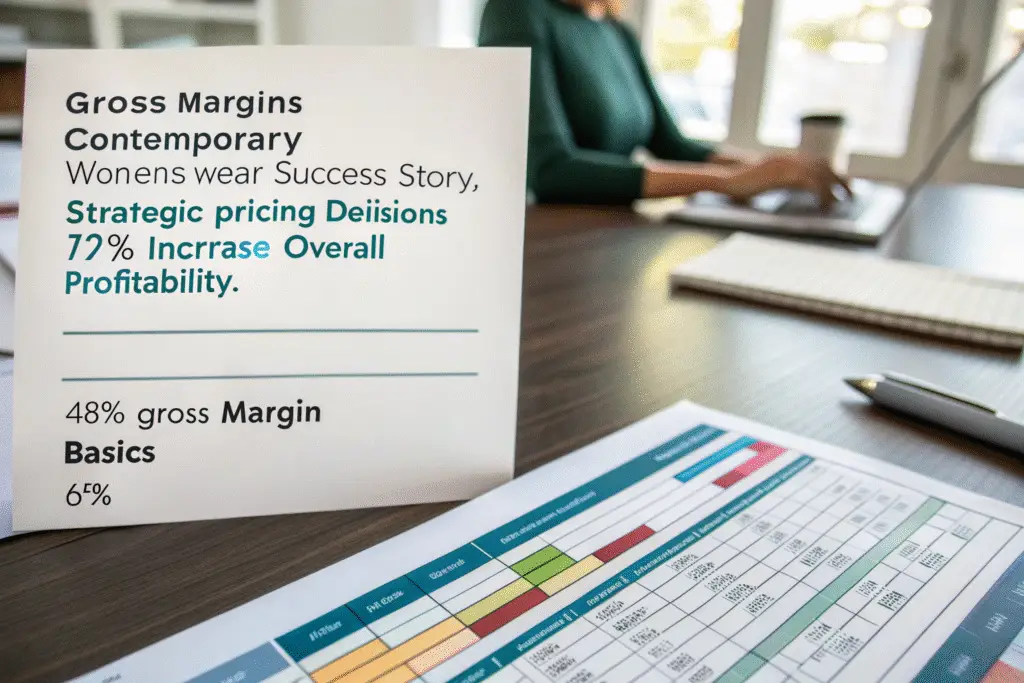
The estimate allows you to calculate your exact gross margins for each product, enabling strategic pricing decisions across your entire collection. We recently worked with a contemporary womenswear brand that was struggling with inconsistent margins across their line. Their best-selling dress had a 48% gross margin while their basics hovered around 65%—a mismatch they hadn’t identified until our detailed estimate revealed the true costs of the dress’s complex construction. By adjusting their pricing architecture based on the estimate data, they increased their overall profitability by 12% while remaining competitive in their market position.
What’s the relationship between cost breakdown and value pricing?
A detailed estimate reveals which products deliver the best value perception relative to their manufacturing cost. Products with high perceived value but moderate production costs become your margin drivers, while complex items with lower perceived value might need repositioning. We helped an accessories brand identify that their most elaborate (and expensive) bag actually had the lowest margin due to its high labor content. By slightly increasing its price and featuring it as a premium flagship item, they transformed it from a margin-drain to a brand-building hero product that justified its cost through enhanced positioning.
How can estimates prevent pricing mistakes?
Without accurate cost data, brands often make critical pricing errors—either undervaluing complex items or overpricing simple ones. A detailed estimate provides the factual basis for pricing decisions. One startup nearly priced their intricately constructed jackets 30% below what was sustainable because they underestimated the specialized labor required. Our estimate revealed the true costs, allowing them to adjust their pricing before launch and avoid what would have been a catastrophic margin miscalculation on their highest-cost product.
How does production timing in estimates affect inventory planning?
Your production estimate includes not just costs but detailed timelines that directly impact your inventory strategy. Understanding when goods will arrive allows you to optimize inventory levels, reduce storage costs, and ensure product availability aligns with demand peaks—all critical for seasonal selling success.
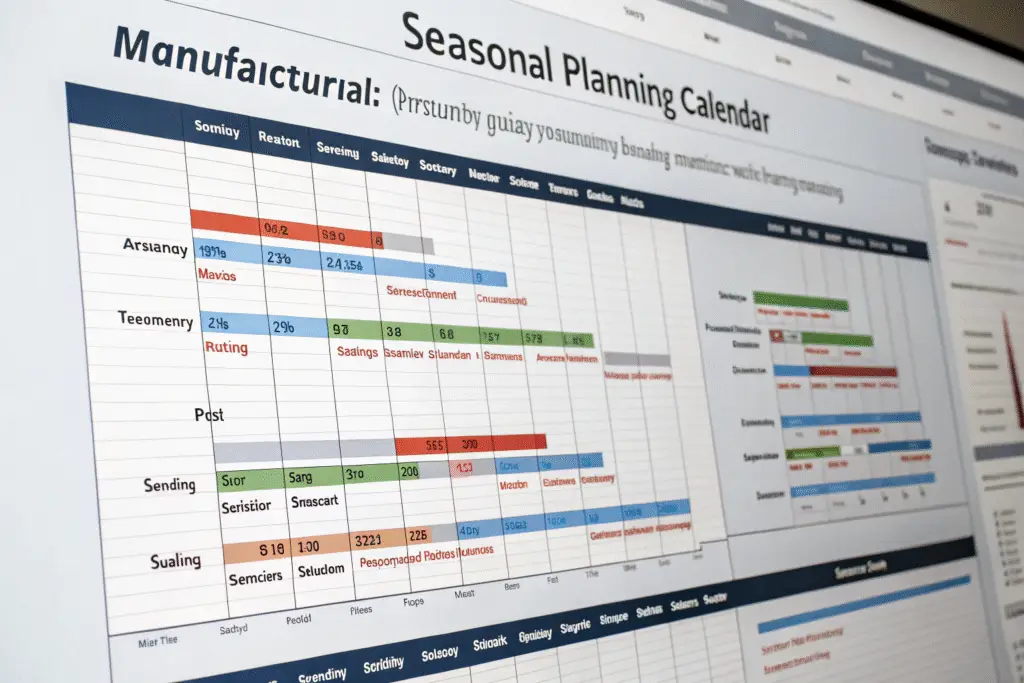
The production schedule within your estimate determines your inventory receipt dates, which in turn drives your entire sales calendar. We create integrated timelines that show clients exactly when each product will arrive relative to their selling peaks. For a swimwear brand, our estimate timeline revealed that their production schedule would deliver goods six weeks before their peak selling season—too early for optimal cash flow but perfect for building initial inventory. This allowed them to plan a phased marketing approach with early promotions to loyal customers, followed by full-price selling during peak season, maximizing both inventory turnover and margin preservation.

How do production phases influence launch sequencing?
A detailed estimate breaks production into phases—sampling, cutting, sewing, finishing—allowing you to coordinate product launches with manufacturing progress. We helped a streetwear brand leverage this by planning their capsule collections around production batches. Their estimate showed that basic tees would complete first, followed by more complex hoodies, enabling a staggered launch that maintained customer engagement throughout the season while matching inventory availability with marketing efforts.
Can estimates help prevent stockouts or overstock?
Accurate production timing in estimates allows for precise inventory planning that balances availability with cost efficiency. By knowing exactly when goods will arrive, you can maintain leaner inventory levels without risking stockouts. One brand reduced their safety stock by 40% after our estimates provided reliable delivery dates, significantly cutting their storage costs while maintaining a 99% in-stock rate during peak season through better planning aligned with production schedules.
How do payment terms in estimates impact cash flow?
The payment schedule outlined in your production estimate directly determines your cash outflow timing, making it possible to plan your financial resources throughout the selling season. Understanding when manufacturing payments are due allows you to align expenses with revenue generation and secure appropriate financing if needed.
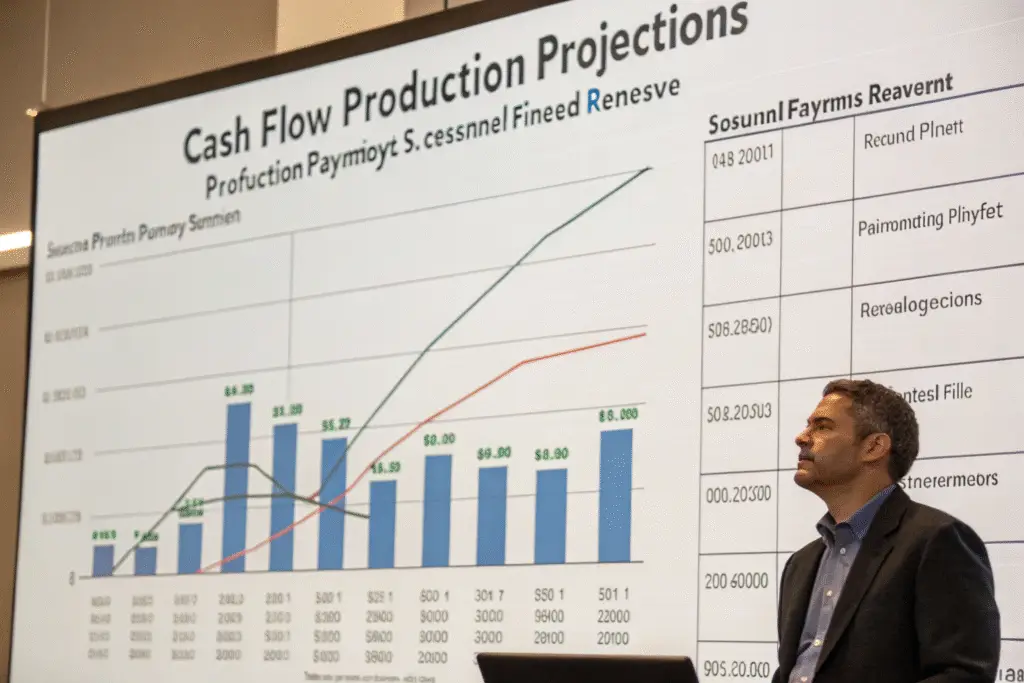
Production estimates typically specify payment milestones—deposit upon order, progress payments during production, and balance before shipment. This structure creates predictable cash outflows that can be planned against expected revenue. We recently helped a growing brand analyze how different payment terms would affect their cash flow throughout the season. By comparing 50/50 terms against 30/40/30 terms, they realized the latter would better align with their wholesale payment cycles, reducing their working capital needs by $85,000 during critical growth months.
How can estimates help secure financing?
Detailed, professional production estimates provide the documentation needed to obtain business financing. Lenders and investors require clear cost breakdowns and timelines to assess risk. We’ve helped multiple clients use our comprehensive estimates to secure lines of credit specifically for production financing. One brand obtained a $200,000 inventory loan specifically because our estimate provided the detailed cost verification and delivery timeline the bank required to feel confident in their investment.
What’s the strategic value of payment timing?
The payment schedule in your estimate affects not just your cash flow but your negotiation leverage and risk management. Understanding standard industry terms helps you negotiate favorable conditions. We educate clients about how different payment structures affect their position—larger deposits might secure better pricing but increase risk, while milestone payments provide more control over quality but may cost slightly more. This understanding transforms payment terms from a financial formality into a strategic tool for managing manufacturer relationships and financial risk.
How does cost clarity in estimates affect marketing budgeting?
When you know your exact production costs, you can confidently allocate marketing resources to products with the best profit potential. The estimate provides the financial intelligence needed to make strategic decisions about which products to feature, promote, and support with advertising spend.
Your production estimate reveals which products have the healthiest margins and can therefore support aggressive marketing, and which need more conservative support. We helped an activewear brand analyze their production costs across 25 SKUs and discovered that their highest-margin items weren’t their obvious bestsellers but rather their mid-tier products with efficient construction and moderate material costs. By reallocating their marketing budget to feature these hidden gems, they increased their overall ROI on marketing spend by 28% while maintaining sales volume on their lower-margin hero items.
How do estimates influence promotional planning?
Knowing your exact costs allows you to calculate how deep you can discount while maintaining profitability. We create margin analysis reports that show clients exactly how much promotional flexibility each product has. One retailer avoided a costly mistake when they planned a 40% off promotion on their most complex jacket—our estimate analysis revealed this would put them below cost. They adjusted to a 25% promotion that maintained a slim margin while still driving traffic, preventing what would have been a loss-leader situation on their most expensive product.
Can estimates guide product selection for campaigns?
Production costs should directly influence which products you feature in paid marketing. High-margin products can support more aggressive customer acquisition costs, while low-margin items might rely on organic visibility. We helped a DTC brand identify that their simple, high-margin basics could support a $35 customer acquisition cost, making them ideal for Facebook and Google ads, while their complex, lower-margin statement pieces needed to be discovered through organic social and PR. This data-driven approach to marketing allocation based on production costs transformed their advertising efficiency.
Conclusion
A production estimate is far more than a manufacturing document—it’s the strategic foundation for your entire selling season. By providing clarity on costs, timing, and payment schedules, it enables informed decisions about pricing, inventory, cash flow, and marketing that directly impact your seasonal profitability. Brands that leverage estimates as planning tools rather than simple cost quotes gain significant competitive advantages through better resource allocation and risk management.
Transform your production estimate from a necessary step into a strategic advantage. For estimates that provide the clarity and detail needed to plan your most successful selling season yet, contact our Business Director Elaine at elaine@fumaoclothing.com. Let’s build a manufacturing partnership that supports your entire business strategy, not just your production needs.