A clear brand style guide serves as your company's essential rulebook, ensuring consistent brand presentation across all platforms. When brands lack this consistency, customer confusion inevitably arises, ultimately weakening brand perception. Consequently, we will demonstrate a systematic approach to creating an effective guide that delivers tangible results.
To develop a comprehensive brand style guide, you must systematically define your brand's core identity, including its mission, vision, and target audience, and then translate these elements into concrete visual and verbal guidelines. This involves establishing rules for your logo usage, color palette, typography, imagery, and tone of voice. A well-crafted guide ensures consistency across all touchpoints, from your clothing labels and packaging to your marketing materials, which builds brand recognition and trust with your customers.
Although creating a style guide might appear complex initially, it represents a crucial long-term investment. Furthermore, it streamlines design and marketing efforts while facilitating smoother collaboration with manufacturing partners. Therefore, let's examine this process through a structured, step-by-step approach.
What are the core components of a brand style guide?
Your brand style guide forms the fundamental foundation of your identity, containing all essential rules for brand presentation. Without these core components, brands typically experience inconsistency and diluted messaging. Accordingly, we will explore the indispensable elements every robust guide must contain.
A comprehensive brand style guide begins with establishing your brand's core principles. First, you must clearly define your mission, vision, and fundamental values. Simultaneously, understanding your target audience becomes equally critical. These foundational elements subsequently inform every visual and verbal decision throughout the development process.
What visual elements must be included?
Visual components constitute the most recognizable aspects of your brand identity. Since these elements create immediate visual impact, their proper specification becomes paramount. Your logo naturally serves as the primary visual identifier; therefore, the guide must demonstrate correct usage, spacing requirements, and prohibited modifications. Similarly, your color palette requires precise definition through specific color codes for both print (Pantone, CMYK) and digital (HEX, RGB) applications. This meticulous approach guarantees color consistency across diverse media, from digital platforms to physical hang tags. Additionally, typography selection establishes consistent textual communication, while imagery guidelines maintain visual cohesion across all brand representations.
How do you define your brand's voice and tone?
Your brand's voice represents its consistent personality expressed through language, while tone adapts this voice to specific contexts. To establish this effectively, begin by identifying 3-5 core personality traits that authentically represent your brand. For instance, if your brand embodies "adventurous" characteristics, its communication should consistently reflect this quality. Subsequently, develop practical language guidelines that specify appropriate terminology and prohibited phrases. This linguistic consistency proves particularly valuable for product descriptions and manufacturing communications, ultimately fostering deeper customer connections through recognizable brand personality.
How to establish your brand's visual identity?
Your visual identity creates immediate brand recognition, transforming casual observers into loyal customers. Moreover, a cohesive visual system builds consumer trust and communicates professionalism. Let's examine how to construct this system methodically.
Establishing visual identity extends beyond subjective color preferences, requiring strategic alignment with brand values and target audience preferences. Consequently, each design decision should deliberately reinforce your brand's core message while appealing to your specific customer demographic.
What is the process for selecting a color palette?
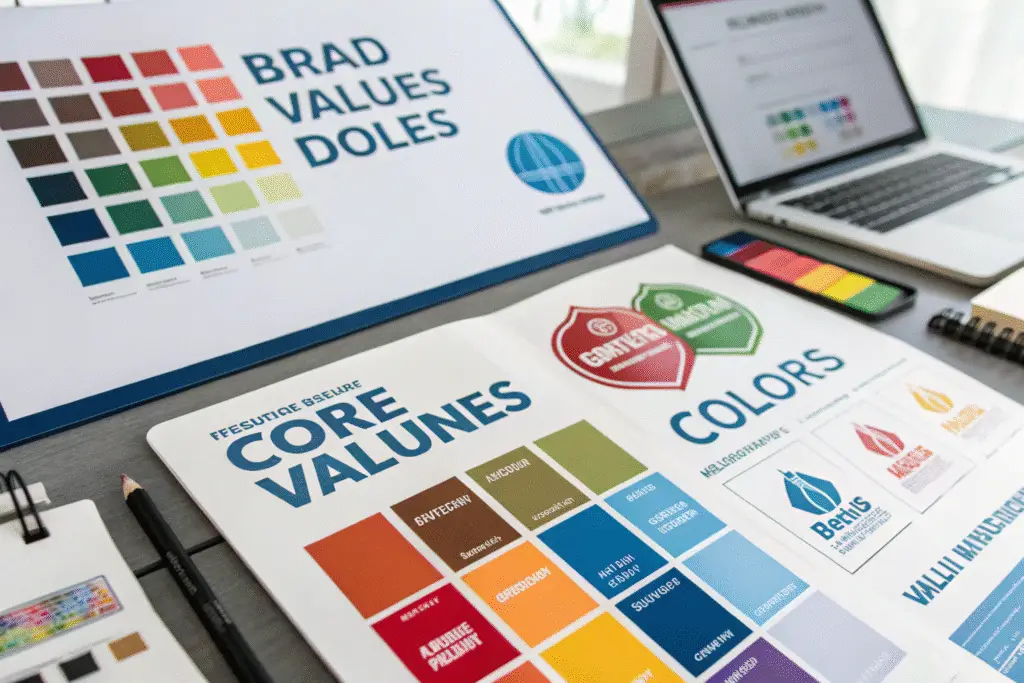
Color selection strategically influences emotional response and enhances brand recall. Begin this process by understanding color psychology—for example, blue typically conveys trustworthiness, while yellow often suggests energy and optimism. Next, analyze competitor palettes to identify distinctive color opportunities. A well-structured palette typically includes primary, secondary, and neutral colors, each with precisely defined technical values. This color precision ensures your custom apparel maintains visual consistency across all applications, from digital marketing to physical products.
How to choose the right typography?
Typography functions as the audible voice of your written communication, requiring both legibility and brand alignment. Start by selecting complementary typefaces for headlines and body text, typically limiting selections to 2-3 families to prevent visual clutter. Subsequently, establish specific sizing, weight, and spacing guidelines for various applications, including digital interfaces and physical packaging. For globally distributed brands, additionally consider web-safe font options or include proper licensing information to ensure consistent rendering across different systems and regions, which proves especially important for international fashion logistics operations.
| Use Case | Font Family | Weight | Size | Color |
|---|---|---|---|---|
| Main Headlines | Montserrat | Bold | 32px | Primary Blue |
| Body Text | Open Sans | Regular | 16px | Dark Gray |
| Labels & Tags | Montserrat | Semi-Bold | 12px | White |
Why is a logo usage guide critical?
Your logo acts as your brand's visual ambassador, requiring consistent presentation to maintain its impact. Improper logo usage frequently damages brand perception and undermines credibility. Therefore, comprehensive usage guidelines prevent these negative consequences through clear specifications.
A logo usage guide establishes essential rules for your most valuable brand asset, ensuring consistent application regardless of user—whether internal teams, partners, or manufacturers. This protective measure directly safeguards brand integrity across all touchpoints.
What are the clear space and sizing rules?
Clear space (or padding) creates essential breathing room around your logo, preventing visual competition with adjacent elements. Define this space using proportional measurements based on logo dimensions, such as the height of specific characters. Similarly, establish minimum size requirements for various applications: digital displays might require 150px minimum width, while physical garment care labels might need 1-inch minimums. These specifications collectively ensure logo legibility and visual impact across all implementations.
How to specify logo variations and incorrect usage?
Most brands require multiple logo versions for different contexts and applications. Your guide should systematically include primary, secondary, and monochrome versions to accommodate various background and space constraints. Most importantly, provide explicit examples of improper usage to educate stakeholders. Clearly prohibit specific modifications including distortion, rotation, unauthorized color changes, or effects applications. These detailed instructions become particularly crucial when collaborating with international partners to ensure proper execution on all manufactured apparel.
How to implement and maintain your style guide?
A style guide represents an evolving document rather than a one-time project, requiring active usage and periodic updates. Proper implementation transforms this document from theoretical framework to practical business tool, while maintenance prevents gradual obsolescence.
Although guide creation marks significant progress, effective distribution and updating mechanisms determine its ultimate value. Consequently, you need deliberate strategies for team education and systematic revision processes.

What is the best way to distribute the guide to your team?
Accessibility fundamentally determines guide utilization. Instead of relying on easily lost email attachments, establish centralized access through cloud platforms or dedicated brand management software. This centralized approach creates a single source of truth for all brand assets. Following distribution, conduct comprehensive training sessions to explain the rationale behind guidelines, increasing team buy-in and proper implementation. When partnering with manufacturing facilities, provide specifically curated sections containing essential technical specifications like logo files and color codes to ensure production accuracy.
How often should you update your brand style guide?
While brands naturally evolve over time, this evolution should occur deliberately rather than arbitrarily. Establish a formal annual review process to evaluate guide effectiveness and relevance. However, also trigger updates in response to specific organizational changes including rebranding initiatives, market expansion, or significant stakeholder feedback. When implementing changes, manage this process systematically through clear update announcements, version control, and proper archiving of previous editions. This structured approach prevents confusion while maintaining consistency across your entire global supply chain, including all manufacturing partners.
Conclusion
A comprehensive brand style guide transcends simple documentation, functioning as a strategic asset for building recognizable, trustworthy brands. It systematically defines visual identity, clarifies brand voice, and establishes precise logo governance. Through consistent implementation and maintenance, organizations empower teams while ensuring every customer interaction reinforces brand values. This strategic consistency ultimately drives customer recognition and loyalty, directly supporting business growth objectives.
Furthermore, well-defined brand guidelines significantly streamline manufacturing processes. When clothing manufacturers receive precise specifications, production errors decrease while efficiency improves. If you're prepared to transform your brand identity into consistently manufactured apparel, our team at Fumao Clothing provides ideal partnership conditions. We specialize in converting comprehensive brand guidelines into high-quality physical products that maintain brand integrity throughout production. For manufacturing collaboration that prioritizes your brand's consistency and quality, please contact our Business Director Elaine at: elaine@fumaoclothing.com.