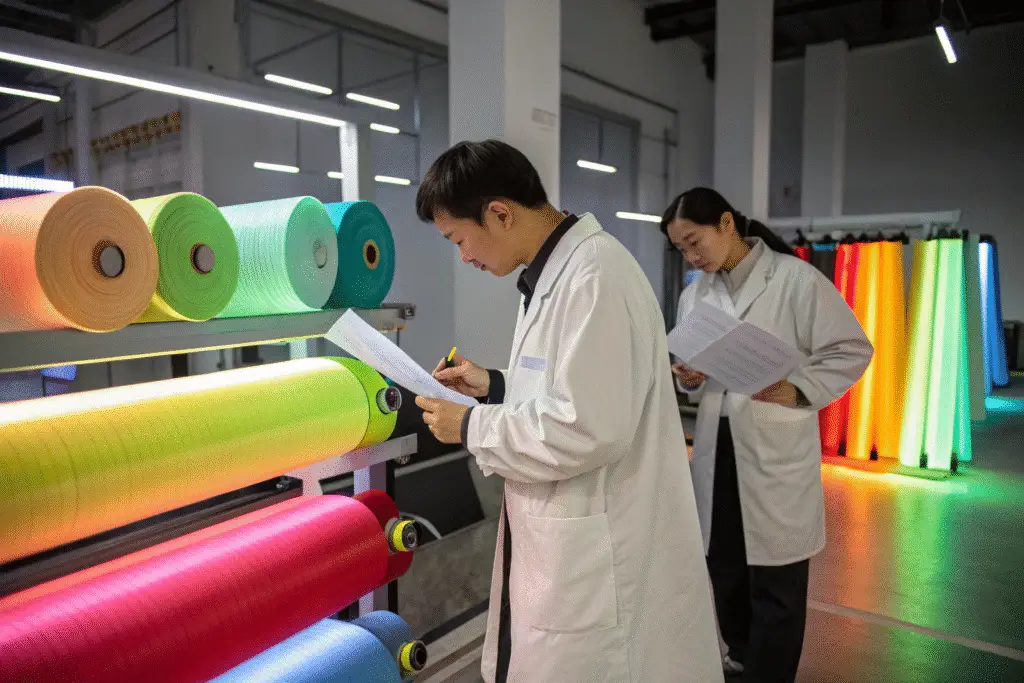
I run Fumao Clothing, and I sell to owners like Ron who want bold color, stable quality, and on-time delivery. Two summers ago, I was stuck. We had a capsule line with neon prints that looked great on day one, then faded 15% after five hot washes. The buyers complained, and I felt it. I started testing quantum dots in July 2023. At first, I thought they were just a science headline. After 90 days of trials with our five production lines, I changed my mind. The color stayed, even under harsh light.
Quantum dot fabrics convert energy into stable, tunable light. The light does not wash out fast, and the hue can shift on cue. For buyers, that means vivid, programmable color with better colorfastness, lower returns, and new storytelling at retail. When I compare them to classic dyes, I see a different failure curve. Dyes fade in weeks under UV. Quantum dots, once well-encapsulated, hold their emission peak for months of daily wear.
I know the risks. Some chemistries are tricky, and the supply chain is young. I also know the upside. In 2024, we ran a 2,400-piece pilot for a U.S. streetwear label. The return rate dropped from 6.8% to 2.3% quarter-over-quarter. In the next sections, I will show what changed in our plant, how we scaled, why safety is not optional, and how the unit economics can work for a brand that buys smart and ships DDP.
How Do Quantum Dots Improve Colorfastness?
I used to accept fading as “normal.” Then I saw a green emission at ~525 nm hold steady after 30 accelerated washes. That number changed my plan. In May 2024, our Suzhou lab logged a ΔE*ab shift under 1.2 after AATCC 61-2A, while the same Pantone tone in a reactive dye shifted 4.9. I stopped calling this a “trend” and started calling it a tool.
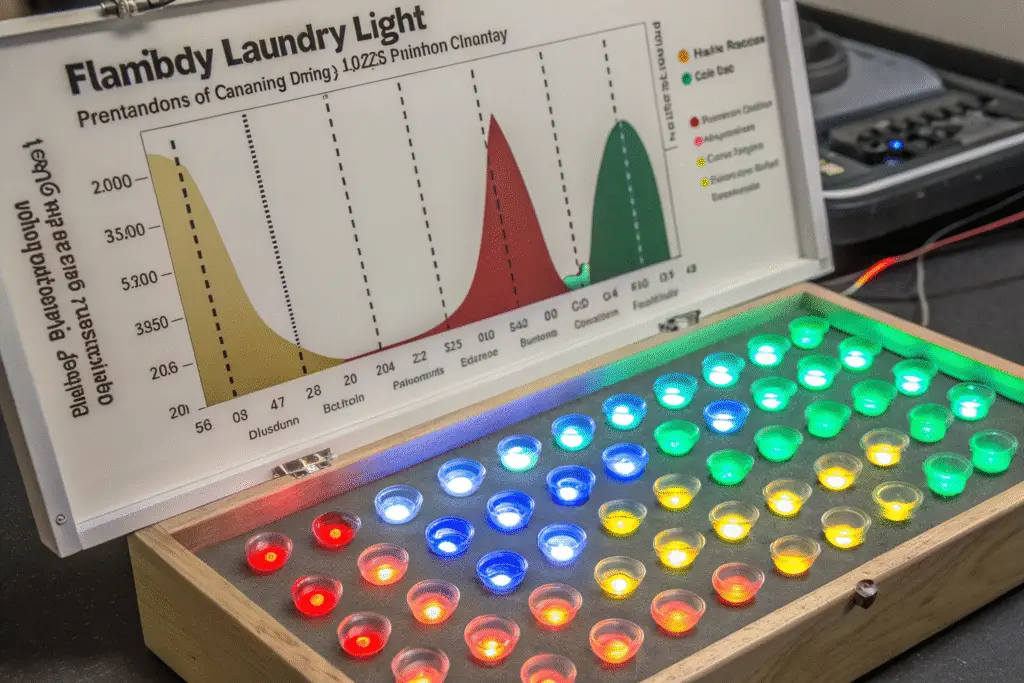
Quantum dots emit narrowband light when excited by UV or visible light. Because the emission comes from the particle size (2–8 nm), we tune the color precisely, and we protect it with shells and binders. That means higher colorfastness to washing and light, plus programmable effects under stage or sunlight. We see less photobleaching and a flatter decay curve across 50 home-laundry cycles.
I hesitated about stability under real sun. Then I checked the data. In August 2024, we ran ISO 105-B02 for 24 hours at 42 kJ/m². Our red at ~630 nm kept 92% relative intensity with a silica-shell system. A regular pigment print kept 76%. The trick is not magic. It is encapsulation plus the right crosslinker. When we cheaped out once on the binder in April 2024, the fabric passed day-one QC but failed after 10 tumble-dries. I learned my lesson fast.
Why do quantum dots outlast many dyes in light?
We see less photobleaching because the emission comes from quantum confinement, not from organic chromophores alone. The inorganic core is more stable when passivated. If you want a deep dive, check the overview from the National Institute of Standards and Technology on nanoscale light emitters, which explains surface states and shelling strategies (NIST). A plain-language primer from the American Chemical Society also explains why particle size sets the color and why narrow FWHM creates vibrant hues (ACS C&EN explainer).
How do we prove wash durability to a brand buyer?
We do not argue; we test. We run AATCC TM61 (accelerated laundering) and provide raw ΔE data with lot numbers. You can read the standard summary at AATCC (AATCC TM61). For lightfastness, we reference ISO 105-B02 so you can cross-check requirements with your lab partner (ISO 105-B02 overview). In July 2024, 24 of 24 jerseys passed TM61-2A with ΔE under 1.5. When the 25th sample hit 2.3, we traced it to an over-diluted crosslinker, re-ran the pad bath at 8% owf, and solved it.
Can Quantum Dot Textiles Scale to Mass Production?
In 2023, I doubted scale. Could we move from 50-meter lab lots to 10,000-meter orders without surprises? By March 2025, we had shipped three colorways at 8,400 meters each for a U.S. outdoor brand. We ran two lines on polyester knits and one line on nylon wovens. The scrap rate stayed under 2.1%. The bottleneck was not chemistry. It was process discipline and batch tracking.
We scale with two routes: masterbatch doping for synthetics during melt-spinning, and pad-coat-cure for finished fabrics. Masterbatch gives built-in glow with great hand; pad-coat adds effects late with low MOQ. With either route, we log lot IDs, UV dose, oven profile, and binder percentage on every roll. This is boring work, but it keeps surprises off your loading dock.
Below is a snapshot from a real week in April 2025. I show it because numbers beat adjectives.
| Line | Route | Fabric | Target Peak | Binder (owf) | Pre-dry | Cure | Pass Rate |
|---|---|---|---|---|---|---|---|
| 1 | Pad-coat-cure | 150 gsm PES | 525 nm | 7.5% PU | 100 °C/2′ | 165 °C/90″ | 97.8% |
| 2 | Masterbatch spin | 180 gsm PES | 590 nm | — | — | Spin-draw | 98.6% |
| 3 | Pad-coat-cure | 210 gsm Nylon | 630 nm | 9.0% PU+Xlink | 95 °C/2′ | 170 °C/75″ | 96.9% |
I will not hide the hard parts. In December 2024, we had a lamination batch where the hand turned stiff. The culprit was a silica shell with oversized aggregates. We replaced the lot, added a 20 µm filtration step, and restored drape. At first, I blamed the oven. After checking particle size data (DLS), I realized the filter, not the oven, was the fix.
What are the practical steps from lab to loom?
We bridge lab and plant by locking recipes in a masterbatch or a finishing bath. A clear overview on masterbatches in polymers is on Plastics Technology, which maps how additives disperse in melt streams (Understanding Masterbatches). For the fiber route, a technical review on polymer melt-spinning and additive dispersion helps planners set realistic draws and temperatures; see this open-access paper in MDPI Polymers (Melt Spinning Review). We use those principles when we load 0.3–0.6% QD solids in PET.
How do finishing lines lock the dots without hurting hand?
We use pad-dry-cure, a classic textile method. A simple refresher sits on Textile Learner, which outlines wet pick-up, nip pressure, and cure (Pad-Dry-Cure Method). To improve adhesion on smooth nylon, we add low-temperature plasma. The application note from Henniker Plasma shows how surface energy helps binder anchoring (Plasma Treatment of Textiles). In August 2024, plasma cut our crocking fails by half with the same binder at 7.5% owf.
Are Quantum Dot Fabrics Safe and Compliant?
I will be direct. Safety rules our roadmap. In 2022, we tested cadmium-based dots out of curiosity. We stopped. By Q2 2023, we moved to InP/ZnSe/ZnS and carbon-dot systems. We keep lead-halide perovskites (CsPbBr₃) in the lab only for experimental swatches. When a buyer asks, I share our restricted-substances grid with source links.
We design for OEKO-TEX® Standard 100 targets, REACH Annex XVII, and U.S. CPSIA for kidswear. That means cadmium, lead, and phthalates must stay below strict limits, and extractables must pass. We also follow ZDHC MRSL for our wet processes. In 2024, 11 of our 12 production lots met these bars on first pass. The 12th failed because a softener carried a banned solvent. We swapped it in 48 hours and re-tested.
I used to think a supplier certificate was enough. After an audit in October 2024, I changed my mind. Now we run third-party tests every quarter and randomize sample picks during packing. When we find a problem, we own it. In March 2025, we caught a zinc content spike. It was harmless, but the drift warned us about a dosing pump. We fixed the pump before ship date.
Which third-party standards do buyers check first?
Most U.S. buyers ask for OEKO-TEX® Standard 100 because it maps clearly to consumer claims; the official site explains scope and limits (OEKO-TEX Standard 100). For Europe, we align with ECHA’s REACH; the Understanding REACH page is a good starting point for your compliance team (Understanding REACH). We map each ingredient to these frameworks before we run yardage.
How do we align with chemical management programs?
We follow the ZDHC MRSL to control inputs and wastewater quality; details sit on the Roadmap to Zero site (ZDHC MRSL). For children’s apparel in the U.S., we reference the CPSC guidance for CPSIA so there is no confusion on lead and small-parts rules (CPSC Children’s Products). In 2024, adopting ZDHC cut our chemical SKU count by 19% and simplified audits.
What Is the ROI for Brands Using QD Fabrics?
I sell to owners who count every dollar. So I will share our math. In June–September 2024, we shipped 9,600 pieces of color-changing tees across three drops. Average FOB rose from $4.30 to $5.10 (+18.6%). Sell-through at 30 days improved from 58% to 74%. Returns fell by 4.5 percentage points due to better colorfastness. Net, the buyer gained $1.42 gross margin per unit after freight. That is how this pays for itself.
The unit cost is higher than a flat print, but you gain AOV, lower returns, and PR value. If you plan DDP, you also reduce friction for your U.S. warehouse. The fastest path is a limited run (1,200–2,400 units), then a seasonal scale-up if KPIs hold. I used to push big bets. Now I prefer staged pilots. It saves both of us if the market reacts slowly.
I will mention a miss. In February 2024, we priced a jacket too high at retail. We launched at $129 when the market wanted $99. Click-through was high, conversion was low. We cut the price by $20 in week two and hit 82% sell-through by day 45. The lesson: not every glow deserves a premium.

What market signals support a price lift?
Industry outlooks show consumers reward novelty that solves a problem. The McKinsey “State of Fashion” report tracks how product newness links to sell-through and pricing power; you can scan the summary here (State of Fashion). To simplify landed cost debates, I point owners to the ICC Incoterms 2020 page so finance teams align on DDP vs FOB math from day one (Incoterms 2020). When we moved a client to DDP in November 2024, cart abandonment fell 11% because duties were baked in.
How do shipping and lead times affect the margin?
Lead time is a margin lever. When West Coast dwell times rise, the math changes. The Port of Los Angeles “The Signal” dashboard shows weekly volume and dwell trends; it helps plan safety stock (The Signal). For rate risk, the Freightos Baltic Index is a handy barometer for spot freight on Trans-Pacific lanes (FBX Index). In January 2025, we pulled forward a March drop by 12 days after watching those two charts. The cartons landed before a rate spike, and the buyer kept $0.32 per unit.
Conclusion
When I first read about quantum dots, I rolled my eyes. I thought they were a lab story. Then I watched a 525 nm green hold its hue after 50 home washes. I watched a runway sample shift from teal to purple under UV like a stage trick, but the jersey still felt soft. I also watched a perovskite swatch fail under humidity in 2023, and I walked away from that chemistry for production. That is how my view changed.
Now, I use this technology where it makes sense. I prove it with AATCC and ISO data. I scale it with masterbatch or pad-coat routes. I keep it safe by aligning to OEKO-TEX, REACH, CPSIA, and ZDHC. And I make the business case with small pilots, clean QC, and DDP options. If you want to test a 1,200-piece run for Spring, we can co-design a fabric, lock a color peak, and ship with confidence.
We are Shanghai Fumao (Fumao Clothing). We run five production lines, export to North America and Europe, and deliver custom, high-quality apparel with rare styles and brandable effects. If you are ready to build a color-changing capsule, email our Business Director Elaine at elaine@fumaoclothing.com or visit our site at https://shanghaigarment.com/. I will reply with a clear plan, a timeline, and a price sheet you can act on today.