Blockchain has begun reshaping how apparel manufacturers and international buyers approach the verification of fiber origin. Many sourcing executives in the U.S., particularly those managing brand procurement, worry about whether raw materials such as cotton or viscose are truly traceable. Traditional methods often resulted in delayed communication and unreliable certificates, creating severe commercial risks. With the adoption of blockchain technology, the apparel sector now has a stronger method to demonstrate trust and accountability.
In essence, blockchain-powered traceability platforms enable a transparent chain of evidence from fiber production through final garment delivery, ensuring both authenticity and compliance.
As a clothing manufacturer engaged in exporting to North America and Europe, I have witnessed these challenges directly. Buyers often raise questions about provenance verification, and now blockchain allows us to respond with reliable, data-driven solutions. Below I will outline the major systems currently shaping the field.
FibreTrace vs Digital Blockchain Platforms
When discussing blockchain in textiles, two broad models emerge: physical tracers applied to fibers, and purely digital tracking systems. Each model has particular strengths and is chosen depending on supply chain priorities.
Among the most recognized names are FibreTrace and TextileGenesis, which provide real-time verification tools for global fashion brands.
The fashion industry has long struggled with counterfeit documentation claiming sustainable sourcing. Some exporters submit falsified certificates, creating liability for U.S. labels. FibreTrace addresses this by embedding pigments into fibers, while TextileGenesis records transactions digitally through blockchain. Together, they highlight two distinct approaches to solving the same trust issue.

How Does FibreTrace Ensure Authenticity?
FibreTrace incorporates an indelible pigment at the fiber’s birth. This tracer persists even when fibers are recycled or blended. At every processing stage, scanning devices confirm identity, and the blockchain records each step in a tamper-resistant ledger.
International initiatives such as Sustainable Apparel Coalition and Fashion for Good frequently spotlight FibreTrace as an innovative approach to product passports. By linking physical fibers with digital proof, brands are able to reassure customers about material origin.
Why Do Brands Prefer TextileGenesis for Supply Chain Mapping?
Unlike pigment-based tracking, TextileGenesis relies on digital “Fibercoins,” each representing verified volumes of certified fiber. Transactions across spinners, mills, and retailers are securely stored on blockchain.
Platforms like Higg Index and OEKO-TEX are often connected to TextileGenesis, offering brands integrated compliance monitoring. For American companies with complex sourcing networks, this digital-first model provides wide visibility and easier integration into reporting frameworks.
DNA and Molecular Tracing in Fibers
Another emerging method uses molecular or DNA tracers embedded into fibers. This creates a unique identity code that can be validated through laboratory analysis and matched with blockchain records.
Birla’s GreenTrack and Lenzing’s traceability systems represent the strongest cases where molecular science meets digital ledgers.
Such tracers drastically reduce the possibility of fraudulent material claims, making them highly attractive for premium and luxury apparel markets where reputation is essential.

How Does Birla’s GreenTrack Work in Real Supply Chains?
GreenTrack introduces DNA-based tracers into viscose fibers at the point of manufacture. These can later be tested in labs to prove authenticity, with results secured on blockchain for permanent reference.
Partnerships with organizations like Forest Stewardship Council (FSC) and Canopy further strengthen its reliability. For U.S. buyers, this combination of scientific proof and blockchain transparency is particularly valuable in meeting sustainability commitments.
Why Is Lenzing’s Blockchain Solution a Model for the Industry?
Lenzing integrates proprietary fiber markers with blockchain documentation. This hybrid approach ensures fibers carry verifiable identity markers that auditors can check at any stage.
Groups such as Textile Exchange and Ellen MacArthur Foundation frequently recognize Lenzing’s framework as a benchmark example. It offers apparel brands both technical proof and compliance-friendly data sharing.
Sustainable Fiber Tracking for Viscose and Cotton
Concerns around sustainable raw materials are driving new blockchain programs in viscose and cotton sectors. Both fibers dominate global production yet often face criticism for environmental impact.
Initiatives like APR’s Follow Our Fibre and Good Earth Cotton are setting practical examples in this area.
For U.S. buyers, proving that cotton and viscose are responsibly produced is no longer optional. It is becoming a commercial necessity as consumers demand accountability.
How Does APR’s Follow Our Fibre Build Trust for Viscose?
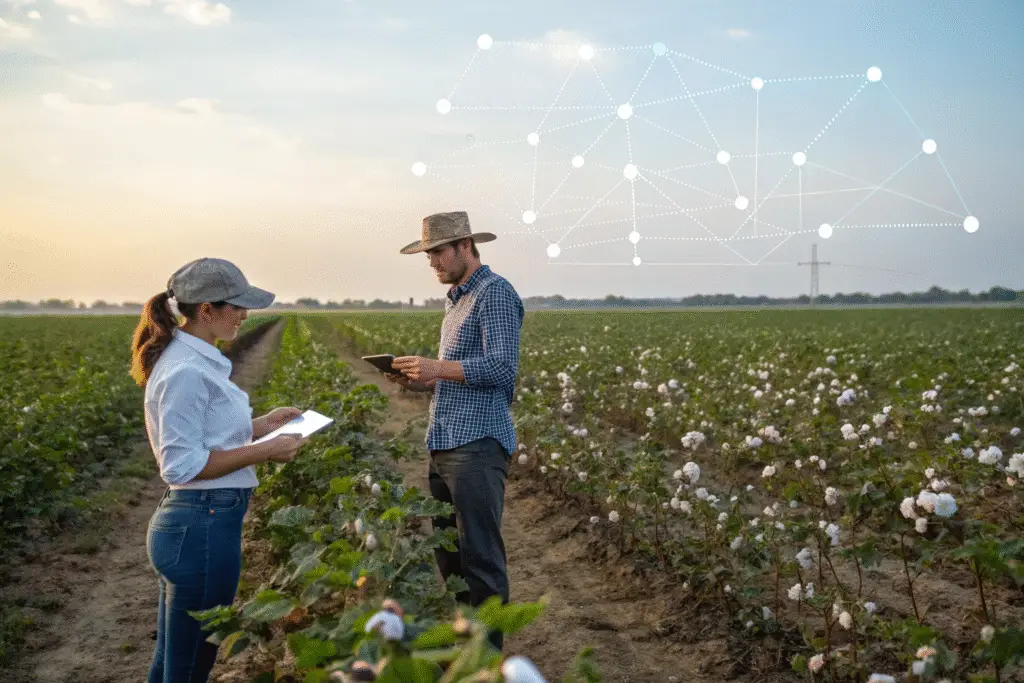
APR developed a digital chain that records every phase of viscose creation—from nursery planting to finished fiber delivery. Data is openly shared, making it easier for brands to access credible sourcing information.
Programs like Textile Exchange and Better Cotton Initiative acknowledge the value of this model. By relying on blockchain documentation, buyers reduce their risk of relying on unverifiable paperwork.
Why Is Good Earth Cotton Important for U.S. Buyers?
Good Earth Cotton combines blockchain transparency with regenerative farming methods. Farmers record data on carbon sequestration and environmental impact, which is stored in digital product passports.
Sustainability advocates such as Fashion Revolution and World Resources Institute frequently highlight these efforts. For American companies, adopting cotton sourced through this system strengthens both brand value and consumer trust.
Comparing Blockchain Fiber Solutions
While all systems aim at increasing trust, their key features differ. Some prioritize instant verification, others emphasize certification integration, and still others highlight sustainability.
Selecting the right approach depends on whether a buyer values speed of proof, regulatory alignment, or ecological reporting.
From my experience advising international buyers, preferences vary. Companies seeking immediate authenticity checks often lean toward FibreTrace, whereas those focused on compliance frameworks tend to adopt TextileGenesis.
Which Solution Works Best for Real-Time Tracking?
FibreTrace dominates real-time validation. Pigments remain embedded throughout fiber life, making quick checks possible even at later stages.
Industry platforms such as Supply Chain Digital and Chainlink regularly highlight FibreTrace as a strong physical-digital integration tool.
Which Solution Offers the Most Reliable Compliance Integration?
TextileGenesis provides extensive compliance benefits, especially for multi-tier supply chains. Its integration with recognized certification standards allows brands to maintain continuous oversight.
Large organizations like Global Fashion Agenda and UN Alliance for Sustainable Fashion emphasize TextileGenesis as an example of scalable, policy-friendly technology.
Conclusion
Blockchain is gradually redefining fiber origin verification across the apparel industry. From FibreTrace pigments and TextileGenesis digital tokens to Birla’s DNA tracers, Lenzing’s hybrid model, APR’s viscose tracking, and carbon-positive cotton projects, multiple pathways are now available.
Each system delivers distinct value, yet all share one outcome: better visibility and stronger credibility for global buyers.
As the head of Fumao Clothing, I recognize how important this is for American partners searching for trustworthy suppliers. If you are considering garments produced with blockchain-backed fibers, I invite you to connect with our Business Director Elaine at elaine@fumaoclothing.com and explore collaboration opportunities.