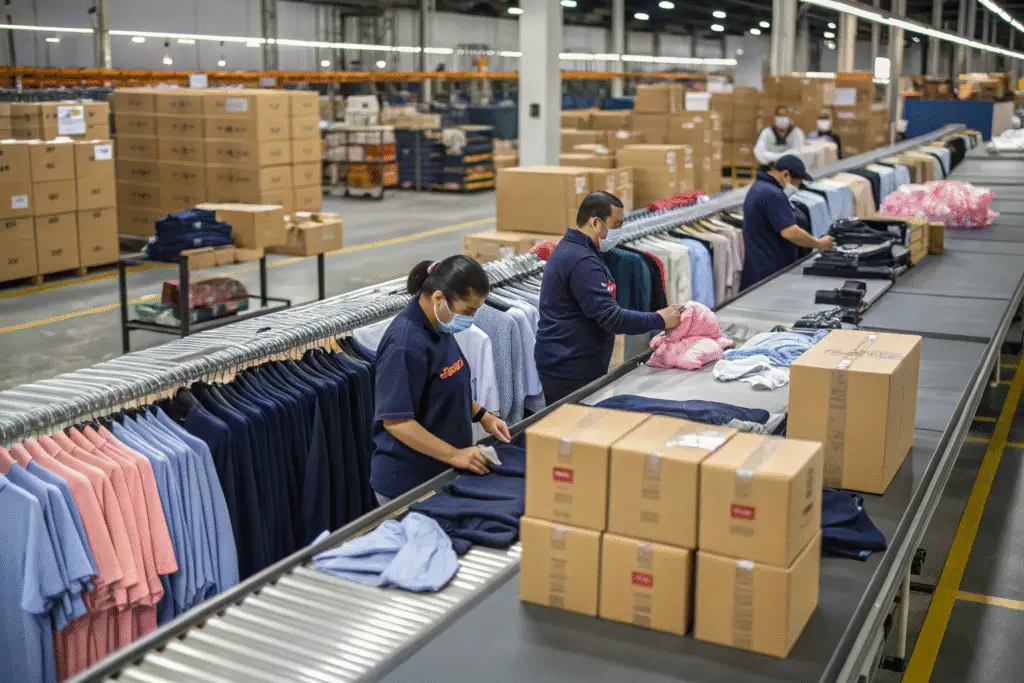
Inaccurate bundling can ruin retail relationships and cause costly delays at distribution centers. Whether you're shipping women's cardigans, kids' sleepwear, or men's tracksuits, your bundled units must match the retailer's exact spec — or risk chargebacks, return shipments, and loss of trust. For international buyers like Ron, getting bundling wrong isn’t just a mistake — it’s a financial liability.
To ensure accurate bundling for retail distribution, you must implement strict size ratio checks, barcode-based verification, clear bundle instructions, and pre-shipment audits.
At Fumao Clothing, we’ve fulfilled thousands of bundled apparel shipments to big-box retailers, Amazon FBA warehouses, and boutique chains across the U.S. and Europe. In this article, I’ll break down how to set up bundling accuracy workflows — and how we do it right for our global clients.
What Are the Standard Bundling Requirements in Retail?
Before you ship, you need to know how your buyer wants the product bundled — by size, color, or SKU. Most retailers won’t accept random packing. If your bundles are off by even one size, your cartons may be rejected.
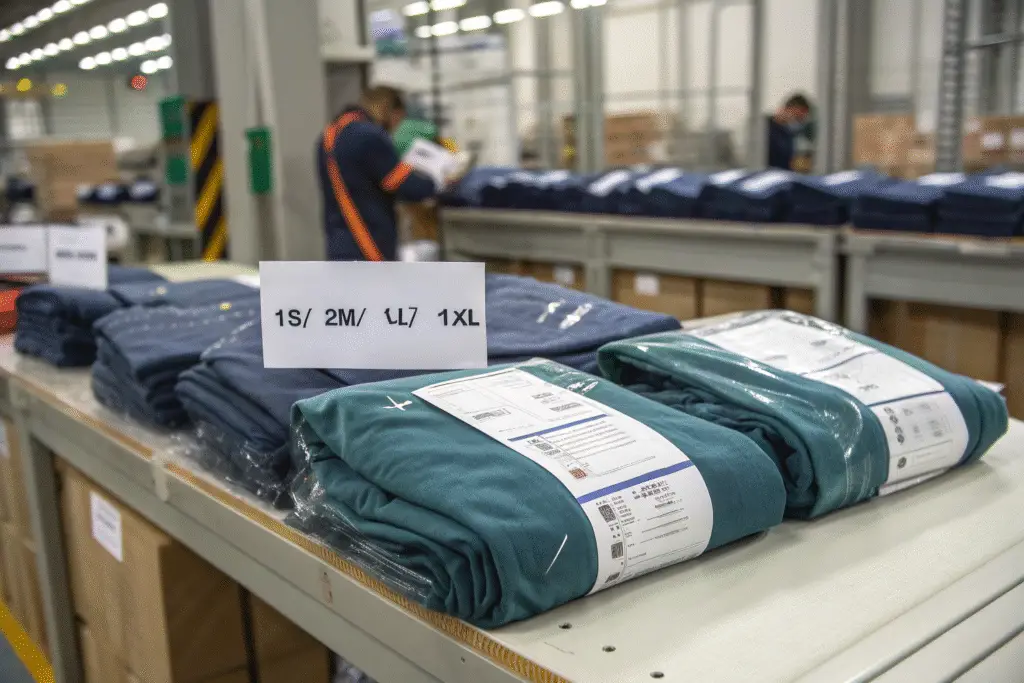
Standard retail bundling types include prepack ratio bundles (e.g., 1S/2M/2L), same-size bulk packs, or single-SKU case packs. Each retailer has its own labeling and carton rules.
What Are Ratio Packs and Why Are They Common?
Ratio packs — also known as prepacks — are a mix of sizes in one polybag or inner carton. For example:
- 1S / 2M / 2L / 1XL (6 pcs)
- 2M / 2L / 2XL (6 pcs)
- 2T / 3T / 4T (kidswear)
These save shelf space and simplify store-level restocking. Most U.S. department stores and fashion chains request ratio packs for efficiency.
How Are Bulk Packs Different?
Bulk packs contain one size only — often used for e-commerce or Amazon FBA orders. These must follow strict labeling guidelines. See Amazon’s FBA prep instructions for exact barcode, polybag suffocation warning, and case weight specs.
How to Build an Error-Free Bundling Workflow?
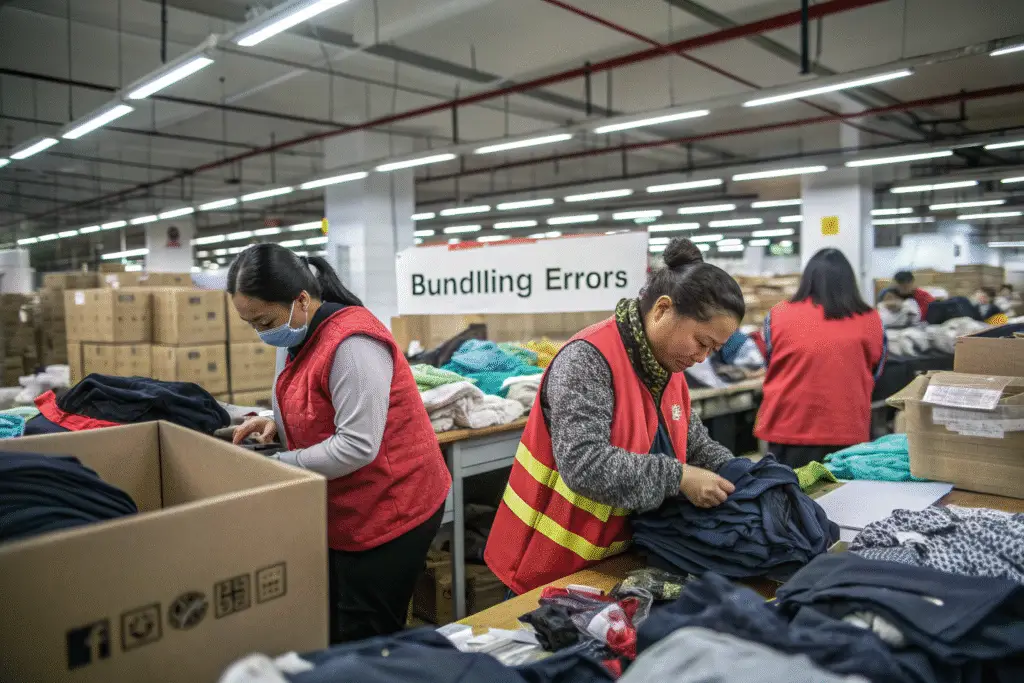
Bundling errors often happen at the last mile of production — when garments are sorted, packed, and labeled. Human error is the top culprit.
To avoid bundling errors, set up an SOP with size sorting verification, barcode scan checks, bundling spec sheets, and final supervisor confirmation.
How Do You Use Barcodes to Prevent Packing Mistakes?
Assign unique barcodes to each SKU and size. Then, scan each garment before placing it into a bundle. The scanner will beep or flag an error if the wrong size or SKU is inserted.
We use Urovo and Zebra handheld scanners synced to a bundling checklist. This reduces human error by 90% and ensures pack integrity.
What About Using Photos or Printed Spec Sheets?
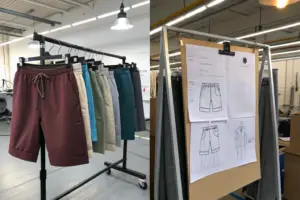
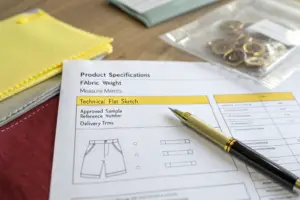
Spec sheets act as visual guides. We post printed bundle ratio diagrams at every packing station. These include:
- Size breakdown
- SKU code
- Polybag size
- Barcode location
For large orders, we print color-coded labels for size groups. Learn more about bundle visualization practices that improve accuracy in fast-paced settings.
What QC Procedures Verify Bundling Accuracy?
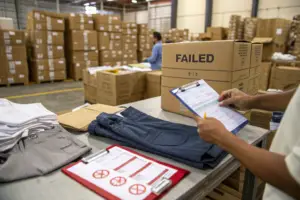
Even with bundling SOPs, errors can still sneak through. Final-stage quality control is critical before loading containers or booking air freight.
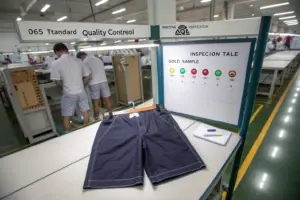
QC checks for bundling include random bundle audits, label/barcode matching, physical recounts, and verifying against master pack lists.

What Is the AQL Level for Bundling Audits?
We use AQL 2.5 for final bundling audits, the same level used in apparel QC. Inspectors randomly select a % of cartons and check:
- Bundle quantity per spec
- Correct size ratios
- Barcode accuracy
- Inner polybag seal and suffocation warnings
Refer to this AQL chart for sample sizes and tolerance levels.
Can Buyers Request External QC Services?
Yes — many buyers use third-party firms like QIMA or Intertek for final bundling verification. We coordinate directly with these auditors to schedule inspections, prepare samples, and correct any nonconformities before shipment.
How Can You Streamline Shipping for Bundled Goods?
Even if your bundles are accurate, poor documentation or carton confusion at loading can result in delays or retail rejection.
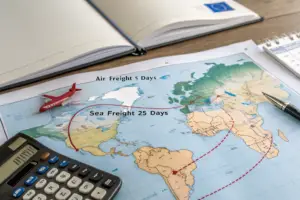
Shipping bundling best practices include accurate carton labeling, bundle manifest generation, DDP logistics, and delivery time buffers.
What Should Be on the Bundle Carton Label?
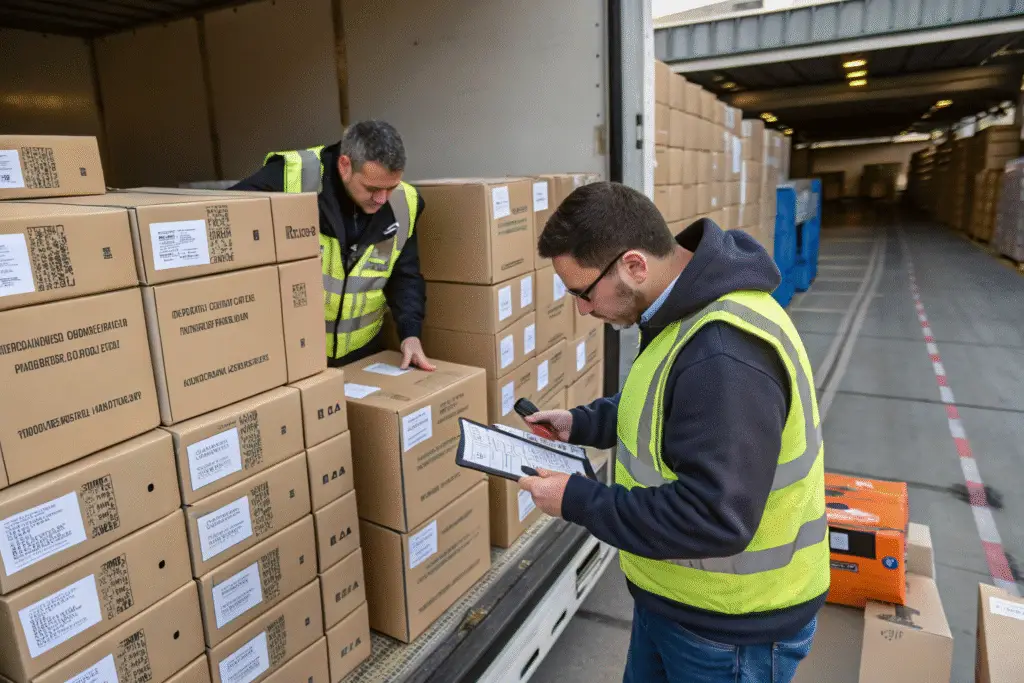
Each carton should have:
- PO number
- Style number
- Bundle configuration (e.g., 1S/2M/2L/1XL)
- Carton number (e.g., Carton 3 of 20)
- Gross/net weight
- Country of origin
- UPC or FNSKU labels (if for Amazon)
Retailers like Walmart and Target also require SSCC barcode labels for pallet tracking.
Why Choose DDP Shipping for Bundled Orders?
DDP (Delivered Duty Paid) means the supplier handles all customs, duty, and freight until it arrives at the buyer’s warehouse. This reduces transit error risk and simplifies retail onboarding.
We offer DDP to U.S. distribution centers, including Amazon, Macy’s, and Walmart-approved 3PLs. Our freight team handles:
- Export declaration
- Import documents
- Customs clearance
- Final-mile delivery
Learn more about DDP advantages in apparel logistics.
Conclusion
Accurate bundling is a silent hero in retail supply chains — and a deal-breaker when done wrong. From size ratio matching to barcode scanning and QC audits, every step in the process ensures your goods land on shelves correctly and on time. Don’t let a labeling error cost you a retail partner.
At Fumao Clothing, we support bundling precision through SOPs, automated scanners, QC inspections, and DDP shipping to U.S. retail warehouses. Whether you're bundling women's dresses, men's tracksuits, or kidswear pajama sets, we’ve got you covered.
To learn more or request a quote for your bundled apparel order, contact our Business Director Elaine at elaine@fumaoclothing.com. Let’s make every carton accurate — and every delivery profitable.