
You’ve seen the term “MOQ” in almost every supplier conversation—but there’s a lot more to it than just a number.
MOQ (Minimum Order Quantity) directly affects pricing, production planning, and your ability to test the market—yet most buyers don’t fully understand how to use it to their advantage.
Let’s go beyond the surface and explore the facts, risks, and smart strategies hidden behind this common manufacturing term.
What are the disadvantages of MOQ?
Most buyers think MOQs are just inconvenient. But the real risks go deeper—especially for small businesses.
The disadvantages of MOQ include high upfront investment, excess inventory, cash flow pressure, and reduced flexibility in product testing.

How does MOQ limit small businesses?
Small businesses often struggle to meet high MOQs1, especially when starting a new product line. If you’re required to order 1,000 pieces per style, but you only need 100 to test the market, you risk overstock, cash drain, and unsold inventory.
Here are a few more potential issues:
- Higher financial risk: Ties up capital in stock you may not sell.
- Storage burden: You need space to hold the inventory.
- Reduced product variety: Can’t test multiple styles at once.
- Missed opportunities: If one item fails, your budget is gone.
How to mitigate MOQ disadvantages?
- Negotiate a trial run or sample batch2.
- Partner with small-batch manufacturers3.
- Choose basic designs first, then expand.
- Pool orders with other small brands for shared MOQ.
Not every factory will agree, but if you ask the right way and build trust, many are open to working with new clients at lower volumes.
What is the difference between MOQ and EOQ?
MOQ and EOQ both deal with quantity—but they serve different purposes in manufacturing and inventory management.
MOQ (Minimum Order Quantity) is the minimum number of units a supplier will produce, while EOQ (Economic Order Quantity) is the optimal number of units a buyer should order to minimize costs.

Why do buyers need to understand both terms?
MOQ4 is supplier-driven. EOQ5 is buyer-driven. Balancing the two helps avoid waste and inefficiencies.
Here’s how they compare:
| Term | Who Sets It | Purpose | Affects |
|---|---|---|---|
| MOQ | Supplier | Ensures production cost is covered | Order acceptance |
| EOQ | Buyer | Minimizes inventory cost6 | Reorder schedule and stock use |
How do MOQ and EOQ conflict?
Let’s say your EOQ is 300 units based on your warehouse space and customer demand. But the supplier’s MOQ is 500. You’ll need to either find another supplier or negotiate a split shipment.
Understanding EOQ helps you know how much stock you should hold, not just how much the supplier wants you to order.
What are the rules for MOQ?
You may think MOQ is a fixed number, but in reality, it’s more of a business rule—and it’s often negotiable.
The rules for MOQ depend on factors like product type, production method, material cost, and supplier policies. There are no universal standards, but general trends exist.

What influences a supplier’s MOQ?
- Fabric and trims: Some materials must be purchased in bulk.
- Printing techniques: Setup cost for screen printing or embroidery.
- Production efficiency7: Changing machines for small runs is time-consuming.
- Packaging and labeling8: Custom elements require higher volumes.
- Factory size9: Larger factories prefer large orders to keep machines running efficiently.
Common MOQ ranges by product type:
| Product Type | Typical MOQ |
|---|---|
| T-shirts (plain) | 50–200 pcs |
| Embroidered caps | 100–300 pcs |
| Dresses | 100–500 pcs |
| Activewear sets | 200–600 pcs |
If you’re launching a new brand, always ask if the factory has leftover stock fabrics—this can help reduce MOQ since no custom dyeing is needed.
How to decide MOQ?
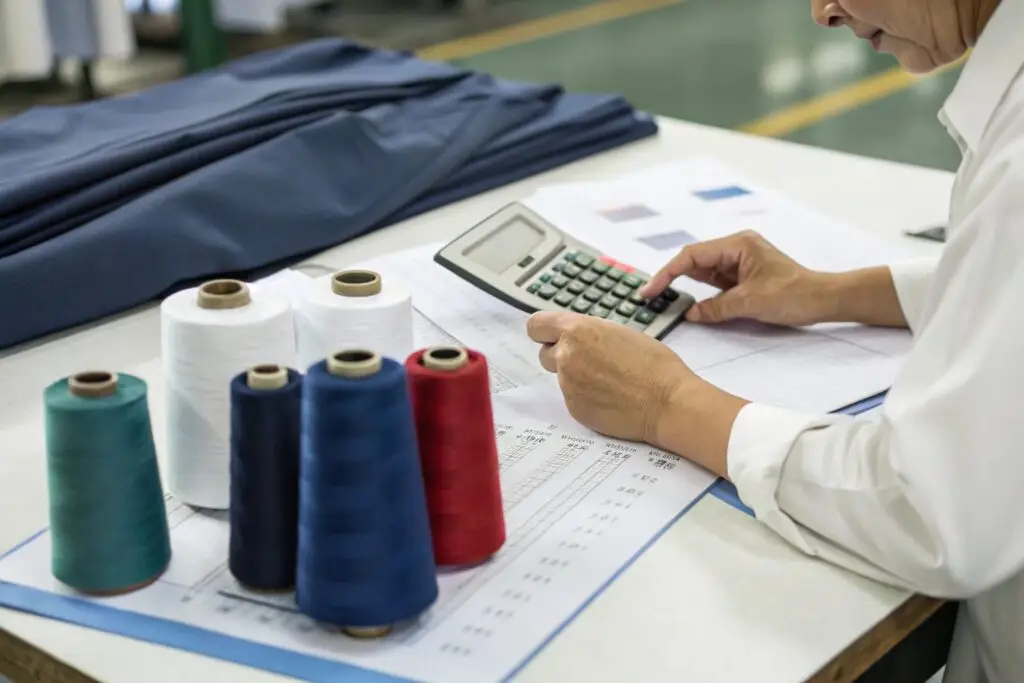
If you're a clothing supplier or factory, setting your MOQ can be tricky—you don’t want to scare away small clients, but you also can’t lose money.
To decide on MOQ, calculate your break-even point, analyze production setup costs, and consider your business goals and customer type.
What are the key steps in setting MOQ?
-
Understand fixed costs10
Factor in setup time, labor, material wastage, and admin work. This gives you the base cost to open production. -
Evaluate profit margins11
Decide how many units you must sell to cover the cost and make a profit. If 100 pieces earn too little, raise the MOQ. -
Analyze past orders
Review your historical data. What quantity tends to sell smoothly? This can guide realistic MOQ levels. -
Check material sourcing limits12
Some mills only sell fabric by the roll. If one roll produces 500 units, you may need to set MOQ accordingly. -
Balance growth with volume
Keep your MOQ lower for startup clients. Offer tiered pricing to grow together.
Why flexibility helps win more clients?
Having a flexible MOQ policy—like offering lower MOQs for standard styles—can bring in new buyers who turn into long-term partners. You can also offer a higher unit cost for small runs to cover the gap.
Conclusion
MOQ isn’t just a number—it’s a strategy. Whether you’re a buyer trying to minimize risk or a supplier protecting your margins, understanding how MOQ works gives you more control, more confidence, and better results in the apparel business.
-
Understanding the implications of MOQs can help small businesses strategize better and avoid financial pitfalls. ↩
-
Learning about trial runs can help businesses test products without committing to large orders, minimizing risk. ↩
-
Exploring small-batch manufacturing options can provide flexibility and reduce financial risks for small businesses. ↩
-
Exploring this link will deepen your understanding of Minimum Order Quantity and its impact on supplier relationships. ↩
-
This resource will clarify the Economic Order Quantity concept and its significance in minimizing costs. ↩
-
Discover strategies to reduce inventory costs, enhancing your overall supply chain efficiency. ↩
-
Understanding production efficiency can help you optimize your supply chain and reduce costs. ↩
-
Exploring this topic can provide insights into how to manage costs effectively while maintaining quality. ↩
-
Learning about factory size can help you choose the right supplier for your production needs. ↩
-
Understanding fixed costs is crucial for setting an effective MOQ. Explore this link to gain insights into managing production expenses. ↩
-
Profit margins directly impact your pricing strategy. Discover how to optimize them for better MOQ decisions. ↩
-
Material sourcing limits can dictate your production capabilities. Learn more about their impact on MOQ settings. ↩