Choosing the right payment method in custom clothing manufacturing is like selecting the right fabric for a garment—it must be durable, flexible, and appropriate for the specific project. A poor choice can unravel the entire business relationship. For factory owners and brand buyers alike, this decision balances trust, risk, cash flow, and administrative ease, with significant consequences for profitability and partnership longevity.
There is no single "best" payment method for all custom clothing manufacturing. The optimal choice depends on a strategic evaluation of order value, relationship history, and risk tolerance. A balanced approach, often combining methods like a substantial deposit with progress payments, typically offers the most security and fairness for both manufacturer and client. The goal is to align financial terms with the production journey, ensuring neither party carries disproportionate risk.
At Shanghai Fumao, after years of navigating thousands of orders, we've found that the most successful partnerships use tailored payment structures. What works for a first-time, high-value knitwear collection differs from a repeat order for basic woven shirts from a trusted partner. Let's break down the common methods and provide a clear framework for choosing the right one for your next project.
How Do You Evaluate Risk for Different Payment Methods?
Every payment method distributes risk differently between the manufacturer and the buyer. A proper evaluation requires honestly assessing where the vulnerabilities lie at each stage of a custom order—from fabric sourcing to final delivery. Understanding this risk map allows you to select a method that protects your business without stifling the partnership.
Custom manufacturing is inherently risky for the factory: we commit to specific fabrics, trims, and labor for a unique product that may have little resale value if the order is canceled. Therefore, payment terms must mitigate this sunk-cost risk. Conversely, buyers risk paying for goods that don't meet their quality expectations. A good payment method addresses both concerns.
What are the core risks for manufacturers and buyers?
The risks are asymmetric but interconnected.
- Manufacturer's Primary Risk: Non-payment for shipped goods or cancellation after costly materials have been purchased. This directly threatens cash flow and profitability.
- Buyer's Primary Risk: Receiving substandard or non-conforming goods after full payment has been made. This can devastate a selling season.
A secure method like a Letter of Credit (L/C) mitigates the manufacturer's risk of non-payment but is complex and costly for the buyer. 100% Advance Payment eliminates the factory's risk but is highly risky and cash-flow intensive for the buyer. Open Account is the opposite. The risk management challenge is finding the middle ground.
How does order value and relationship history influence risk?
These are the two most critical factors in our decision matrix at Shanghai Fumao.
- Order Value: Higher value equals higher risk. A $5,000 sample order may warrant more flexible terms than a $200,000 bulk production run.
- Relationship History: Trust is earned. A new client is an unknown risk. A client with a 3-year history of on-time payments and clear communication represents lower risk.
We formalize this with a simple internal rating. A new client with a large order gets our most secure terms (e.g., L/C or large deposit). A long-standing partner with a repeat order might qualify for a simplified deposit + balance structure. Last year, we moved a reliable client from 50% deposit/50% before shipment to 30% deposit/70% net 30 days after shipment, strengthening our partnership because their 2-year history warranted it.
What Are the Pros and Cons of Common Payment Methods?
Each standard payment method has a clear profile of advantages and disadvantages. The key is to match these profiles to the specific context of your order and partnership. Below is a comparative analysis of the most frequently used methods in our apparel manufacturing business.
Is a Letter of Credit (L/C) the gold standard for security?
A Letter of Credit is a bank-guaranteed payment promise, making it extremely secure for the seller.
- Pros for Manufacturer: Near-elimination of credit risk if documents are compliant. Guaranteed payment upon shipment.
- Cons for Manufacturer: High administrative burden. Risk of discrepancies leading to non-payment. Bank fees.
- Pros for Buyer: Payment only released if factory meets exact contractual terms (proven via documents).
- Cons for Buyer: Ties up credit line with bank. Complex and costly to arrange. Inflexible.
Verdict: Best for high-value orders with new clients or in politically/economically unstable regions. It's overkill for small, repeat orders with trusted partners.
Are milestone payments the fairest approach?
This method breaks payment into portions tied to completed production stages (e.g., 30% deposit, 40% after production, 30% after shipment).
- Pros for Both: Aligns cash outflow with production progress. Fairly shares financial commitment. Builds transparency.
- Cons for Manufacturer: Still carries some risk if buyer defaults at a later stage.
- Cons for Buyer: Requires active monitoring of production milestones.
Verdict: Often the most balanced and recommended approach for custom manufacturing. It protects the factory's upfront costs and gives the buyer ongoing leverage for quality.
Why is a Tiered "Deposit + Balance" Strategy Often Most Effective?
A tiered strategy that starts with a significant deposit and concludes with a final balance payment—often linked to a key production or shipping milestone—strikes an optimal balance between security and partnership. It is less rigid than an L/C but far more secure than open account. This method acknowledges the financial reality of manufacturing while giving the buyer reasonable assurance.
This approach directly addresses the core financial pain point: material cost. The deposit should be large enough to cover the majority of fabric and trim expenses. This ensures the factory is not financing the buyer's project with its own working capital. The balance payment then covers labor, overhead, and profit, and is triggered by an objective event.
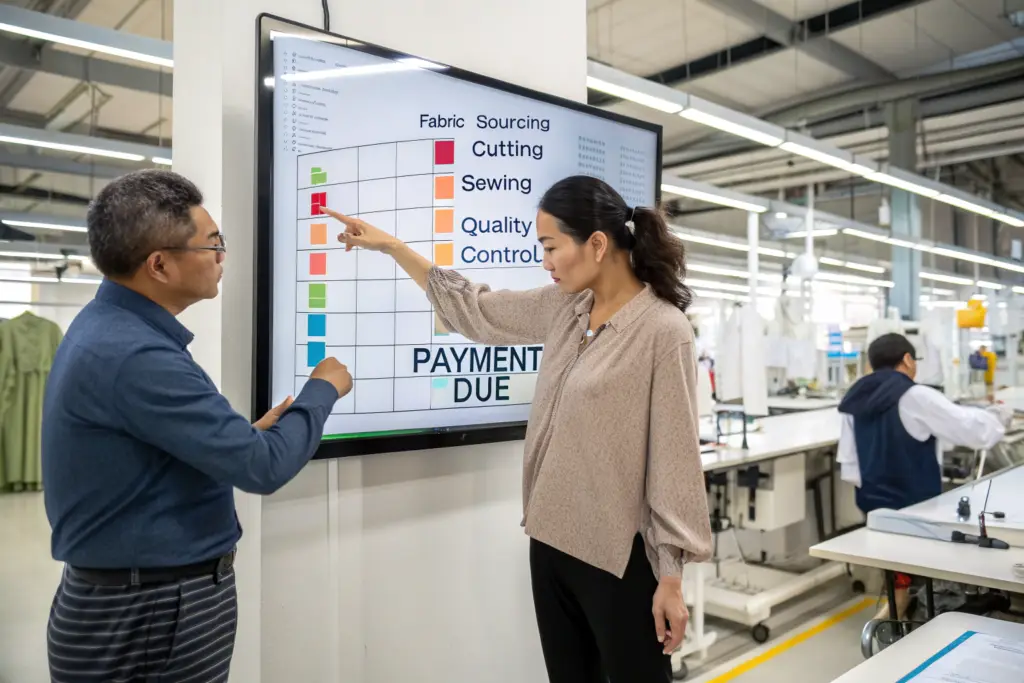
How do you structure the deposit amount?
The deposit is not arbitrary; it should be calculated.
- Standard Practice: 30%-50% of total order value.
- Calculation Basis: It should at minimum cover the total cost of all raw materials (fabrics, threads, buttons, zippers, labels).
- Variable Factors: For orders using very expensive or specialized materials (e.g., certified organic cotton, Japanese selvedge denim), we may request a 50% or higher deposit. For basic cotton tee orders, 30% may suffice.
We once produced a collection using a novel recycled fabric that was costly and had a long lead time. We structured a 60% deposit to secure the fabric order, with the client's understanding. This transparency built trust, and the project was completed smoothly.
What is the best trigger for the final balance payment?
The timing of the final payment is crucial for closing the risk loop. Common and effective triggers include:
- Before Shipment: Payment of balance is required before goods are loaded onto the vessel/plane. This is very secure for the factory.
- Against Shipping Documents: Balance is paid upon presentation of copy Bill of Lading and other shipping docs. This is a common compromise.
- Net Terms After Shipment (e.g., Net 30): The least secure for factory, but may be offered to trusted clients. To mitigate risk, we often combine this with Export Credit Insurance.
For most of our clients, we use "Balance before shipment" as the standard. This gives the buyer final quality verification during pre-shipment inspection while ensuring we are paid before relinquishing physical control of the goods. It's a cornerstone of our full-package service.
How Can Technology and Hybrid Models Enhance Security?
Modern tools and creative hybrid models can streamline payment processes and create new ways to share risk comfortably. Technology adds transparency, while hybrid models allow for customization beyond standard templates. These approaches are especially valuable for growing brands and factories building long-term portfolios.
The integration of production management software with financial triggers is a game-changer. It removes ambiguity and creates an automatic, rules-based process for releasing work based on payment confirmation.
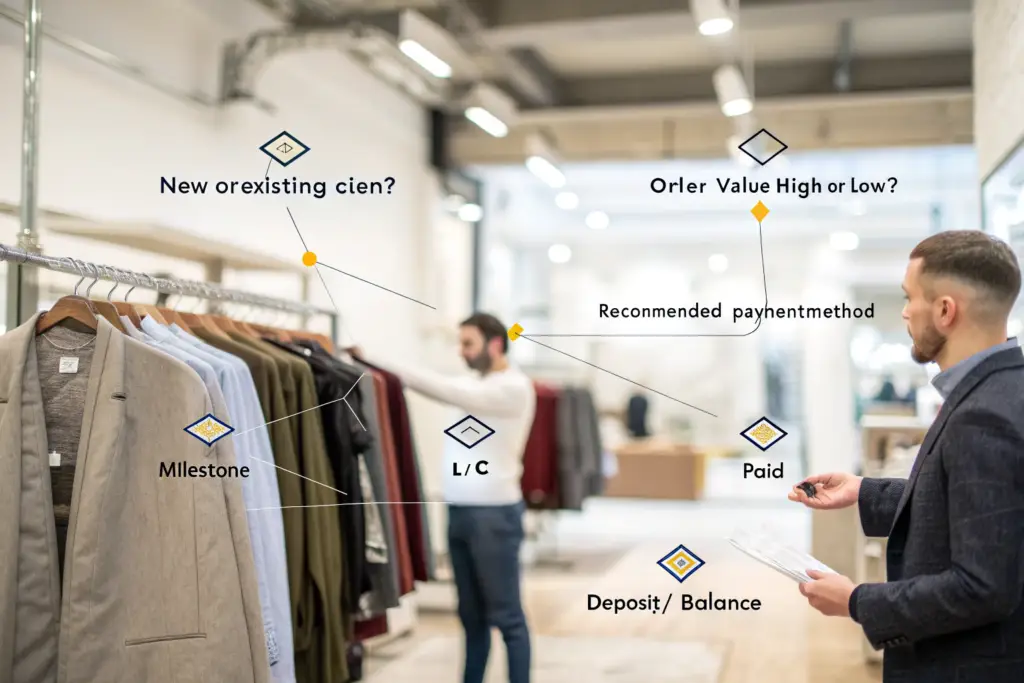
What role does production management software play?
Advanced Manufacturing Execution Systems (MES) or ERP software can link payment status to production stages. In our system:
- An order cannot be moved from "Design Approved" to "Material Ordered" until the deposit is logged.
- The "Cutting" stage cannot be scheduled without material confirmation.
- The "Ready for Shipment" flag is not triggered until the balance payment is confirmed.
This creates an objective, transparent workflow. A client can see their order's status in a portal, and they understand that payments are the key that unlocks the next phase. This technological layer enforces the agreed terms impartially.
Can you combine different methods for one order?
Absolutely. Hybrid models are often the most practical solution. Examples include:
- L/C with Deposit: For a massive order, a buyer might pay a 10% deposit via TT to secure factory capacity, with the remaining 90% covered by an L/C. This shares the commitment.
- Milestone + Open Account Component: For a trusted partner, we might do 30% deposit, 40% after production, and 30% on open account net 30 days after shipment. The open account portion is a gesture of trust for the final portion.
- Payment against Inspection Report: The final balance is due only after the buyer or a third-party (like SGS or Bureau Veritas) approves the pre-shipment inspection report. This directly links payment to verified quality.
We successfully used the inspection-report trigger with a client who was particularly anxious about quality. We agreed that the final 30% payment would be due within 24 hours of their QC manager approving the digital inspection report and photos. This gave them control and us a clear, fast payment trigger.
Conclusion
The search for the "best" payment method ends with a simple truth: context is king. The optimal structure is the one that proportionally manages the specific risks of the order while fostering a collaborative partnership. For most custom clothing manufacturing projects, a tiered deposit and balance system—often expressed as milestone payments—provides the ideal equilibrium of security, fairness, and operational simplicity.
As a manufacturer, presenting clear, logical payment options is a sign of professionalism. It shows you understand the business realities of your clients while safeguarding your own ability to deliver consistently. At Shanghai Fumao, we don't see payment terms as a battle to win, but as a framework to build upon. Our goal is to propose a structure that lets both sides sleep soundly, focusing creative energy on the product, not on financial anxiety.
If you are planning a custom apparel project and want to discuss a payment structure that protects your investment and aligns with your production timeline, we are here to craft a solution. Contact our Business Director, Elaine, at elaine@fumaoclothing.com to start a conversation about building your collection on a foundation of financial clarity and mutual trust.