You're about to place a significant apparel order with a Chinese factory. Your financial controller, concerned about sending large sums overseas, suggests using a Letter of Credit (L/C) because it's "the safest method." But is it truly safe for sourcing clothing? The answer is nuanced: an L/C provides a specific type of documentary safety but introduces significant commercial, operational, and financial risks that are often mismatched with the realities of custom garment production. For most apparel importers, an L/C is a cumbersome, expensive solution that creates new dangers while solving a problem better managed through other means.
L/C payments are "safe" in the narrow sense that they guarantee payment to the supplier only upon presentation of perfect shipping documents, theoretically protecting against supplier non-shipment. However, they are notoriously unsafe for ensuring product quality, are vulnerable to costly documentary discrepancies, add weeks to your timeline, and incur high bank fees—making them a high-cost, high-complexity tool often ill-suited for the quality-focused, time-sensitive nature of clothing sourcing from China. For apparel, safety is better achieved through supplier vetting, milestone payments tied to inspections, and building trust.
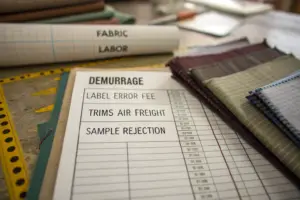
At Shanghai Fumao, a European brand insisted on an L/C for their first $120,000 order. They believed it was the ultimate protection. The process delayed production start by two weeks due to document issuance. After shipment, the bank rejected the documents because the Bill of Lading listed the port as "Shanghai" while the L/C said "Port of Shanghai." This typographical discrepancy triggered a $350 fee and a 5-day delay while we obtained a waiver. The goods, which were perfect, sat at the port accruing demurrage. The brand paid over $3,000 in L/C fees and learned that their "safe" payment method almost caused them to miss their season. They now use T/T with inspection. This story highlights the paradox of L/C safety. Let's dissect it.
What Specific Risks Does an L/C Actually Mitigate?
To evaluate safety, we must define what threat an L/C is designed to counter. Its primary function is to manage payment risk in a transaction between two parties who don't fully trust each other, using banks as trusted intermediaries.
It addresses a specific, narrow set of concerns.

The "Safe" Promise: Mitigation of Supplier Non-Performance
An L/C is fundamentally a bank's promise to pay. Your bank promises the supplier's bank: "We will pay you $X, but only if you present documents A, B, and C that exactly match our requirements." This theoretically protects you from two scenarios:
- Supplier Takes Payment and Never Ships: Without an L/C, if you pay 100% upfront and the supplier vanishes, you lose everything. The L/C ensures payment only happens after proof of shipment (the Bill of Lading).
- Supplier Ships Incorrect Goods (on paper): If the L/C requires a "Certificate of Origin stating Country X" and the supplier presents one for Country Y, payment is refused.
In this narrow documentary sense, the L/C creates a conditional barrier to payment that forces the supplier to comply with the documentary terms.
The Critical Caveat: It Manages Documents, Not Goods
This is the most important limitation. An L/C ensures document compliance, not product quality or accuracy. The banks deal exclusively in paper. They do not open containers to check if the polo shirts are 100% cotton as described, if the stitching is correct, or if the colors match the approved lab dip. A supplier could ship boxes of rags, but if the documents are perfect, the banks will pay.
Therefore, an L/C's "safety" is only against documentary fraud or non-shipment, not against the far more common risks in apparel sourcing: quality failure, specification mismatch, and delayed production.
What New and Significant Risks Does an L/C Introduce?
While solving one set of problems, an L/C creates a host of others that are often more damaging to an apparel business. These are the "unsafe" aspects of L/Cs that many first-time importers don't anticipate.
The complexity of the instrument itself becomes a primary source of risk.

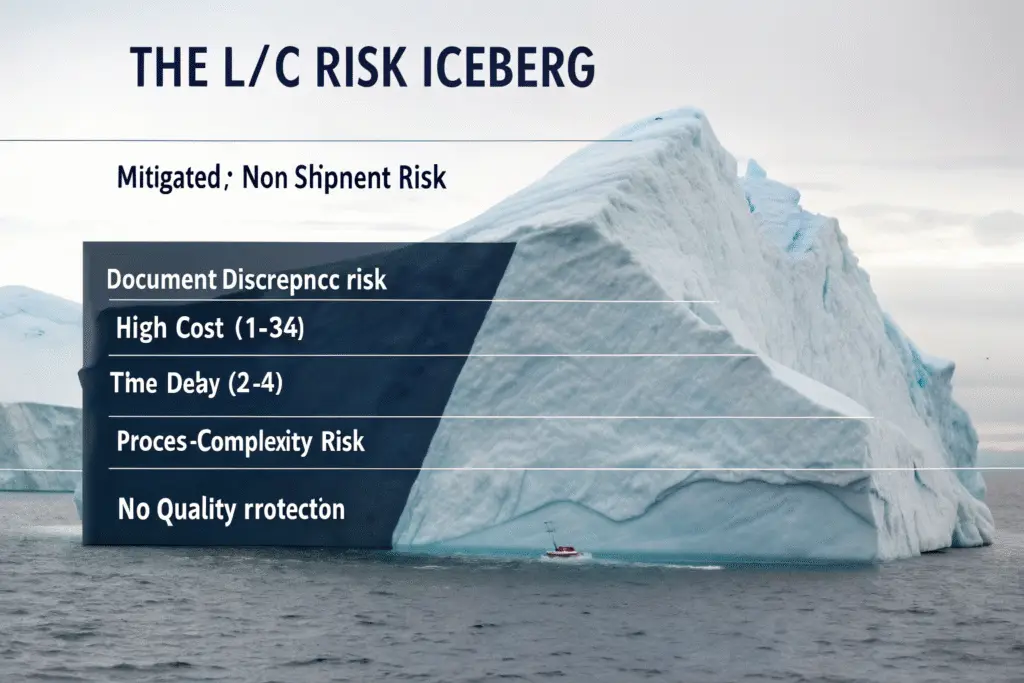
1. Documentary Discrepancy Risk (The #1 Problem)
Banks are famously pedantic. Any difference, no matter how trivial, between the L/C terms and the presented documents is a "discrepancy." Common discrepancies in apparel L/Cs include:
- Typographical errors (e.g., "T-shrit" vs. "T-shirt").
- Date inconsistencies (shipment date vs. BL date).
- Description mismatches (the commercial invoice says "Garment" but the L/C says "Apparel").
- Bill of Lading issues (e.g., "On Board" notation missing).
When a discrepancy occurs: Payment is halted. The supplier must either (a) correct the documents (often impossible once goods are shipped), (b) get you to waive the discrepancy, or (c) forfeit payment. This process incurs fees ($50-$200 per discrepancy) and causes delays of days or weeks while goods are stuck in transit or at port.
2. High and Unpredictable Costs
L/C fees are a significant percentage of the order value, eroding your margin.
- Opening Fee: 0.1% - 1% of L/C value (your bank).
- Advising/Confirmation Fee: 0.1% - 0.5% (supplier's bank).
- Amendment Fee: $50-$150 per change if the L/C needs correction.
- Discrepancy Fee: As above.
Total cost can easily reach 1.5-3% of the order value. On a $100,000 order, that's $1,500-$3,000 gone in fees alone.
3. Severe Time Delays
An L/C adds 2-4 weeks to your financial timeline:
- Issuance and advising: 1-2 weeks.
- Post-shipment document preparation and bank review: 1-2 weeks.
In fashion, this delay can mean missing a crucial shipping window or a selling season entirely. The factory also cannot start production until the L/C is advised, delaying the entire project.
4. Complexity and Process Risk
Drafting an L/C requires expert knowledge. A poorly drafted L/C (e.g., omitting the requirement for a Third-Party Inspection Certificate) leaves you exposed to quality risk. Managing the process demands significant internal administrative focus.
For apparel, where time, cost, and quality are paramount, these introduced risks often outweigh the documentary protection gained.
How Do Standard T/T Terms with Inspection Provide Better "Real-World" Safety?
For clothing sourcing, safety is not just about preventing non-payment; it's about ensuring you receive the right quality, on time, and at the agreed cost. A structured Telegraphic Transfer (T/T) process with built-in quality checkpoints addresses these real-world concerns more directly and efficiently.
This approach manages commercial risk through control and verification, not just documentary conditions.
The Standard T/T Process: Milestone-Based Control
The common 30% deposit, 70% balance before shipment model, when executed professionally, creates a superior safety framework:
- 30% Deposit: Released after supplier vetting and sample approval. This covers their material costs, showing commitment.
- 70% Balance: Released only after you approve a Pre-Shipment Inspection (PSI) Report. This is the critical safety checkpoint.
Why This is Safer Than an L/C for Apparel:
- Quality Assurance: The PSI is a physical inspection of the actual goods, checking workmanship, measurements, fabrics, and packaging. An L/C cannot do this unless you add an Inspection Certificate as a required document—which adds cost and another potential discrepancy point.
- Timeline Control: Payments and inspections happen in days, not weeks. You control the release of the final payment, which controls the release of the shipment.
- Cost Certainty: Bank fees are minimal (flat $25-$80 per transfer). No surprise discrepancy or amendment fees.
- Relationship Building: T/T terms, especially when payments are made promptly, build trust. This trust leads to better service, priority treatment, and future flexibility (like payment against BL).
The Essential Role of Supplier Vetting
Both L/C and T/T require you to manage supplier risk. With T/T, you do this upfront through due diligence:
- Factory Audits (virtual or in-person)
- Checking Business Licenses and References
- Starting with a small paid sample development order to test capability and professionalism.
This proactive vetting is far more effective at ensuring a reliable partner than relying on a bank to check documents after the fact.
At Shanghai Fumao, our clients' safety comes from our track record, our transparent processes, and our commitment to having goods pass independent inspection before final payment is requested. This commercial safety is more valuable than any documentary guarantee.
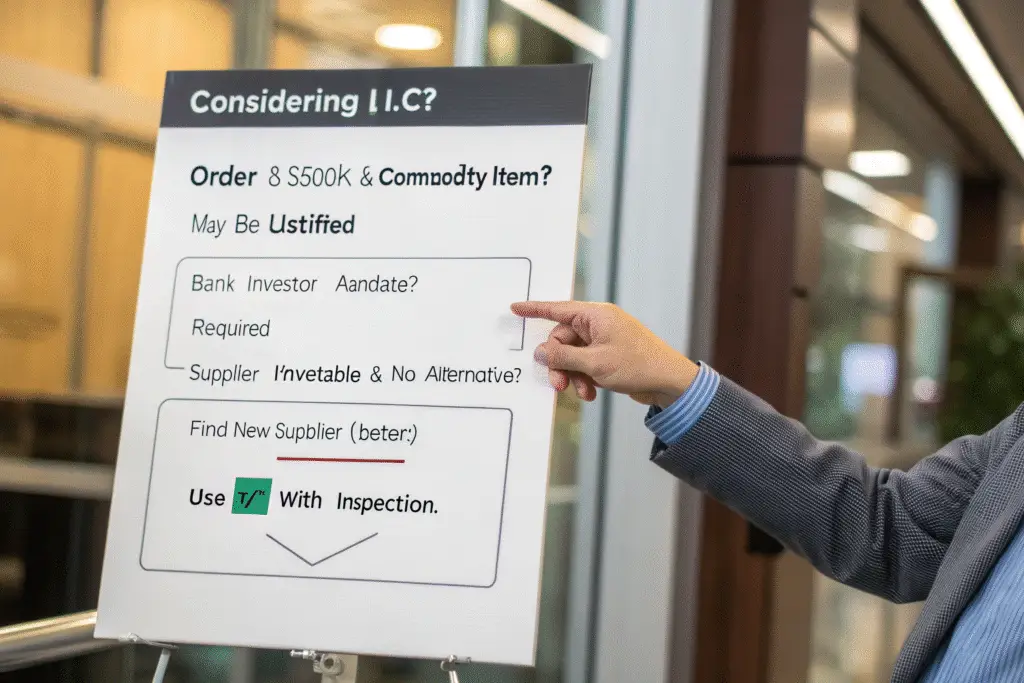
In What Specific Scenarios Might an L/C Be Justified?
Despite its drawbacks, there are niche scenarios where the cost and complexity of an L/C might be deemed necessary. These are exceptions, not the rule, for apparel sourcing from China.
It's a tool for extreme circumstances, not standard operation.

Scenario 1: Exceptionally High-Value, Non-Custom Orders
If you are ordering $500,000+ of a standard, commoditized item (e.g., basic socks, generic t-shirts) from a new supplier, the absolute financial exposure might justify the L/C cost as an insurance premium.
Scenario 2: Mandated by Your Bank or Investor
Some corporate financing or large investment deals require L/Cs as a matter of policy for any international purchase above a certain threshold. In this case, you have no choice but must learn to manage the L/C process expertly.
Scenario 3: Sourcing from a Truly High-Risk, Unverifiable Supplier
If you must source from a factory you cannot properly vet (e.g., no website, no verifiable address, refuses all audits), and you have no other option, an L/C provides a minimal documentary backstop. However, the smarter action is to find a reputable supplier instead.
Scenario 4: The Supplier Demands It
Some large, state-owned factories or those in specific regions may insist on L/Cs from all new international buyers. This is becoming increasingly rare as T/T dominates the industry.
For the overwhelming majority of brands sourcing custom-designed apparel from professional Chinese manufacturers like Shanghai Fumao, these scenarios do not apply. The trust-based, inspection-linked T/T model is the industry standard because it works better.
What Are Best Practices If You Must Use an L/C?
If you find yourself in a situation where an L/C is necessary, you can take steps to mitigate its inherent risks. Careful drafting and process management are crucial.
The goal is to make the L/C as "apparel-friendly" as possible.
Drafting a Safer Apparel L/C:
- Include a Clean Report of Findings (CRF) from a Pre-Shipment Inspection as a Required Document. This forces a quality check before payment. Specify the inspection company (e.g., SGS, BV, Intertek).
- Keep Descriptions General but Accurate. Instead of a long, detailed description of the garment that invites typos, refer to "Garments as per Proforma Invoice No. XXX dated DD/MM/YYYY." Let the commercial invoice hold the details.
- Allow for Tolerances: Specify that quantities and amounts can have a +/- 5% or 10% tolerance to avoid discrepancies for minor over/under shipments.
- Specify Acceptable Document Discrepancies: Allow for minor spelling errors or instruct the bank to accept certain common variations.
- Use an Experienced Trade Finance Bank: Work with a bank that has a strong international trade department. Their advice can prevent drafting errors.
Managing the Process:
- Start Early: Initiate the L/C application as soon as the order is confirmed to avoid production delays.
- Review All Documents Yourself Before the Supplier Presents Them: Ask the supplier to send you draft copies of the Bill of Lading, Commercial Invoice, and Packing List for pre-approval.
- Budget for Fees and Delays: Factor in the 2-3% cost and the extra 2-3 weeks in your financial and logistical planning.
Even with these practices, an L/C will remain more costly, slower, and riskier from a process standpoint than a well-managed T/T transaction with a trusted partner.
Conclusion
For sourcing clothing from China, L/C payments are "safe" only in a narrow, documentary sense that often does not align with the real risks of apparel production—namely, quality failure and timeline disruption. They introduce high costs, severe delays, and a labyrinth of documentary risk that can easily strand your shipment and erase your margins. In the dynamic, trust-based world of garment manufacturing, this bureaucratic instrument is a blunt tool that often causes more harm than protection.
True safety in apparel sourcing is achieved through diligent supplier vetting, milestone-based payments controlled by physical inspections, and the cultivation of long-term, transparent partnerships. The standard T/T model, when executed with these professional safeguards, provides a more comprehensive, efficient, and cost-effective form of security that directly addresses what matters most: getting the right quality, on time.
If you are seeking a manufacturing partner in China whose reliability and quality systems make complex L/Cs unnecessary, we are built for that trust. At Shanghai Fumao, our transparency and commitment to inspection-based approvals allow our clients to use simple, secure T/T payments with complete confidence. Contact our Business Director Elaine to discuss how we build safety into our process, not just our paperwork: elaine@fumaoclothing.com.