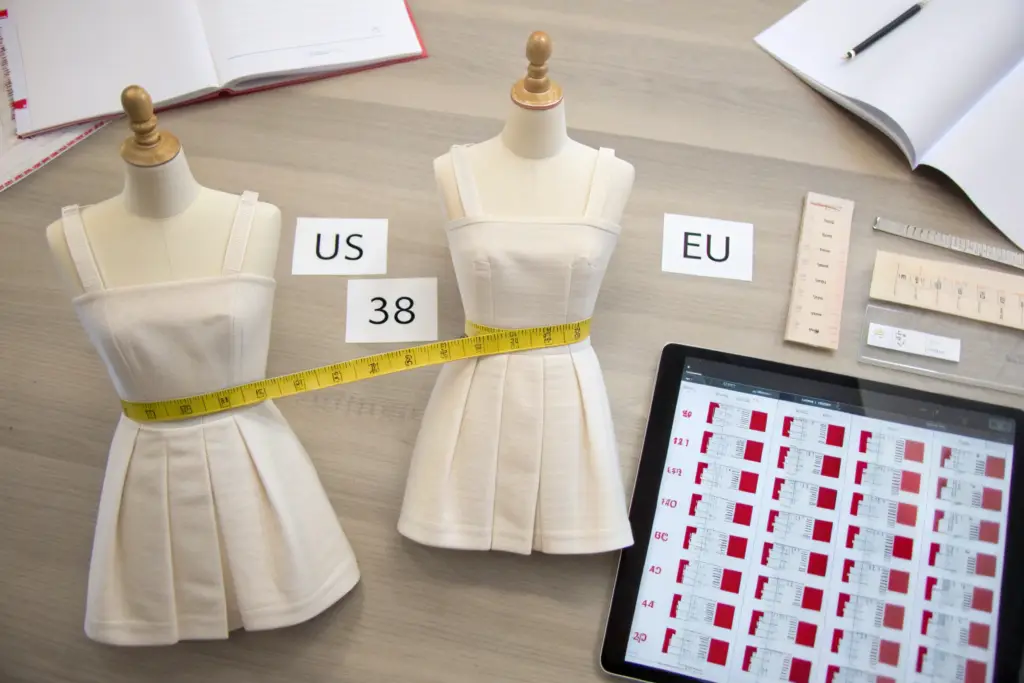
You have built a successful brand in the US. Your fit is perfected. Your customers love your size Medium. Now, you are ready to expand into the European market. You confidently send your US-graded patterns to the factory and simply ask them to print a new label: "US 8 / EU 38." The orders come in, and then the returns start flooding back. The EU 38 is enormous on the European customer. You are baffled. A frustrated brand owner told me, "I thought a size was a size. I learned the hard way that a US 8 and an EU 38 are not the same body. They aren't even close. My label was lying to my customer, and my returns proved it."
Navigating the differences between US and European clothing sizes requires abandoning the myth of a simple label conversion. It is a technical challenge of engineering a different product for a different body. A US 8 is built for a bust of approximately 36 inches. An EU 38 is built for a bust of approximately 34.5 inches. They are different sizes, with different proportions, and require separate base patterns and grading rules. You cannot translate a fit; you must re-engineer it for each market using market-specific data and rigorous fit testing on local models.
At Shanghai Fumao, our pattern makers and graders are experts in this precise technical challenge. We help our B2B partners build collections that fit perfectly in New York, London, and Berlin. Let me explain the core differences between these sizing systems and the exact process we use to ensure your brand delivers a flawless, market-specific fit every time.
Why Is a "Size Conversion Chart" a Dangerous Lie on a Hangtag?
The most common and costly mistake brands make is relying on a simple printed size conversion chart on their hangtag. This chart implies that the underlying garment is magically three different sizes at once. It is a fiction. A physical garment can only be one set of measurements. If it was cut and graded to fit a US size 8 body, it will not fit a standard UK 12 or EU 40 body, regardless of what the label says. The chart changes the label; it does not change the fit.
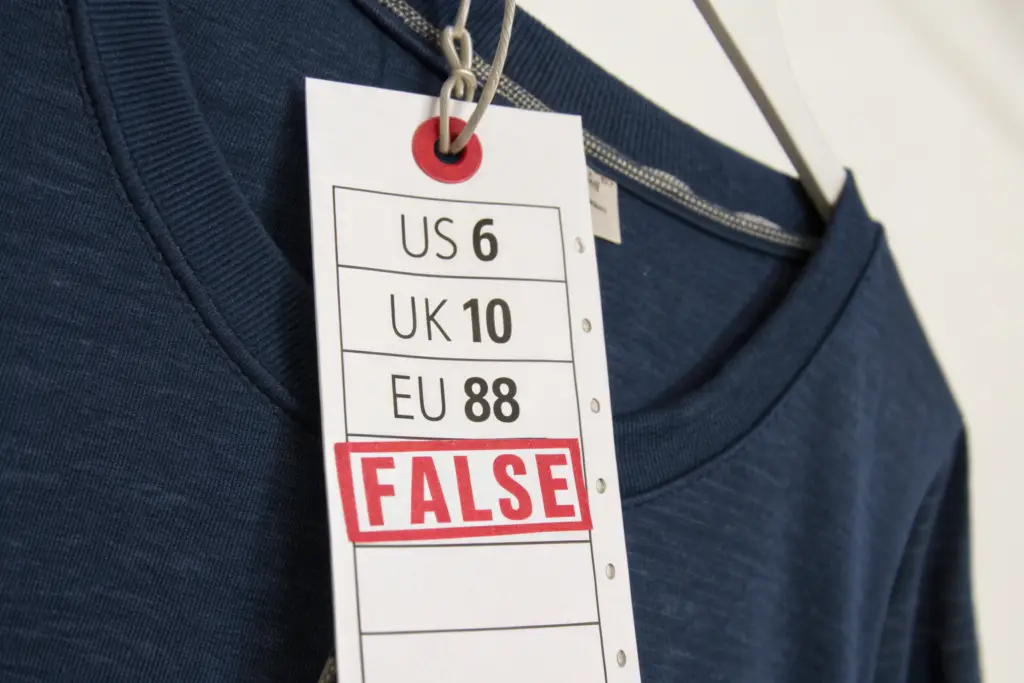
A printed size conversion chart is dangerous because it implies a single garment can fit three different body measurements. It cannot. A garment is a physical object cut and graded for a specific set of base body measurements. A US 8 is built for a bust of ~36". An EU 38 is built for a bust of ~34.5". Labeling a US 8 as an EU 38 is telling a significantly smaller customer that this garment is designed for them, which will result in a poor, oversized fit and a guaranteed return. The only honest conversion is a separate production run for each market.
I recall a brand that launched in Europe by simply adding a conversion chart to their US-graded line. Their returns were catastrophic. A European customer ordering a size 38 received what was actually a US 8, and the shoulder seams hung off her by an inch and a half. The brand's reputation for fit was destroyed before it even got started. They learned the most expensive lesson in global expansion: you cannot fake a fit. This is the reality of international sizing integrity .
What Is the Actual Bust Measurement Difference Between a US 8 and an EU 38?
This is the smoking gun. A standard US size 8 is designed around a 36-inch bust (approximately 91.5 cm). A standard EU size 38 is designed around a 34.6-inch bust (approximately 88 cm). There is a 1.5-inch (4 cm) difference in the foundational body measurement. A garment built for one cannot magically shrink to fit the other. This is the mathematical reality.
Why Is This Mislabeling the #1 Cause of Returns for Brands Going Global?
It is a betrayal of customer trust. A shopper in Paris orders her standard EU 38. She receives a garment that is scaled for a body 1.5 inches larger than her own. It feels enormous and ill-fitting. She doesn't blame the size chart; she blames your brand for having inconsistent, poor sizing. She returns the item and never shops with you again. You have lost a customer not because of a design flaw, but because of a labeling lie. This is the self-inflicted wound of incorrect international sizing .
What Are the Core Technical Differences in Base Bodies and Grading Rules?
The difference between US and EU sizing is not just a different starting number; it is a fundamentally different interpretation of the human body. Each system is based on decades of anthropometric data collected from its own population, resulting in distinct "base body" archetypes and different rules for how the body grows between sizes. You are not just tweaking a label; you are designing for two different customers.
The core technical difference lies in the base body measurements and the grading rules. A US base size (e.g., 8) has a larger bust, broader shoulders, and a different hip-to-waist ratio compared to an EU base size (e.g., 38). The grading rules—how much a pattern is scaled between sizes—are also different. For example, the bust grade between sizes is typically 1 inch in the US system but 2 cm in the EU system, causing the sizes to diverge further as you move away from the base. You cannot use a US-graded nest of patterns for an EU customer.
A brand we work with successfully launched in Germany. We did not use their US patterns. We worked with them to create a new, EU-specific base size 38 pattern, using our EU standard grade rules. The same dress design, when produced on the two different pattern foundations, yielded beautifully fitting products for both markets. The US customer remained loyal to her size 8, and the new German customer found that the size 38 fit her body perfectly. This is the strategic solution of market-specific engineering .
What Are the Two Separate "Grade Rule" Libraries a Professional Factory Maintains?
A professional factory serving both markets will have two distinct libraries of grade rules. A US Grade Rule Library is based on ASTM standards, typically in inches (e.g., bust grade of 1 inch). An EU Grade Rule Library is based on EU standards, typically in centimeters (e.g., bust grade of 2 cm). Using the correct rule library for the target market is the non-negotiable technical foundation of a successful global fit. This is a key part of our grading expertise .
How Do You Decide on the Best "Base Size" for Each Market?
Your base size is the anchor for the entire production run. You should choose a base size that corresponds to the median body of your specific target customer in that market. For a young, contemporary US brand, a size 8 might be a good base. For a more classic European brand, a size 38 or 40 could be the anchor. Our team can advise you on the best starting point based on your brand's identity and your target demographic. This is a key strategic decision in our collaborative development process .
How to Validate an International Fit with a Proper Fit Model Audit?
The ultimate test of your new market-specific patterns is not on a spec sheet; it is on a real human body. You must conduct a separate fit validation using a professional fit model who represents the exact body type of your new target customer. This is not a model you like the look of; this is a model whose measurements are a certified match for the standard base size of that market. This live fit session will reveal all the subtle, 3D nuances that a table measurement can miss.
A proper fit model audit is the non-negotiable final validation for an international fit. You must hire a professional fit model who is a certified EU size 38 (or your chosen base size). You then conduct a live fit session, dressing the model in your EU-graded sample. You evaluate the fit, the drape, and the comfort. You measure the key POMs on the body. This process validates that your mathematical grading has successfully translated the design's intended fit and proportions to a different body archetype, not just a different set of numbers.
A brand we work with did this brilliantly for their Paris launch. They flew in a certified EU 38 fit model to our Shanghai office. We conducted a full-day fit session, putting her in every style. We discovered that while the waist measurements were technically correct, the visual proportion of the skirt length needed to be adjusted for the EU model's slightly different torso length. We made the adjustments. The result was a collection that Parisian customers described as "fitting like it was made for me." This is the power of a live, market-specific fit validation process .
Why Is a Local Fit Model More Important Than a Localized Size Chart?
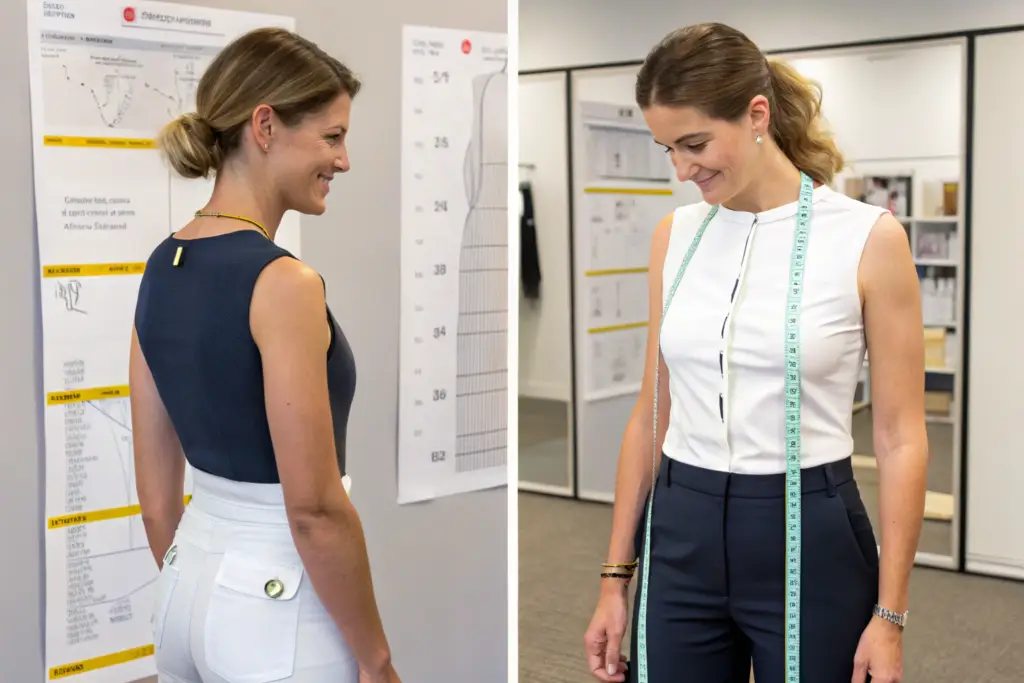
A size chart is a 2D table of abstract numbers. A fit model is a 3D, living, breathing representation of your target customer. A garment is designed to fit a body, not a chart. Only by putting the garment on the specific body you are designing for can you verify the complex interplay of drape, ease, and movement. The model's feel is the ultimate test. This is our philosophy of body-first fit development .
How Do You Conduct a Live Fit Session with an Overseas Model?
This is a professional service. You can book a certified fit model through an agency. They will come to our factory. We will facilitate the session, with our technical team taking measurements, photographing the fit, and streaming it live so you can direct the session from your office in New York or London. It is a seamless, collaborative process. This is the standard of our global fit support .
How Does Fumao's Global Sizing Expertise Help You Expand with Confidence?
Expanding into a new market is a huge opportunity, but the sizing challenge can feel like a technical and financial barrier. Our role is to remove that barrier. We provide the deep technical expertise, the market-specific data, and the rigorous validation processes that allow you to launch in a new territory with total confidence in your product's fit. We make the complex science of international sizing a seamless, manageable part of your growth strategy.
Fumao's global sizing expertise empowers you to expand with confidence. We maintain separate, proven grade rule libraries for the US, UK, and EU markets. Our pattern makers can develop a distinct, market-specific base pattern for your designs. We can source and manage a fit session with a certified local fit model. We handle the complex technical engineering, allowing you to focus on the creative and commercial aspects of your expansion. We ensure your size Medium in Berlin fits as perfectly as your size Medium in New York.
A brand founder told us, "You made the impossible feel easy. The idea of creating a separate EU-graded collection was terrifying. Your team just handled it. You explained the science, built the new patterns, and facilitated the fit model session. My German launch was flawless, and my return rate was a fraction of what I had feared." That is our goal. To provide the technical mastery that turns a daunting expansion into a seamless, successful reality. This is the power of a true global manufacturing partner .

What Market-Specific Grade Rule Libraries Do You Maintain?
We have developed and continuously refined grade rule libraries for our key markets:
- United States (US) - ASTM Standards.
- United Kingdom (UK) - British Standards.
- European Union (EU) - European Standards.
- Australia (AU).
These libraries are the technical foundation for a successful market-specific launch. This is a key part of our technical service offering .
How Can You Help a Brand Develop a Unique, Proprietary Fit for a New Market?
Your brand may not want to use a standard industry fit. You may want to create a unique, proprietary fit block—a "Fumao Berlin Fit"—that is slightly different from the norm. Our pattern makers can work with you to define your target customer's specific body measurements and create a custom base pattern and grade rules that define your brand's unique signature in that market. This is the ultimate level of our product development partnership .
Conclusion
Navigating the differences between US and European clothing sizes is not a marketing challenge; it is a technical engineering challenge. It requires abandoning the dangerous myth of a simple label conversion and instead committing to the disciplined process of building a separate, correctly sized product for a different body. The reward is a loyal customer who feels the garment was made just for them.
At Shanghai Fumao, we are masters of this technical discipline. Our market-specific grading expertise, our proven fit validation processes, and our global fit model network provide the complete solution for brands seeking to expand across borders without sacrificing their reputation for a perfect fit. We turn a complex risk into a strategic advantage.
If you are ready to take your brand global with a partner who can guarantee a perfect fit in every market, let's talk. Our Business Director, Elaine, can connect you with our pattern making team. Please email Elaine at: elaine@fumaoclothing.com.